
• Home
  • About
  • Discover
    • History
    • Culture
    • Nature
    • Food
    • Living in Japan
    • Destinations
    • Language
    • Tips
  • Interview
  • Recommended Books
Exploring the Wonders of Rural Japan
Culture Folklore

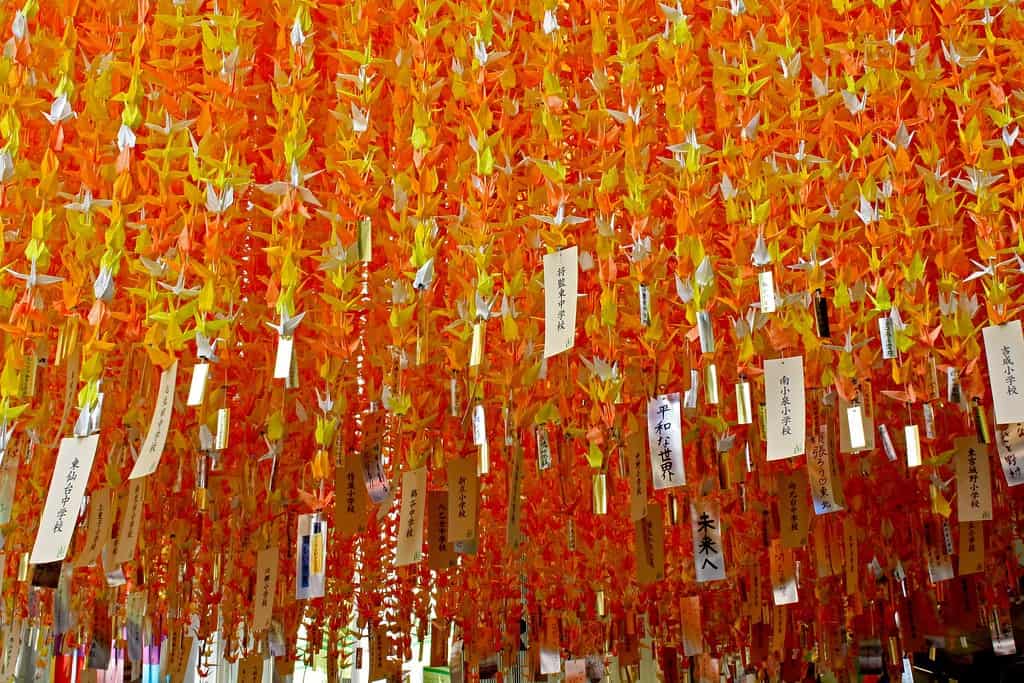
Tanabata, The Star Festival—A Yearly Meeting of Yearning Lovers

Japan’s Tanabata Festival

Tanabata, the Star Festival, is held in Japan every year on July 7 or August 7, depending on local customs. It celebrates the yearly meeting of Orihime, the Weaving Princess, embodied in the star, Vega, and her beloved Hikoboshi, the Cowherd, in the star, Altair.
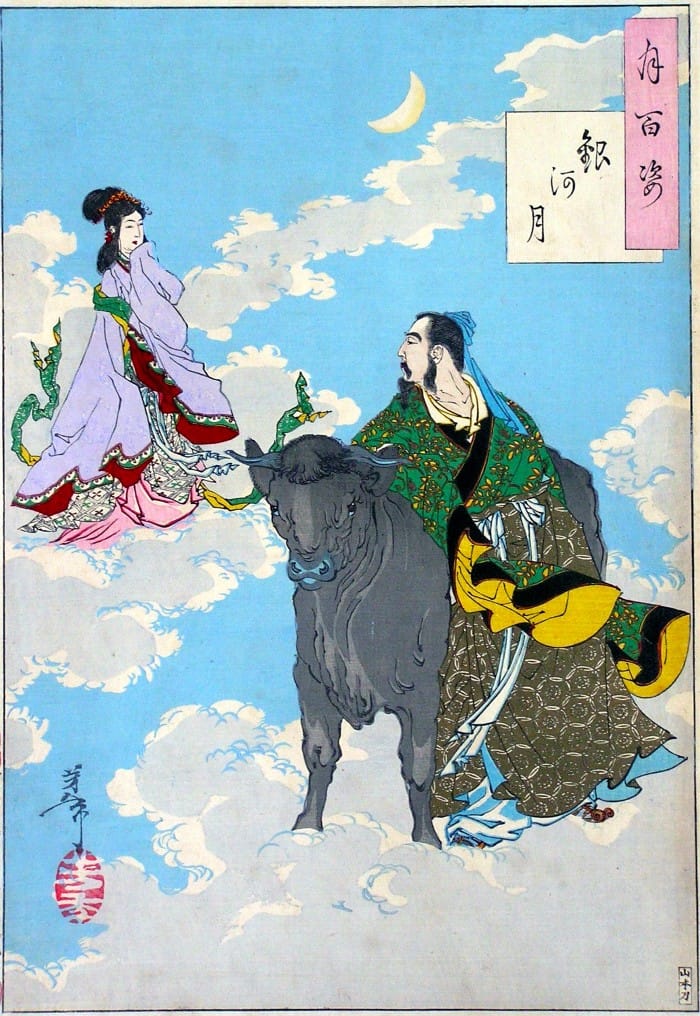
The origin of the Tanabata Festival is the story of Orihime and Tentei.
From 100 Aspects of the Moon, by Tsukioka Yoshitoshi. Late 1800’s. (Public Domain)

The Story of Star-Crossed Lovers

Beautiful Orihime was a gifted weaver who spent her days weaving kimonos for the gods beside the Amanogawa, Heaven’s River, the Milky Way. She was so diligently absorbed in her work that there was no time in her life for love.

Yet Orihime yearned for romance. This yearning filled her with despair.

Her father, Tentei, Heaven’s King, pitied his beloved daughter. He arranged for her to marry the hard-working cowherd, Hikoboshi. It was a perfect match.

Orihime and Hikoboshi fell hopelessly in love and spent their days in blissful play — to the complete neglect of their duties.

Before long, gods were complaining to Tentei about the sorry state of their kimonos and the havoc that Hikoboshi’s cows were wreaking as they strayed across the heavens.

Furious at the lovers’ negligence, Tentei banished Orihime and Hikoboshi to opposite sides of Heaven’s River.

They returned to their duties, but Orihime’s heartbreak reduced her to tears every day.

Tentei couldn’t bear to see his daughter cry. He declared that if she and Hikoboshi continued to work hard, they would be allowed to meet once a year on the night of the 7th day of the 7th month.

On that night, a celestial magpie would spread its enormous wings to create a bridge across the Milky Way for Orihime to cross — if the skies were clear.

If it were to rain, the River of Heaven would become too full making it impossible for Orihime cross over to meet Hikoboshi.

People pray for clear skies on that night, so they can gaze up at the Milky Way and imagine the yearning lovers meeting. Rain that falls on the night of 7/7 has a special name, Sairuiu, “the tears of Orihime and Hikoboshi.”
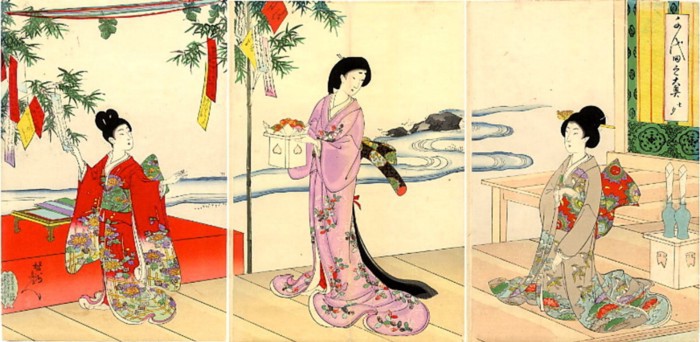
Women hanging wishes as part of the Tanabata festival.
Aristocratic women hanging tanzaku wishes. Tanabata, by Yoshu Chikanobu, 1885. (Public Domain)

Other Weaving-girls

The story of Orihime and Hikoboshi was brought over from China during the Nara Era (710–794). Yet Tanabata’s origin can also be traced to an ancient Japanese story that tells of a celestial weaver, Tanabata-tsume, who fashioned clothing for the gods. She would meet her lover, a kami (Shinto divinity) once a year at a hut beside Heaven’s River.

There was another festival long ago called Kikōden (乞巧奠), where women prayed to improve their weaving skills.

These stories were mixed together and passed down, forming the basis for the Tanabata festival celebrated today.

According to Japan’s old lunar calendar, Tanabata was celebrated on what is now August 7. This is close to the Obon Festival of August 13, when the spirits of ancestors are welcomed back to their homes and their family gathers to spend time with them. During these days people prayed to their ancestral spirits for good harvests. In ancient days, these two festivals were often combined.

Tanabata Festival

During the early years of Tanabata, women would pray for improvement in their weaving and sewing skills. And both women and men would pray for improvement in their calligraphy.

The Heian, or Kyoto, elite wrote their prayers on mulberry paper with special ink made by grinding an inkstone with drops of dew from taro leaves, believing this magical combination would create more effective prayers.

Tanabata moved from the aristocratic halls of the wealthy during the Heian Era (794–1185), to the streets of Edo (Tokyo) during the Edo Era (1603–1867) where it became a popular, lively festival.
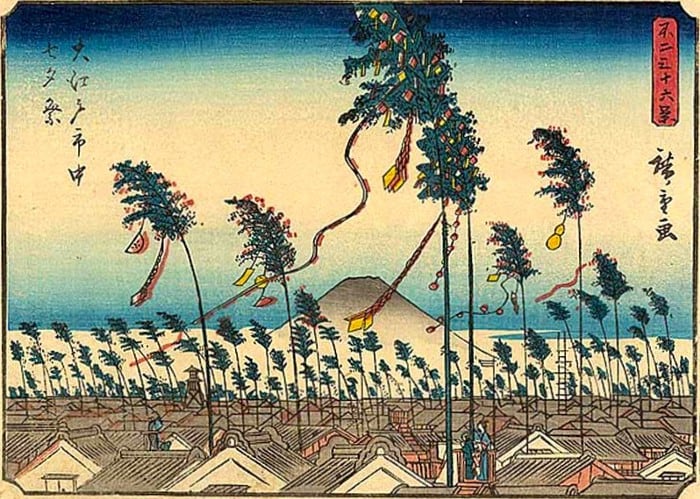
The Tanabata festival as celebrated during the Edo era.
Tanabata Festival In Edo, by Utagawa Hiroshige, 1852. (Public Domain)

Today, people of all ages continue the tradition of writing poems and wishes on thin strips of paper, called tanzaku, and hanging them from bamboo stalks — bamboo being a vehicle for divine spirits.

Colorful bamboo decorations adorn people’s houses, city streets, schools, and businesses from about a week before Tanabata until the end of the festival. Then, the bamboo and all its decorations are cast into a river or burnt, sending the prayers to the gods

Sendai Tanabata Festival—the biggest in the world
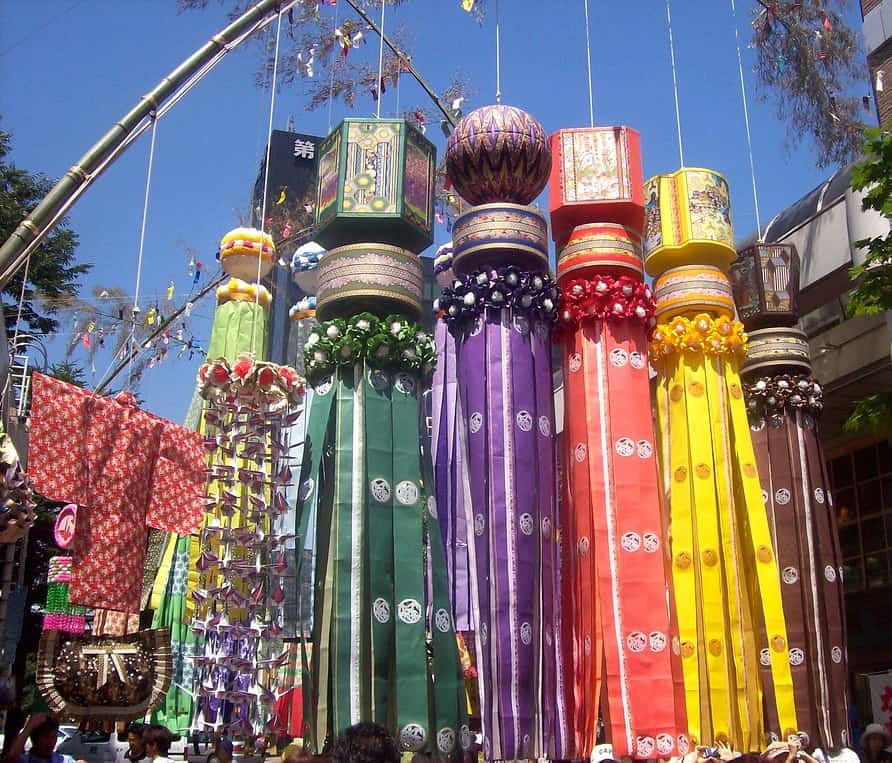
Huge decorations hanging at the largest Tanabata festival in Japan, held in Sendai.
A paper kimono, money pouch, and various windsocks decorate the streets of Sendai. (“SENDAI TANABATA” by FlutterbyNessa is licensed under CC BY-NC-SA 2.00)
Crane decorations at Sendai's Tanabata festival.
Thousands of folded cranes and tanzaku wishes, Sendai. (“Tanabata, Sendai” by staticontheradio is licensed under CC BY-NC 2.0)

At the most fabulous Tanabata Festival, held in Miyagi Prefecture’s capital of Sendai from August 6–8, the main streets are decorated with bamboo — 10 meters tall or more — hung with wishes and elaborate paper decorations.

Each decoration has a traditional meaning:

  • Tanzaku — long rectangles of paper upon which are written prayers for progress in calligraphy and academics
  • Kamigoromo — kimonos for protection from calamities, for good health, and for improved sewing skills
  • Orizuru — folded cranes, for safety and longevity
  • Kinchaku — money purses, for prosperity
  • Toami — fishnets, for bountiful catches and harvests
  • Kuzukago — trash cans, for cleanliness and frugality
  • Fukinagashi — windsocks, representing Orihime’s thread

There is a grand contest on the afternoon of August 6 to determine the most beautiful decorations in each area of downtown Sendai City. Every year, the competition is fierce, resulting in the creation of more and more extravagant decorations. Just one of these bamboo decorations can cost from hundreds of thousands to several million yen (~$30,000 USD)!

If the tears of Orihime and Hikoboshi threaten to fall, merchants rush to cover their valuable handiwork with plastic bags.
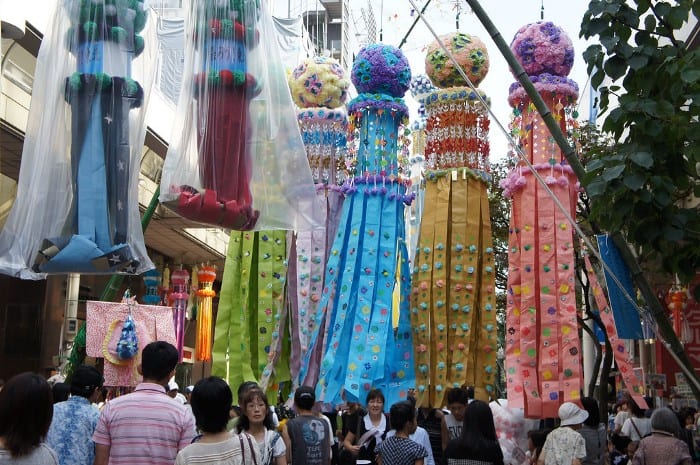
Decorations at Sendai's Tanabata festival protected against rain.
A couple of windsocks covered in plastic to protect them from rain. (“Sendai Tanabata (The Star Festival)” by yisris is licensed under CC BY 2.0)

The Five Festivals

Tanabata is one of the five festivals, go-sekku, that celebrate the change of seasons. These are days set aside to prepare for the coming months through purification, prayers, and banishment of misfortune.

The five festivals were imported along with the Chinese lunar calendar from Tang Dynasty China in the 8th century. During the Meiji Era, the festivals were moved to coincide with Western dates that mirrored their former auspicious odd-numbered lunar months and days.

  • 1/7 Jin-jitsu, Human Day, or Nanakusa-no-sekku, Seven Herbs Day. On this day people eat rice gruel made with seven wild herbs. This is the last day of New Year’s celebrations.
  • 3/3 Hina Matsuri, Dolls or Girls’ Day.
  • 5/5 Tango-no-sekku, formerly Boys’ Day, now Kodomo-no-hi, Children’s Day.
  • 7/7 Tanabata, Star Festival.
  • 9/9 Kiku-no-sekku, Chrysanthemum Festival.
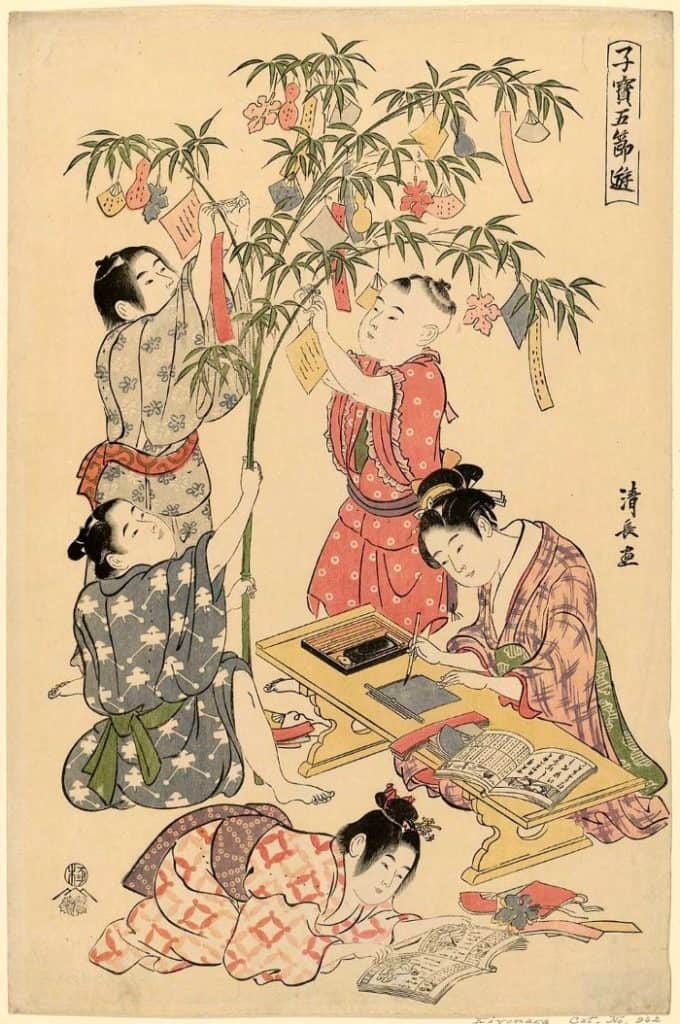
18th century illustration of the Tanabata festival.
The Tanabata Festival, from Precious Children’s Games of the Five Festivals, by Kiyonaga Torii, late 1700s. (Public Domain)

Tanabata Food

A Japanese festival would not be complete without special food. Since Tanabata falls during the hot days of summer, people feast on street food and cold noodles.

Somen — thin noodles served cold with a slightly salty dipping sauce.

Yakitori — grilled chicken on skewers.

A grill covered with yakitori.
Yakitori. (Photo by Magic Mary on Unsplash)

Okonomiyaki — savory pancakes filled with lots of vegetables and a little pork.

Yakisoba — noodles stir-fried with cabbage, bean sprouts, carrots, onions, pork and yakisoba sauce.

Takoyaki — grilled dough balls filled with chopped octopus.

Takoyaki street food.
Takoyaki. (Photo by Brunno Tozzo on Unsplash)

Tanabata is just one of many wonderful Japanese festivals held during the hot summer months when people take to the streets in cool cotton yukata and geta sandals.

In fact, one of the largest holidays in Japan falls during the summer, Obon.

Sources:

Kotobank, Digital Museum, https://www.japanese-wiki-corpus.org/, https://www.sendaitanabata.com/, https://www.tohokukanko.jp/, http://www.jaodb.com/, http://renipi.com/knowledge/452/, Institute of Court Culture.


If you have questions about Japan or suggestions for articles, please add them in the comments. For more photos and information on Japan, follow me on instagram at: https://www.instagram.com/more_than_tokyo/

festivals Japan Japanese culture Japanese Customs Japanese History Tanabata Festival
Share
4 Comments
  1. Erinn

    July 4, 2022 5:12 pm

    That was so interesting! Thanks for writing it!

    Reply
    1. Diane Tincher

      July 4, 2022 7:24 pm

      Thank you for reading and for taking the time to comment!

      Reply
  2. J. KIBODEAUX

    August 2, 2023 1:05 pm

    Diane,
    More of your excellent research and beautiful writing. Your ability to make the culture and history of Japan come alive, the careful crating of your stories is greatly appreciated by my wife and I here in New Orleans.
    Again, thank you.

    Joe K.

    Reply
    1. Diane Tincher

      August 3, 2023 7:19 am

      Thank you very much, Joe!

      Reply
Leave a Reply Cancel reply

Your email address will not be published. Required fields are marked *

This site uses Akismet to reduce spam. Learn how your comment data is processed.

Previous Post

Surprising Secrets of Iconic Japanese Inari Shrines

Next Post

The Little-Known Story of the Old Woman of Odawara

If you enjoy my work and would like to help me continue creating, consider supporting me.

Thank you!
PayPal - The safer, easier way to pay online!
Newsletter

Subscribe

Enter your email for notifications of our latest posts

Tags
architecture Buddhism Christianity Edo Era elderly festivals folklore Food Ghosts gratitude Haunting Hiking history holidays honesty Japan Japanese Japanese cuisine Japanese culture Japanese Customs Japanese Food Japanese History Japanese Language Japanese words that English needs Japan Tips Japan travel Japan Travel Tips Jizō Kagoshima Kōyō Living in Japan longevity Manners Nature New Year Ninja Samurai Shinto shogun Shrine Tips Trade Travel volcano Washoku
Featured Posts
History Religion

The Shimabara Rebellion—The Last Stand of Japan’s Christians

July 8, 2026
History

The Okamoto Daihachi Affair—The Scandal That Turned the Tide Against Christianity in Japan

July 6, 2026
History

The 47 Ronin—Disgrace, Revenge, and Death

June 23, 2026
Destinations Folklore Ghosts

Omatsu Daigongen—The Amazing Cat Temple of Shikoku

June 1, 2026
History

Oura Kei—Unstoppable Pioneering Tea Merchant

January 19, 2026
Most Popular

Shinto — The Peaceful Spiritual Heart of Japan

Shinto gate Lake Biwa

Komorebi—A Beautiful Japanese Word that English Needs

Nakasendo Way

Dondoyaki—Burning New Year’s Decorations to Send off the God of the New Year

Dondoyaki fire

The Jizo Statues of Nashi-no-Ki—1,000s of Unique Offerings of Thanks

Jizo statues at Nashi no Jizo, Sado.

Sugawara no Michizane —Japan’s Three Most Infamous Vengeful Ghosts, part 3

Sugawara Michizane
You might also like
Nakasendo Way
Nature Language

Komorebi—A Beautiful Japanese Word that English Needs

1 Min read
November 11, 2021
temple pagoda
Culture Living in Japan

Death in Japan

8 Mins read
March 22, 2022
Elephant by Kano Furunobu
History

The Incredible Tale of the Elephant Who Had an Audience with the Japanese Emperor

7 Mins read
April 6, 2022
Exploring the wonders of rural Japan
Exploring the Wonders of Rural Japan
  • Home
  • About
  • Recommended Books
  • Interview
  • Privacy Policy
Exploring the Wonders of Rural Japan
  • Home
  • About
  • Discover
    • History
    • Culture
    • Nature
    • Food
    • Living in Japan
    • Destinations
    • Language
    • Tips
  • Interview
  • Recommended Books
We use cookies on our website to give you the most relevant experience by remembering your preferences and repeat visits. By clicking “Accept”, you consent to the use of ALL the cookies.
Do not sell my personal information.
Cookie SettingsAccept
Manage consent

Privacy Overview

This website uses cookies to improve your experience while you navigate through the website. Out of these, the cookies that are categorized as necessary are stored on your browser as they are essential for the working of basic functionalities of the website. We also use third-party cookies that help us analyze and understand how you use this website. These cookies will be stored in your browser only with your consent. You also have the option to opt-out of these cookies. But opting out of some of these cookies may affect your browsing experience.
Necessary
Always Enabled
Necessary cookies are absolutely essential for the website to function properly. These cookies ensure basic functionalities and security features of the website, anonymously.
CookieDurationDescription
cookielawinfo-checkbox-analytics11 monthsThis cookie is set by GDPR Cookie Consent plugin. The cookie is used to store the user consent for the cookies in the category "Analytics".
cookielawinfo-checkbox-functional11 monthsThe cookie is set by GDPR cookie consent to record the user consent for the cookies in the category "Functional".
cookielawinfo-checkbox-necessary11 monthsThis cookie is set by GDPR Cookie Consent plugin. The cookies is used to store the user consent for the cookies in the category "Necessary".
cookielawinfo-checkbox-others11 monthsThis cookie is set by GDPR Cookie Consent plugin. The cookie is used to store the user consent for the cookies in the category "Other.
cookielawinfo-checkbox-performance11 monthsThis cookie is set by GDPR Cookie Consent plugin. The cookie is used to store the user consent for the cookies in the category "Performance".
viewed_cookie_policy11 monthsThe cookie is set by the GDPR Cookie Consent plugin and is used to store whether or not user has consented to the use of cookies. It does not store any personal data.
Functional
Functional cookies help to perform certain functionalities like sharing the content of the website on social media platforms, collect feedbacks, and other third-party features.
Performance
Performance cookies are used to understand and analyze the key performance indexes of the website which helps in delivering a better user experience for the visitors.
Analytics
Analytical cookies are used to understand how visitors interact with the website. These cookies help provide information on metrics the number of visitors, bounce rate, traffic source, etc.
Advertisement
Advertisement cookies are used to provide visitors with relevant ads and marketing campaigns. These cookies track visitors across websites and collect information to provide customized ads.
Others
Other uncategorized cookies are those that are being analyzed and have not been classified into a category as yet.
SAVE & ACCEPT