
• Home
  • About
  • Discover
    • History
    • Culture
    • Nature
    • Food
    • Living in Japan
    • Destinations
    • Language
    • Tips
  • Interview
  • Recommended Books
Exploring the Wonders of Rural Japan
History

Surprising Secrets of Iconic Japanese Inari Shrines

Why all the foxes and red gates?

For centuries, visitors to Kyoto have been charmed—and possibly tired out—by climbing the stairs through the thousands of red torii gates to the top of Mount Inari on the grounds of the Fushimi Inari Grand Shrine, the ancient “Vatican” of more than 30,000 Inari shrines throughout Japan.
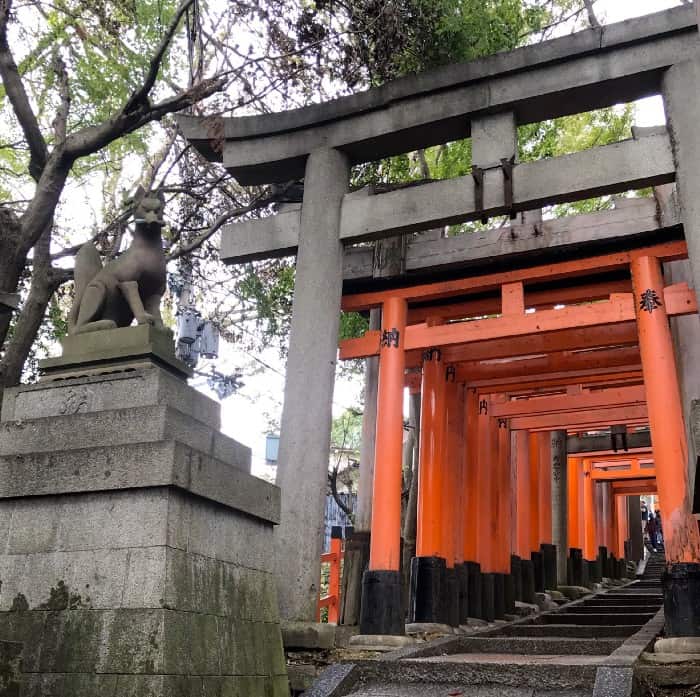
Torii gates line the path behind the Fushimi Inari Grand Shrine.
Nearing the summit of Mount Inari.

What is an Inari Shrine?

The name Inari comes from the Japanese word for rice plant, ina. Inari is a composite of the fox spirit, several gods of agriculture, and the goddess of foodstuff, Uka no Mitama. Inari shrines honor this combined deity.

Inari is one of the most widely venerated kami, divine beings, in the indigenous Japanese Shinto religion.

At the beginning of the 8th century, Mount Inari, in Kyoto, became the center of worship of the fox spirit, the protector of grains. People prayed at the mountaintop Inari shrine for bountiful harvests, rainfall to come or end, and for the country’s safety.

As the years passed, Inari’s portfolio grew, taking on success in sericulture (raising silkworms for the production of silk) during the Heian Era (794–1185) and success in business and swordsmithing during the Edo Era (1603–1867).

Today, Inari has become the guardian of household peace and prosperity, successful studies, finding a suitable spouse, improving skills in the performing arts, and more.
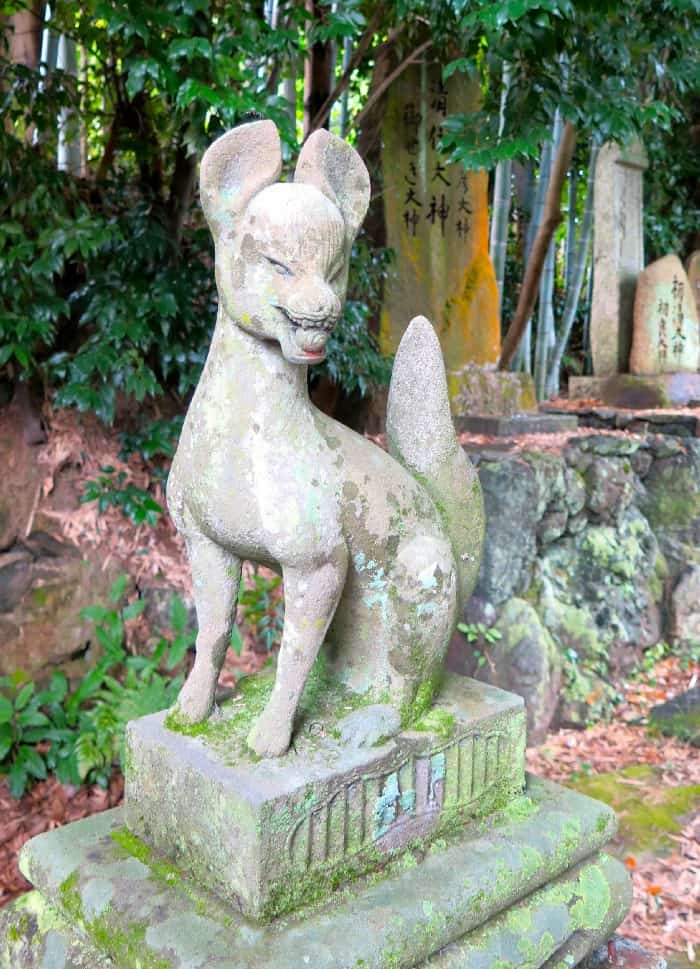
Inari shrines will always have fox guardian statues.
Fox guardian holding a jewel, Arashiyama, Kyoto.

In the early 9th century, at the behest of the Buddhist monk, Kukai, the founder of Shingon Buddhism, the original Inari Shrine was moved to its current location at the foot of Mount Inari. It was soon elevated to the highest rank for Shinto shrines. There is still a small shrine at the top of the mountain, and many smaller shrines and stone offerings along the way up.

During the Edo Era (1603–1867), Inari’s popularity boomed, and thousands of local Inari shrines were built around the country as a place to pray for good harvests, protection, and business prosperity. These small shrines hold the same spiritual power as the Fushimi Grand Shrine in Kyoto.
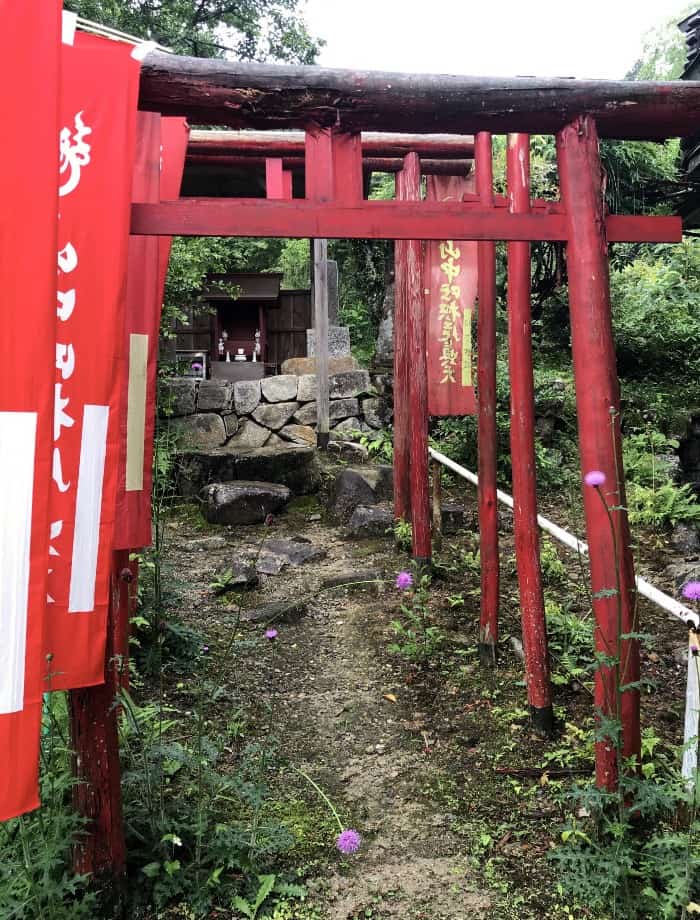
Small rural shrines to Inari are found all over Japan.
Inari shrine, Ochiai, Gifu Prefecture.

Why the red gates?

Just as Ema are hung at shrines in thanksgiving and as prayers, both Ema and red torii gates are offered at Inari Shines. Interestingly, the idea for the gates is said to come from a play on words, 通る, or tooru, which can mean passing through or coming to pass.

While tooru may sound a bit like torii, they are not related. The direct translation of torii is delightfully fitting, “bird residence,” 鳥居.

Donated torii gates are generally painted red or vermillion, which is the traditional color for warding off evil. Palaces, temples, and shrines were often painted this bright color. The vermillion originally used was made from mercury and this served the additional function of preserving the wood.
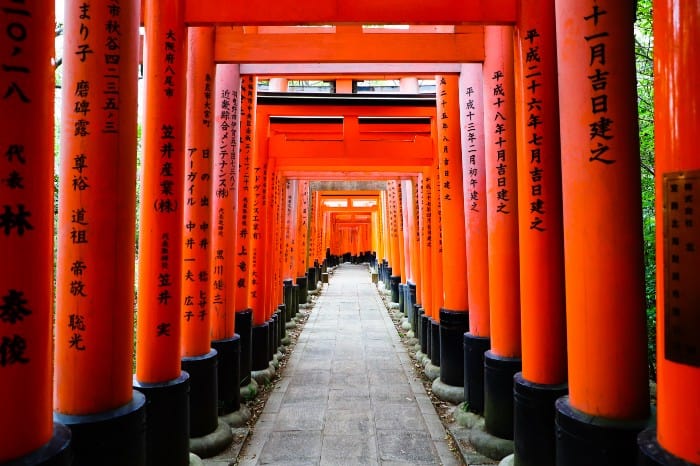
The Inari Grand Shrine is home to the famous senbon torii gates leading to Mount Inari.
Senbon Torii gates along the path to Mount Inari. (Photo by Mathis Jrdl, unsplash.)

At Fushimi Inari Grand Shrine, the gates along the Senbon Torii, “The 1,000 Torii,” actually number in the 10,000s, each one with the name of its donor painted on it.

Foxes

Inari is a fox spirit, and his messengers are foxes, too. These white or translucent spiritual beings are called byakko, 白狐, literally “white fox.” They are shown as guardian statues at the shrines, sometimes holding a grainery key, scroll, or jewel in their mouths.

People often have small Inari shrines in their houses, where they give thanks to their personal Inari for his protection and help. And just as Jizo statues are sometimes dressed in red bibs as a token of reverence and care, so are many of the fox statues given bibs as a show of appreciation to Inari for his blessing and protection.
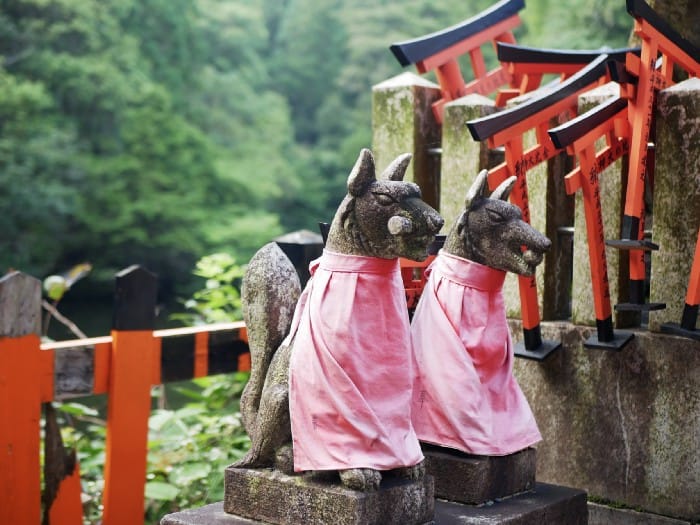
Mount Inari — fox guardians at one of the smaller shrines along the path.
Fox statues holding grainery key and jewel. (Photo by Lapis lazuli, unsplash.)

Stone Monuments

Along the way up Mount Inari behind the Fushimi Grand Shrine, there are thousands of stones carved with the personal names given to individuals’ or companies’ Inari. This practice started long ago, and it has become very popular in the last 100 years. In the 1920s there were 2,500 stones. Today, there are over 10,000.
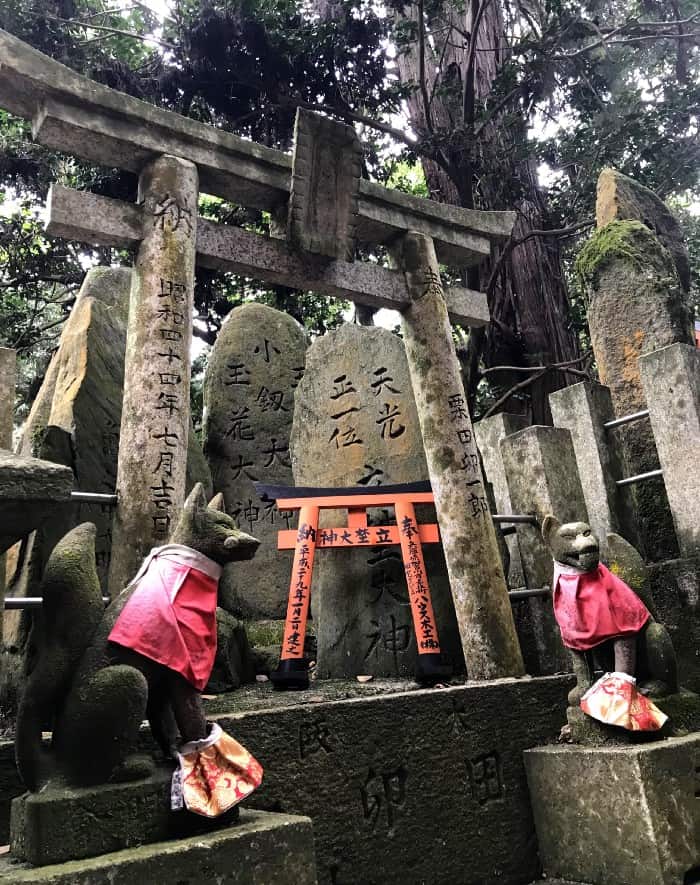
One of the smaller shrines along the path to Mount Inari.
Stones carved with the names of personal Inari along the path up Mount Inari.

Inari Buddhist Temples?

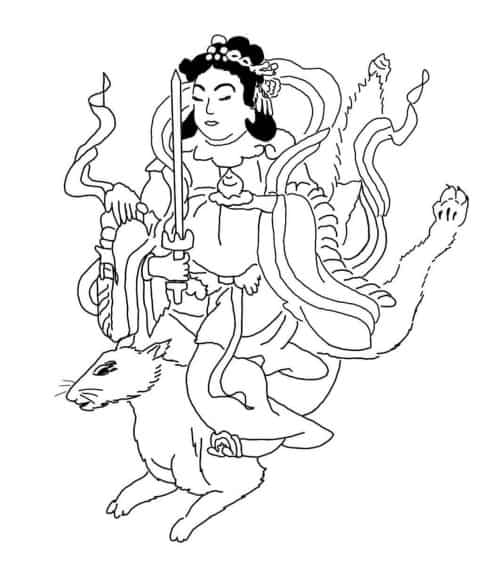
Buddhist deity riding a white fox.
Dakini-ten, the Buddhist deity who became syncretized with Inari.

Although Inari is a Shinto kami, when Buddhism arrived in Japan in the 6th century, many believed the Buddhist deities to be the material manifestations of the local Shinto kami and the two religions grew to coexist peacefully.

Many Buddhist temples have Shinto guardians. In fact, Kukai, the monk mentioned above, adopted Inari as the guardian of his Shingon Buddhist Temple in Kyoto, Tōji.
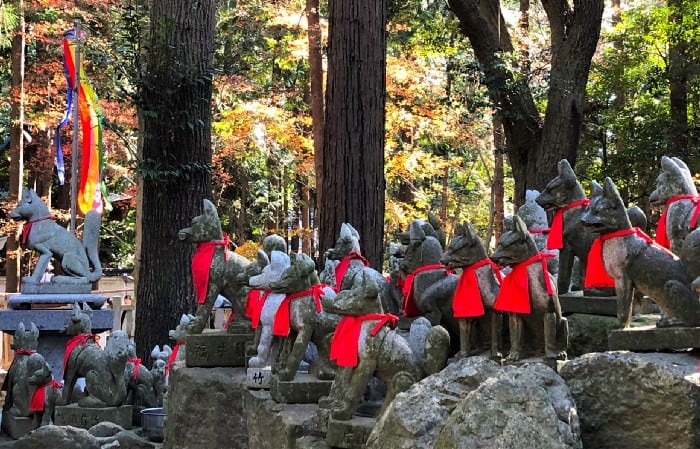
Inari fox statues mix with Buddhist images at Toyokawa Temple in Aichi.
Foxes at Toyokawa Temple, Aichi Prefecture. (Photo by Paul Tincher)

At the Toyokawa Temple in Aichi Prefecture, the Buddhist deity Dakini-ten, who is said to have come to earth riding on a white fox and carrying sheaves of grain, became syncretized with the Shinto deity Inari.

This rather unusual temple has, aside from temple buildings and Buddhist imagery, both a torii gate and thousands of fox statues. This synthesis of deities and religions, though striking many Westerners as odd, is in fact quintessentially Japanese.

Food of the gods?
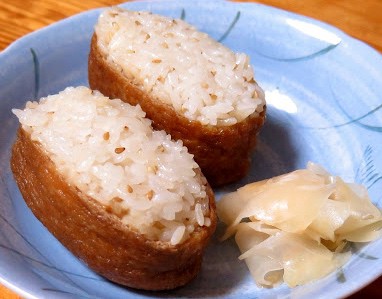
Inari sushi
Inari sushi is seasoned aburaage filled with sushi rice.

In ancient days, farmers were plagued by mice eating their all-important grain crops. They felt a great sense of gratitude towards the foxes who would eat the mice.

This reverence for foxes — with their grain-colored fur and whose tails were said to resemble sheaves of grain — laid the foundation for the worship of Inari.

To show their appreciation, farmers of bygone days would catch and fry mice and offer them as ceremonial gifts before the foxes’ burrows. This tasty dish was known as nezumi aburaage, fried mice, and was said to be a favorite food of foxes.

Along with the spread of Buddhism, a moral aversion to killing spread throughout the land. The practice of offering cooked mice was eventually replaced with the offering of fried thin tofu, aburaage.

From then on, aburaage has been a common offering at Inari shrines, and because of this history, it is a dish that foxes are said to love. Perhaps you have had inari sushi, or maybe kitsune-udon, a type of noodle soup upon which triangles of aburaage are placed.

Kitsune means fox.
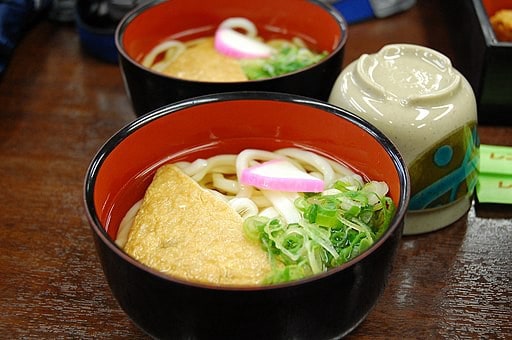
Kitsune udon
Kitsune udon. (photo taken by chou_i_ci from Kyoto, CC BY 2.0, via Wikimedia Commons)

Kitsune udon can be found universally, from standing counters at train stations in Japan to Japanese restaurants all over the world. Little do people realize that when they tuck into their bowls of kitsune udon, they are enjoying a dish that can trace its origins all the way back to offerings of fried mice.


Sources:

Fushimi Grand Shrine, Toyokawa Inari, too many Japanese web pages to list, and 35 years of living in Japan.

All photos by the author unless otherwise stated. Sketch of Dakini-ten based on an image found in the 18th century Butsuzō Zui book of Buddhist Deity illustrations, drawn by the author.


If you have questions about Japan or suggestions for articles, please add them in the comments. For more photos and information on Japan, follow me on instagram at: https://www.instagram.com/more_than_tokyo/

Fox Inari Inarizushi Japan Japanese culture Japanese Customs Kitsune Udon Rice Shinto Shrine
Share
Write Comment
Leave a Reply Cancel reply

Your email address will not be published. Required fields are marked *

This site uses Akismet to reduce spam. Learn how your comment data is processed.

Previous Post

Living in the Shade of Sakurajima—The Most Active Volcano in Japan

Next Post

Tanabata, The Star Festival—A Yearly Meeting of Yearning Lovers

If you enjoy my work and would like to help me continue creating, consider supporting me.

Thank you!
PayPal - The safer, easier way to pay online!
Newsletter

Subscribe

Enter your email for notifications of our latest posts

Tags
architecture Buddhism Christianity Edo Era elderly festivals folklore Food Ghosts gratitude Haunting Hiking history holidays honesty Japan Japanese Japanese cuisine Japanese culture Japanese Customs Japanese Food Japanese History Japanese Language Japanese words that English needs Japan Tips Japan travel Japan Travel Tips Jizō Kagoshima Kōyō Living in Japan longevity Manners Nature New Year Ninja Samurai Shinto shogun Shrine Tips Trade Travel volcano Washoku
Featured Posts
History Religion

The Shimabara Rebellion—The Last Stand of Japan’s Christians

July 8, 2026
History

The Okamoto Daihachi Affair—The Scandal That Turned the Tide Against Christianity in Japan

July 6, 2026
History

The 47 Ronin—Disgrace, Revenge, and Death

June 23, 2026
Destinations Folklore Ghosts

Omatsu Daigongen—The Amazing Cat Temple of Shikoku

June 1, 2026
History

Oura Kei—Unstoppable Pioneering Tea Merchant

January 19, 2026
Most Popular

Shinto — The Peaceful Spiritual Heart of Japan

Shinto gate Lake Biwa

Komorebi—A Beautiful Japanese Word that English Needs

Nakasendo Way

Dondoyaki—Burning New Year’s Decorations to Send off the God of the New Year

Dondoyaki fire

The Jizo Statues of Nashi-no-Ki—1,000s of Unique Offerings of Thanks

Jizo statues at Nashi no Jizo, Sado.

Sugawara no Michizane —Japan’s Three Most Infamous Vengeful Ghosts, part 3

Sugawara Michizane
You might also like
Nakasendo Way
Nature Language

Komorebi—A Beautiful Japanese Word that English Needs

1 Min read
November 11, 2021
temple pagoda
Culture Living in Japan

Death in Japan

8 Mins read
March 22, 2022
Elephant by Kano Furunobu
History

The Incredible Tale of the Elephant Who Had an Audience with the Japanese Emperor

7 Mins read
April 6, 2022
Exploring the wonders of rural Japan
Exploring the Wonders of Rural Japan
  • Home
  • About
  • Recommended Books
  • Interview
  • Privacy Policy
Exploring the Wonders of Rural Japan
  • Home
  • About
  • Discover
    • History
    • Culture
    • Nature
    • Food
    • Living in Japan
    • Destinations
    • Language
    • Tips
  • Interview
  • Recommended Books
We use cookies on our website to give you the most relevant experience by remembering your preferences and repeat visits. By clicking “Accept”, you consent to the use of ALL the cookies.
Do not sell my personal information.
Cookie SettingsAccept
Manage consent

Privacy Overview

This website uses cookies to improve your experience while you navigate through the website. Out of these, the cookies that are categorized as necessary are stored on your browser as they are essential for the working of basic functionalities of the website. We also use third-party cookies that help us analyze and understand how you use this website. These cookies will be stored in your browser only with your consent. You also have the option to opt-out of these cookies. But opting out of some of these cookies may affect your browsing experience.
Necessary
Always Enabled
Necessary cookies are absolutely essential for the website to function properly. These cookies ensure basic functionalities and security features of the website, anonymously.
CookieDurationDescription
cookielawinfo-checkbox-analytics11 monthsThis cookie is set by GDPR Cookie Consent plugin. The cookie is used to store the user consent for the cookies in the category "Analytics".
cookielawinfo-checkbox-functional11 monthsThe cookie is set by GDPR cookie consent to record the user consent for the cookies in the category "Functional".
cookielawinfo-checkbox-necessary11 monthsThis cookie is set by GDPR Cookie Consent plugin. The cookies is used to store the user consent for the cookies in the category "Necessary".
cookielawinfo-checkbox-others11 monthsThis cookie is set by GDPR Cookie Consent plugin. The cookie is used to store the user consent for the cookies in the category "Other.
cookielawinfo-checkbox-performance11 monthsThis cookie is set by GDPR Cookie Consent plugin. The cookie is used to store the user consent for the cookies in the category "Performance".
viewed_cookie_policy11 monthsThe cookie is set by the GDPR Cookie Consent plugin and is used to store whether or not user has consented to the use of cookies. It does not store any personal data.
Functional
Functional cookies help to perform certain functionalities like sharing the content of the website on social media platforms, collect feedbacks, and other third-party features.
Performance
Performance cookies are used to understand and analyze the key performance indexes of the website which helps in delivering a better user experience for the visitors.
Analytics
Analytical cookies are used to understand how visitors interact with the website. These cookies help provide information on metrics the number of visitors, bounce rate, traffic source, etc.
Advertisement
Advertisement cookies are used to provide visitors with relevant ads and marketing campaigns. These cookies track visitors across websites and collect information to provide customized ads.
Others
Other uncategorized cookies are those that are being analyzed and have not been classified into a category as yet.
SAVE & ACCEPT