

• Home
  • About
  • Discover
    • History
    • Culture
    • Nature
    • Food
    • Living in Japan
    • Destinations
    • Language
    • Tips
  • Interview
  • Recommended Books
Exploring the Wonders of Rural Japan
Culture Folklore

Obon—The Happy Homecoming of the Ghosts

The Obon Festival of Japan

Each year, families across Japan welcome home the spirits of their ancestors during the three-day festival of Obon. It is most widely observed in mid-August, although the timing and type of celebrations vary by region and local customs.

Some areas in northeastern Honshu follow the lunar calendar’s date for this holiday and hold their Obon festivals in July. Some areas of southwestern Honshu, Shikoku Island, and Okinawa celebrate Obon in September.

Obon’s origin

The Obon festival traces its origin to Buddha’s disciple, Mokuren, whose mother had fallen into the world of the hungry ghosts, an unpleasant realm in the afterlife. His heart ached to imagine her suffering.

In answer to his appeal for help, the Buddha instructed him to make an offering to his fellow disciple monks of a wide variety of food, and not only his mother, but also the last seven generations of his ancestors would be saved.
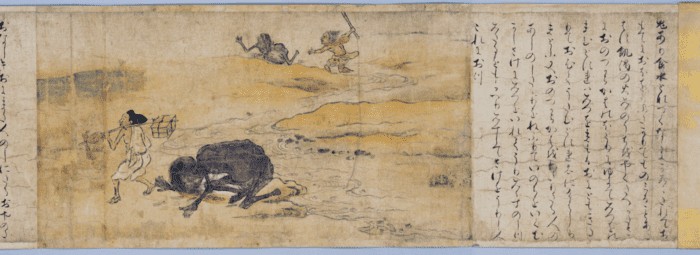
Scroll illustration the realm of the hungry ghosts, a hellish realm in the Buddhist afterlife.
Section of the Hungry Ghost Scroll FEATURES one type of hungry ghost who constantly seeks water. Kyoto National Museum. (Public Domain)

Mokuren obeyed the Buddha, placing his offerings of food on a tray, or obon, which is said to give the festival its name. He then danced a dance of joy, filled with a mix of newfound gratitude toward his mother, and the joy of knowing that she and his other ancestors had been released.

So Mokuren gave us three important Obon traditions:

  • Offerings
  • Gratitude towards mother
  • Dance of joy

Now we’ll see how these have developed into today’s Obon festivities.

Welcome home, Spirits!

Families return to their ancestral homes to welcome the spirits of their departed ancestors on August 13th. Many people go to their family’s graves to accompany the spirits back to their houses, some lighting fires to guide the way. At the threshold of the house, water is set out for the spirits to wash their feet before entering.

Inside the house, a shelf is constructed with a frame of bamboo or chestnut, laid with a board. This is called a Bon-Dana, and it will hold offerings to the ancestors’ spirits. Traditionally, a rush mat is placed on the shelf, upon which are placed flowers, incense, rice dumplings, noodles, vegetables, fruit, and most importantly, water. Front and center is placed a mortuary tablet —a stone tablet inscribed with the names of the family’s deceased—like a place-marker at a banquet. Behind all this is hung a decorative scroll.

The recently deceased are honored with elaborate bamboo and cedar leaf decorations placed in the front yard or under the eaves of the house. They have not yet joined the collective ancestral spirit of their family, or Sorei. After 33 or 50 years, depending on the tradition, they will finally lose their individuality and merge with the Sorei.

Each family’s Sorei visits them four times a year, at Obon, at New Year’s, and at the spring and fall equinoxes.
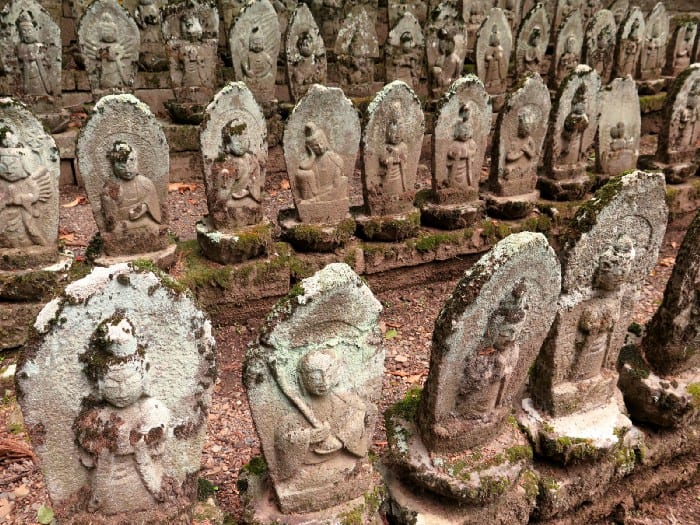
Jizō statues as home for the ghosts of those who died along the Nakasendo Way, Nagano.
Some of the 200 Jizō statues commemorating the Muenbotoke, homeless spirits, who died along the Nakasendo Way. Hachiman Shrine, Narai, Nagano.

But what of Homeless Spirits?

Muenbotoke are spirits of those who have died an unnatural death, at sea, along the road, or those who have no family to look after their graves. If left to themselves, it is believed that they will bring harm, so these spirits, too, are honored at Obon.

Although these strangers have no place on the family’s Bon-Dana, people may build a simple shelf and lay out food, such as eggplants and cucumbers wrapped in leaves, for the Muenbotoke. Others may lay big taro leaves upon the floor beneath the family’s Bon-Dana, upon which offerings of food are placed.

Gratitude to the living

Obon is not just about the dead. Elderly parents are given gifts of special food and drink in a show of appreciation and filial affection.
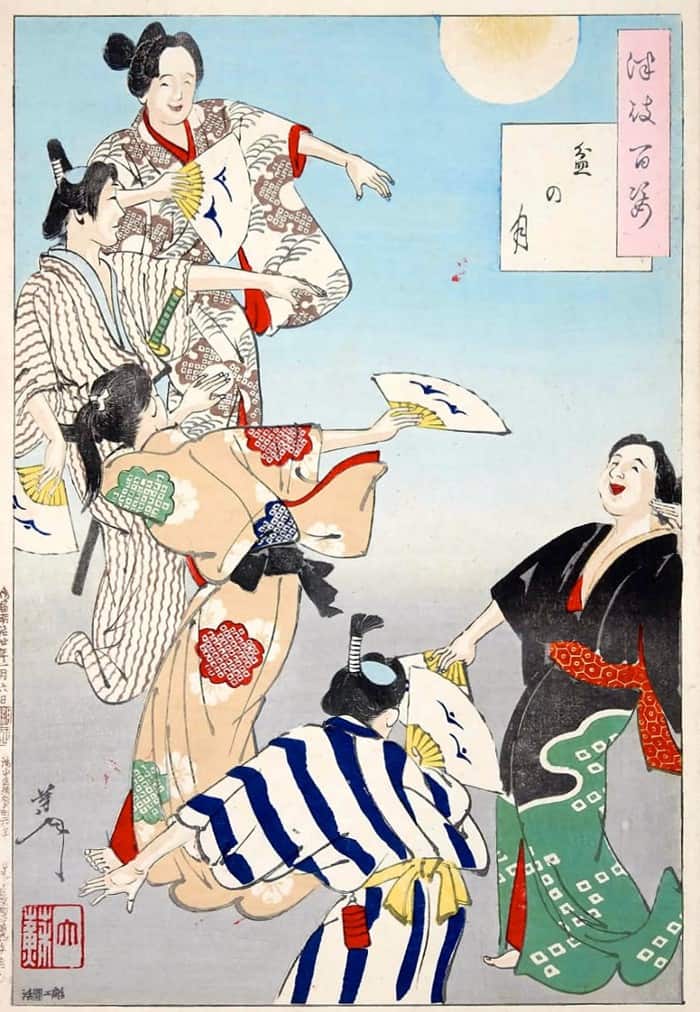
Obon festival is when the ghosts of ancestors visit their living families.
Obon Festival Moon, by Yoshitoshi Tsukioka (Public Domain)

Dancing

Hearkening back to Mokuren’s dance of joy, Bon-Odori are dances held during the Obon holidays. People dress in colorful summer yukatas and dance a synchronized dance through the streets or in circles around a raised platform at shrines. Besides sending the spirits on their way to the realm of the dead with gratitude and joy, the dances also serve as prayers to ward off potential haunting or curses.

Until we meet again

On the night of August 16th, many families walk to their family graves to send their ancestors back to the spirit world. But there are other customs.

Perhaps because people in days past felt the world of the dead was across the sea, or above the sky, various traditions developed. Some people wrap offerings in lotus leaves or reeds and send their ancestors off in these makeshift boats down the river. Others form boats from straw and release their ancestors’ spirits into the sea, while others place paper lanterns on the water for their ancestors’ spirits to ride back to the spirit realm.
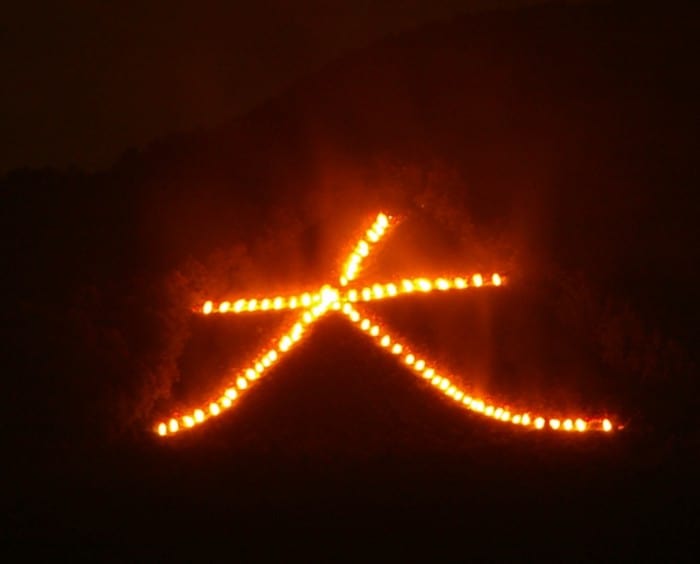
Large bonfires on the hills around Kyoto send ghosts back to the heavens.
The Japanese character meaning “large” lit with bonfires during the Gozan no Okuribi in Kyoto. (Photo taken by J_o at Funaokayama Park, Kyoto)

Most famously, the Kyoto Gozan no Okuribi is held to send the spirits off to the heavens. Five great fires are lit on five mountains surrounding Kyoto City, one by one starting at 8pm on August 16th, each forming a different Japanese character.

In some sections of the country, people prepare Shōryō-uma, horses and cows made from cucumbers and eggplants, for the spirits to ride back into the realm of the dead.
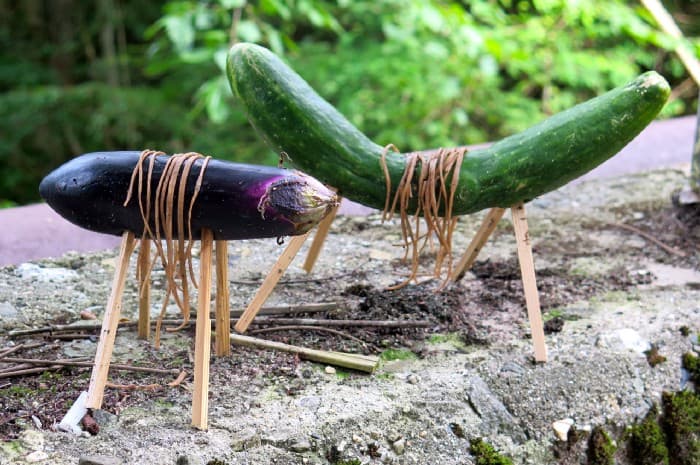
Some ghosts ride on vegetables back to the spiritual realm.
Eggplant cow and cucumber horse draped with soba noodles, spotted along the Nakasendo Way in Nagano Prefecture.

There the spirits will continue learning and growing until their next, not so widely celebrated, visit during the autumn equinox.

All photos ©Diane Tincher, unless otherwise noted.

Sources:

図説民俗探訪事典 compiled by 大島 雄, kotobank.jp, http://www.shingon.org/, and many more Japanese webpages.


If you have questions about Japan or suggestions for articles, please add them in the comments. For more photos and information on Japan, follow me on instagram at: https://www.instagram.com/more_than_tokyo/

folklore Japan Japanese culture Japanese Customs Obon Obon festival
Share
3 Comments
  1. Mike

    August 19, 2022 7:29 am

    It’s fascinating to learn about other cultural spiritual beliefs and honoring your ancestors seems like time well spent in creating a better society.

    Reply
    1. Diane Tincher

      August 19, 2022 12:31 pm

      Yes, I think it’s wonderful to keep the memories of our loved ones alive and respected.

      Reply
Leave a Reply Cancel reply

Your email address will not be published. Required fields are marked *

This site uses Akismet to reduce spam. Learn how your comment data is processed.

Previous Post

The Strongest Oni — The Remarkable Legend of Shuten-dōji

Next Post

Hiraizumi — Once a Fabulous City of Gold, Now a Quiet Home of Mummies

If you enjoy my work and would like to help me continue creating, consider supporting me.

Thank you!
PayPal - The safer, easier way to pay online!
Newsletter

Subscribe

Enter your email for notifications of our latest posts

Tags
architecture Buddhism Christianity Edo Era elderly festivals folklore Food Ghosts gratitude Haunting Hiking history holidays honesty Japan Japanese Japanese cuisine Japanese culture Japanese Customs Japanese Food Japanese History Japanese Language Japanese words that English needs Japan Tips Japan travel Japan Travel Tips Jizō Kagoshima Kōyō Living in Japan longevity Manners Nature New Year Ninja Samurai Shinto shogun Shrine Tips Trade Travel volcano Washoku
Featured Posts
History Religion

The Shimabara Rebellion—The Last Stand of Japan’s Christians

July 8, 2026
History

The Okamoto Daihachi Affair—The Scandal That Turned the Tide Against Christianity in Japan

July 6, 2026
History

The 47 Ronin—Disgrace, Revenge, and Death

June 23, 2026
Destinations Folklore Ghosts

Omatsu Daigongen—The Amazing Cat Temple of Shikoku

June 1, 2026
History

Oura Kei—Unstoppable Pioneering Tea Merchant

January 19, 2026
Most Popular

Shinto — The Peaceful Spiritual Heart of Japan

Shinto gate Lake Biwa

Komorebi—A Beautiful Japanese Word that English Needs

Nakasendo Way

Dondoyaki—Burning New Year’s Decorations to Send off the God of the New Year

Dondoyaki fire

The Jizo Statues of Nashi-no-Ki—1,000s of Unique Offerings of Thanks

Jizo statues at Nashi no Jizo, Sado.

Sugawara no Michizane —Japan’s Three Most Infamous Vengeful Ghosts, part 3

Sugawara Michizane
You might also like
Nakasendo Way
Nature Language

Komorebi—A Beautiful Japanese Word that English Needs

1 Min read
November 11, 2021
temple pagoda
Culture Living in Japan

Death in Japan

8 Mins read
March 22, 2022
Elephant by Kano Furunobu
History

The Incredible Tale of the Elephant Who Had an Audience with the Japanese Emperor

7 Mins read
April 6, 2022
Exploring the wonders of rural Japan
Exploring the Wonders of Rural Japan
  • Home
  • About
  • Recommended Books
  • Interview
  • Privacy Policy
Exploring the Wonders of Rural Japan
  • Home
  • About
  • Discover
    • History
    • Culture
    • Nature
    • Food
    • Living in Japan
    • Destinations
    • Language
    • Tips
  • Interview
  • Recommended Books
We use cookies on our website to give you the most relevant experience by remembering your preferences and repeat visits. By clicking “Accept”, you consent to the use of ALL the cookies.
Do not sell my personal information.
Cookie SettingsAccept
Manage consent

Privacy Overview

This website uses cookies to improve your experience while you navigate through the website. Out of these, the cookies that are categorized as necessary are stored on your browser as they are essential for the working of basic functionalities of the website. We also use third-party cookies that help us analyze and understand how you use this website. These cookies will be stored in your browser only with your consent. You also have the option to opt-out of these cookies. But opting out of some of these cookies may affect your browsing experience.
Necessary
Always Enabled
Necessary cookies are absolutely essential for the website to function properly. These cookies ensure basic functionalities and security features of the website, anonymously.
CookieDurationDescription
cookielawinfo-checkbox-analytics11 monthsThis cookie is set by GDPR Cookie Consent plugin. The cookie is used to store the user consent for the cookies in the category "Analytics".
cookielawinfo-checkbox-functional11 monthsThe cookie is set by GDPR cookie consent to record the user consent for the cookies in the category "Functional".
cookielawinfo-checkbox-necessary11 monthsThis cookie is set by GDPR Cookie Consent plugin. The cookies is used to store the user consent for the cookies in the category "Necessary".
cookielawinfo-checkbox-others11 monthsThis cookie is set by GDPR Cookie Consent plugin. The cookie is used to store the user consent for the cookies in the category "Other.
cookielawinfo-checkbox-performance11 monthsThis cookie is set by GDPR Cookie Consent plugin. The cookie is used to store the user consent for the cookies in the category "Performance".
viewed_cookie_policy11 monthsThe cookie is set by the GDPR Cookie Consent plugin and is used to store whether or not user has consented to the use of cookies. It does not store any personal data.
Functional
Functional cookies help to perform certain functionalities like sharing the content of the website on social media platforms, collect feedbacks, and other third-party features.
Performance
Performance cookies are used to understand and analyze the key performance indexes of the website which helps in delivering a better user experience for the visitors.
Analytics
Analytical cookies are used to understand how visitors interact with the website. These cookies help provide information on metrics the number of visitors, bounce rate, traffic source, etc.
Advertisement
Advertisement cookies are used to provide visitors with relevant ads and marketing campaigns. These cookies track visitors across websites and collect information to provide customized ads.
Others
Other uncategorized cookies are those that are being analyzed and have not been classified into a category as yet.
SAVE & ACCEPT