

Walking Amid Michelin Green Guide Star-Winning Beauty
I recently had the privilege of climbing Mount Haguro in northeastern Japan. The forest walk has been given 3 stars by the Michelin Green Guide, and it did not disappoint. Please allow me to share my journey with you.
Background
Mount Haguro is one of three sacred mountains known as the Dewa Sanzan, 出羽三山, meaning the three mountains of Dewa — the old name for Yamagata and Akita Prefectures. Climbing these mountains has been considered a pilgrimage of spiritual rebirth for centuries.
Each mountain in the Dewa Sanzan represents an aspect of cosmic time that pilgrims face. Mount Gassan is where we ask forgiveness for past wrongs and encounter our ancestors. Mount Haguro is where we overcome the troubles of the present world. And Mount Yudono is where we confront our future selves.
A little history
In the 6th century, Prince Hachiko, the son of the 32nd emperor of Japan, left the capital in Nara. His father, Emperor Sushin, had been assassinated, and his cousin, the influential and powerful Shotoku Taishi, advised him that discretion was the better part of valor. Hachiko accepted this advice and, difficult though it must have been, quietly left the capital.
Legend tells us that Hachiko then traveled the country, healing those wherever he went by magically absorbing their sufferings. The more hardships he took upon himself, the more disfigured he became. Yet Prince Hachiko, without concern for his earthly appearance, kept on.
Eventually, he was led to Mount Haguro by a three-legged crow.
In a quintessential mix of Buddhism and Shinto, Prince Hachiko set up a monastery to practice Buddhism and to worship the Shinto kami of the three mountains. There he remained, teaching and healing, until his death in 641.
From the time Buddhism reached Japan in the 6th century, there was a peaceful syncretism of Buddhism with Shinto. Buddhist gods were considered manifestations of Shinto kami, and many temples and shrines shared the same grounds — some buildings even served as both Buddhist temples and Shinto shrines.
In 1868, as a means of weakening the wealth and power of Buddhist sects and to bring greater respect to the authority of the newly installed Emperor Meiji, himself a Shinto god, the government ordered the division of Buddhism and Shintoism. Temples, statues, bells, and sutras were destroyed in a frenzy of attack by Shinto nationalists. Many Buddhist priests were forced to leave the priesthood; others chose to become Shinto priests.
From that time, Buddhist images were removed from Mount Haguro.
Climbing Mount Haguro
After consulting bus and train schedules, I took an 8:22 train from Niigata City and reached the charming city of Tsuruoka, in Yamagata Prefecture, in plenty of time to catch the 10:41 bus. The next bus was 90 minutes later, so careful planning was essential.
I had a pleasant ride past beautiful countryside with the awesome snow-covered Mount Chokai to the north providing the backdrop. After about 40 minutes, the bus drove through an enormous torii gate, along a narrow road fronting Shukubo shrine lodgings, and arrived at the foot of Mount Haguro.
My lodging for the night was easy to find.
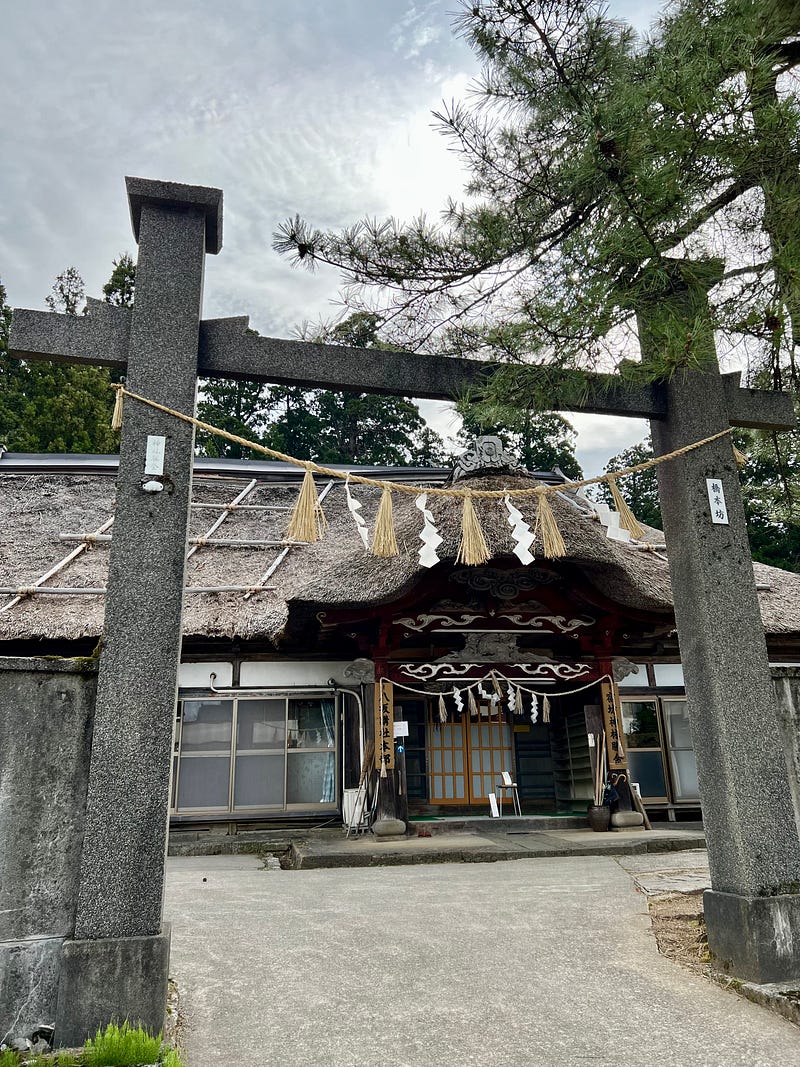
I rang the bell at the shrine where I was going to stay and dropped off my bag. The innkeeper, the Shinto priest’s wife, visibly relaxed when she realized that the foreigner staying with her that night could speak Japanese. I thanked her for keeping my suitcase, bid her goodbye, and headed to the hiking trail.
It was 11:30 and the weather was glorious.
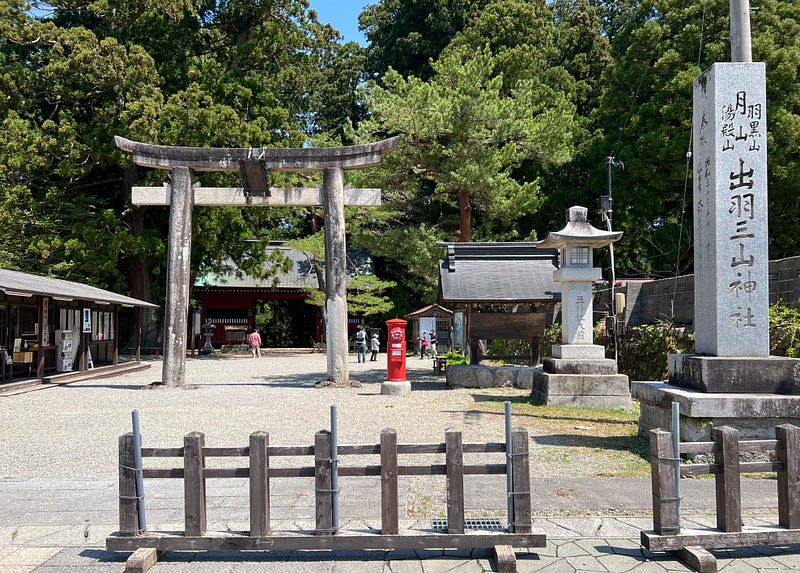
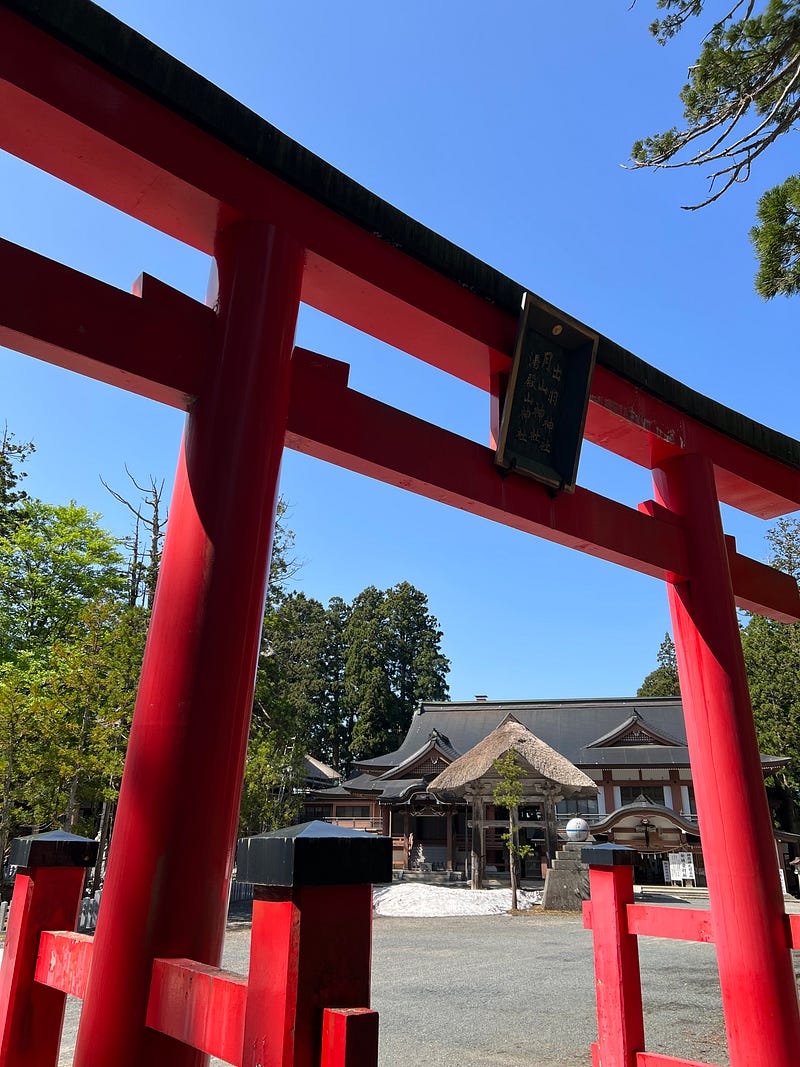
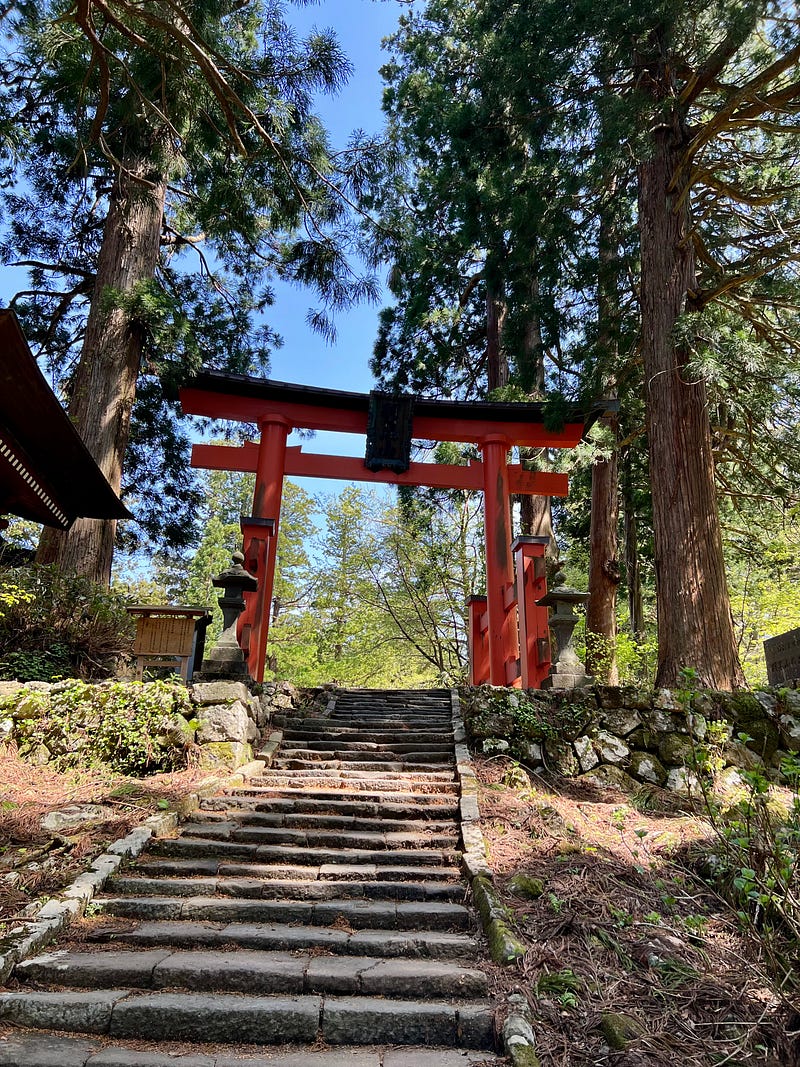
I bowed and passed under the torii gate, symbolizing my entry into the sacred realm of Mount Haguro, a Shinto kami. Then I approached the next gate.
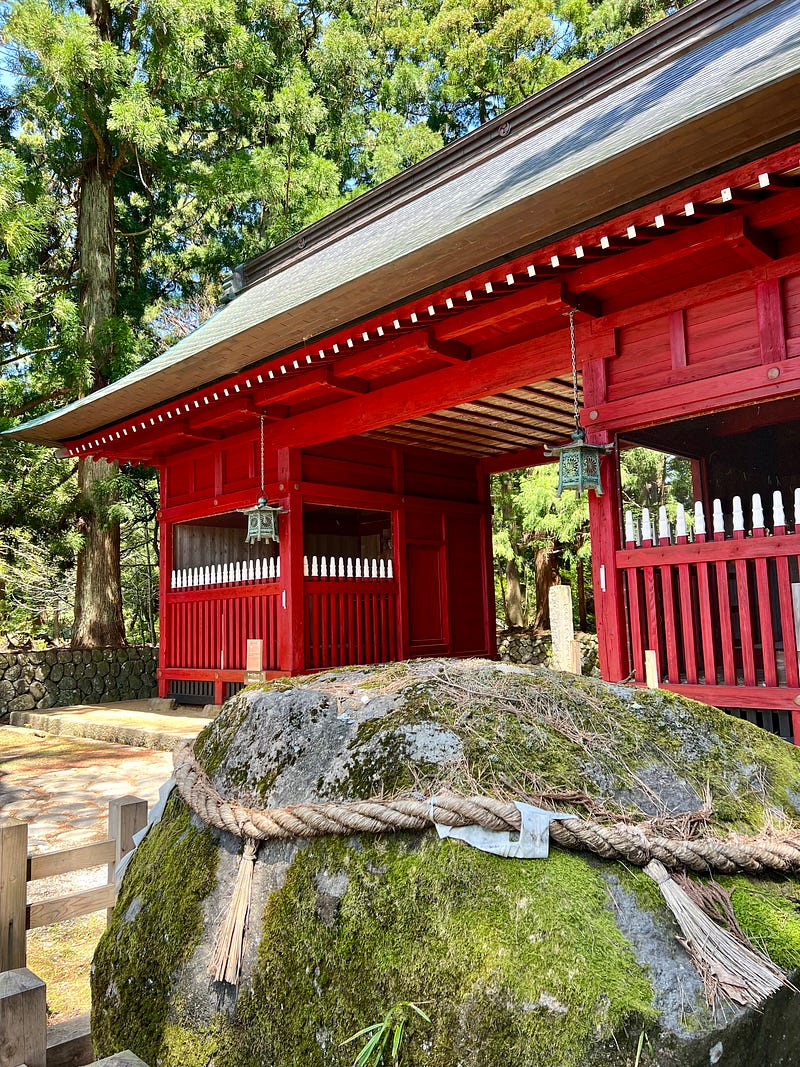
The vermillion Zuishinmon Gate was previously guarded by two Buddhist Nio warriors and had been called the Niomon Gate. These statues were moved to safety and hidden during the anti-Buddhist frenzy. Today, they can be viewed at the Shozen-in Temple, a 15-minute walk from their former home.
This gate marks the beginning of the 2,446 stone steps that lead to the summit.
In 1648, the 50th chief priest of the Dewa Sanzan, Tenyu Betto, laid the thousands of stones that lead from the vermillion gate to the mountaintop Sanjin Gosaiden shrine. It took him 13 years. Along the way, he carved 33 different Buddhist symbols into the stones. If you can find them all, it is said your prayers will assuredly be answered.
I think I found a few.
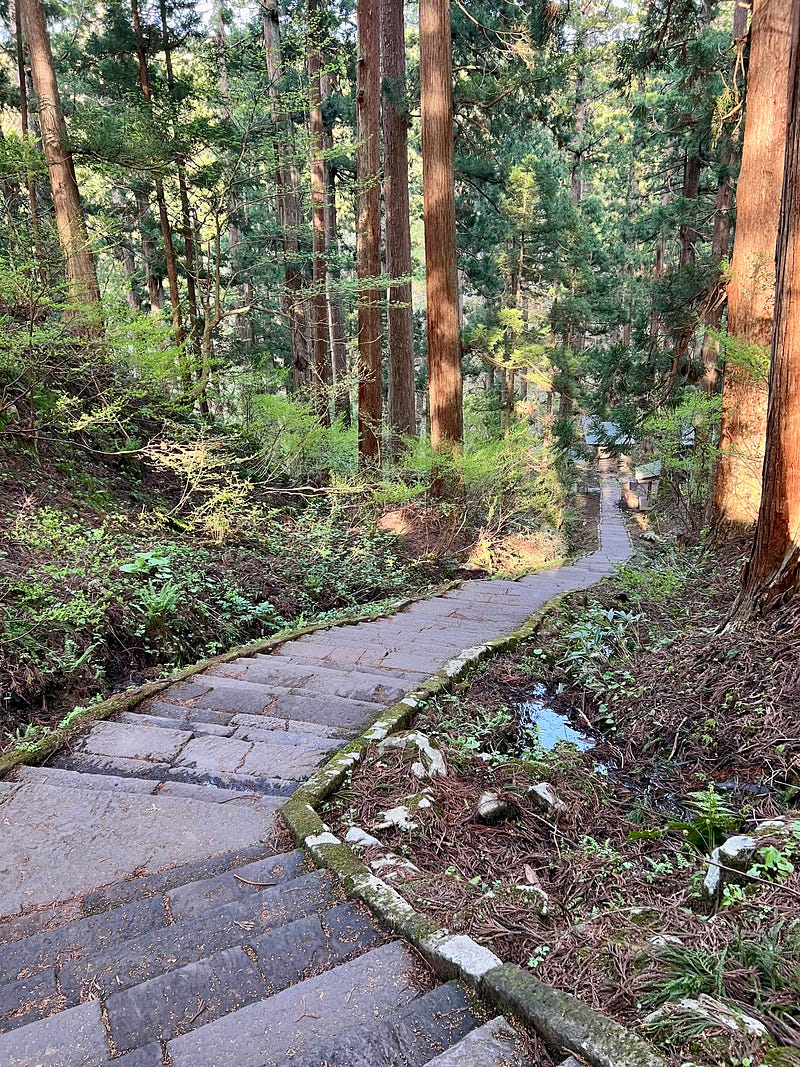
The path first leads downhill to a group of simple wooden shrines.
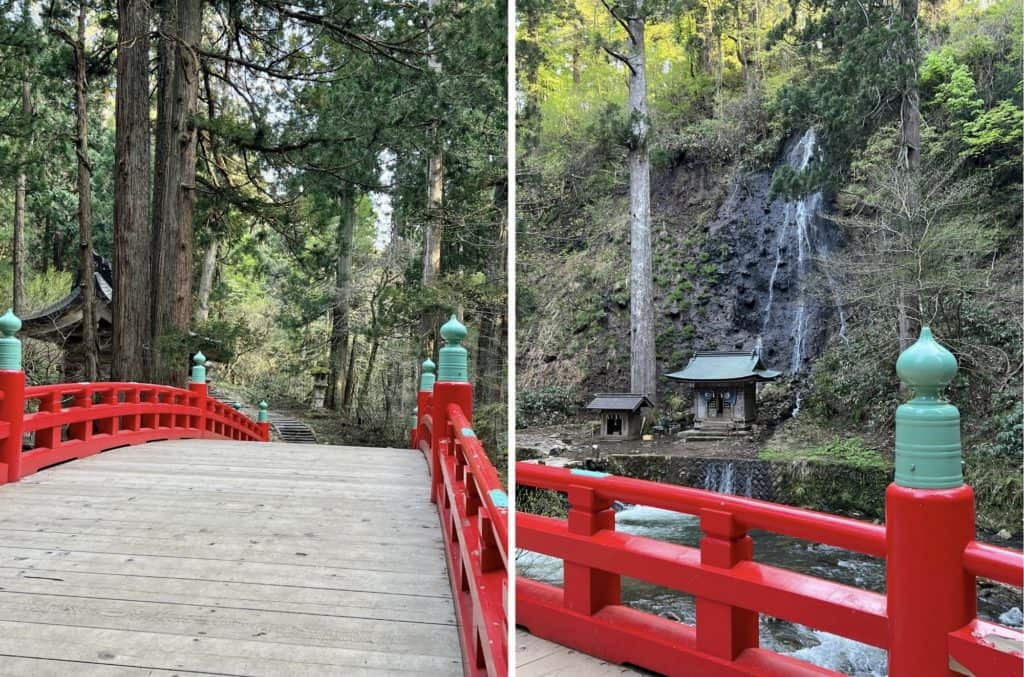
Then it takes us across the red, arched Shinkyo Bridge that had marked the border across which no women could pass until the 19th-century changes. To the right is the 400-year-old, man-made Suga-no-Taki waterfall, also credited to Tenyu Betto.
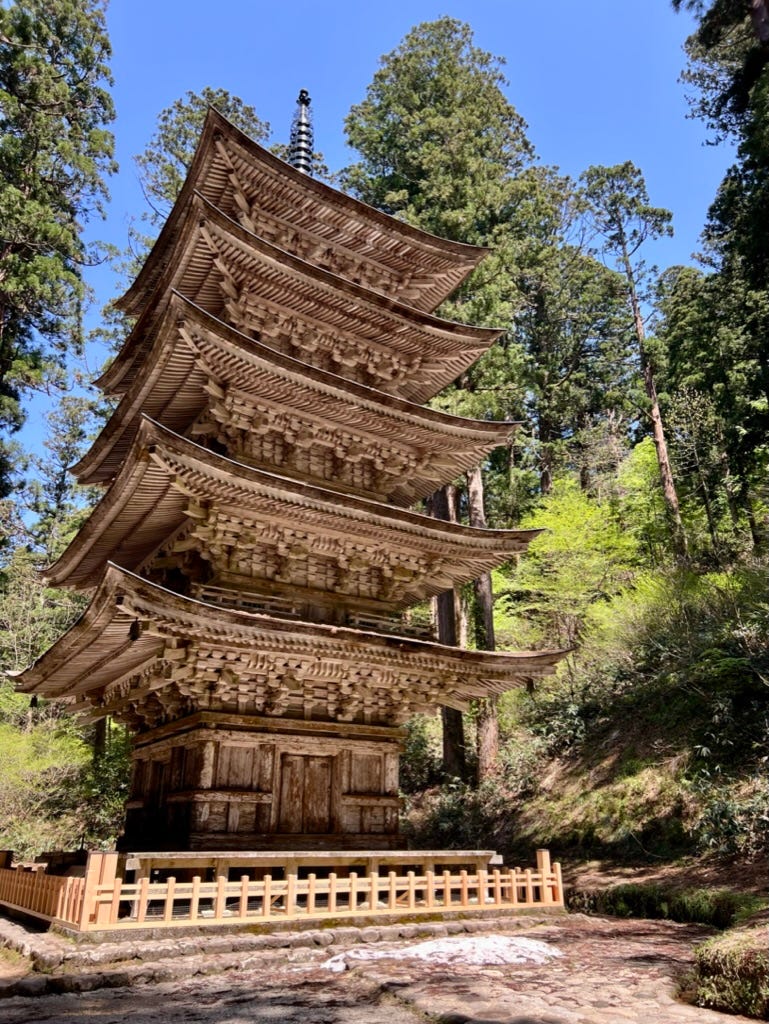
Soon, I meet the 1,000-year-old cedar tree affectionately called Jiji-sugi, or “Grandfather Cedar.” This majestic tree stands near the 600-year-old Go-jū-no-toh, or Five-Story Pagoda. This amazing work of architecture was originally built by none other than Taira no Masakado in the 930s. You may remember Masakado as one of Japan’s Three Most Infamous Vengeful Ghosts.
The Go-jū-no-toh was built without using any nails. It features a large earthquake-resistant pendulum in the center which allows the building to gently and loosely sway like a snake during tremors. Its design has inspired modern techniques for constructing earthquake-proof buildings and towers, such as the 634 meter Tokyo Sky Tree.
The current pagoda dates from 1372 when it was rebuilt by Daihoji Masauji, the chief priest of Mount Haguro. It is all that remains of a temple complex that surrounded it until the 1870s when the buildings were destroyed. Fortunately for us, the Go-jū-no-toh was rechristened as a Shinto shrine before then.
As Yamagata is deep in Japan’s snow country, each winter workers climb up inside the pagoda to sweep off the snow that accumulates on the roofs.
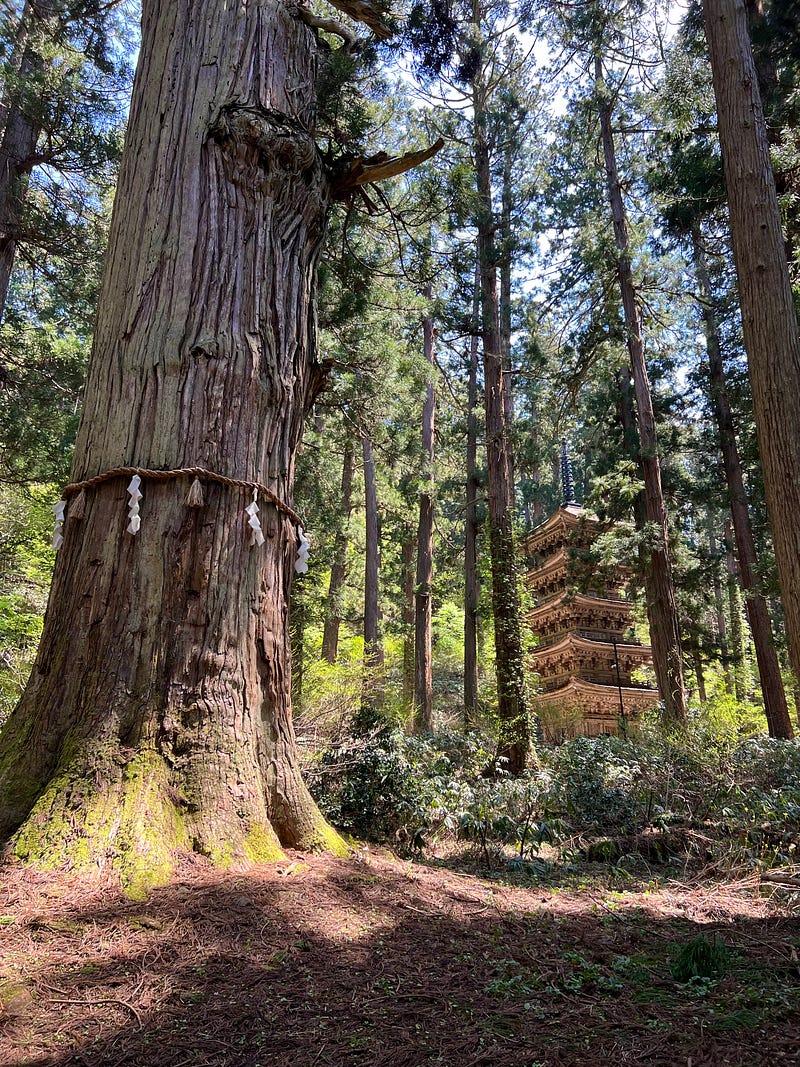
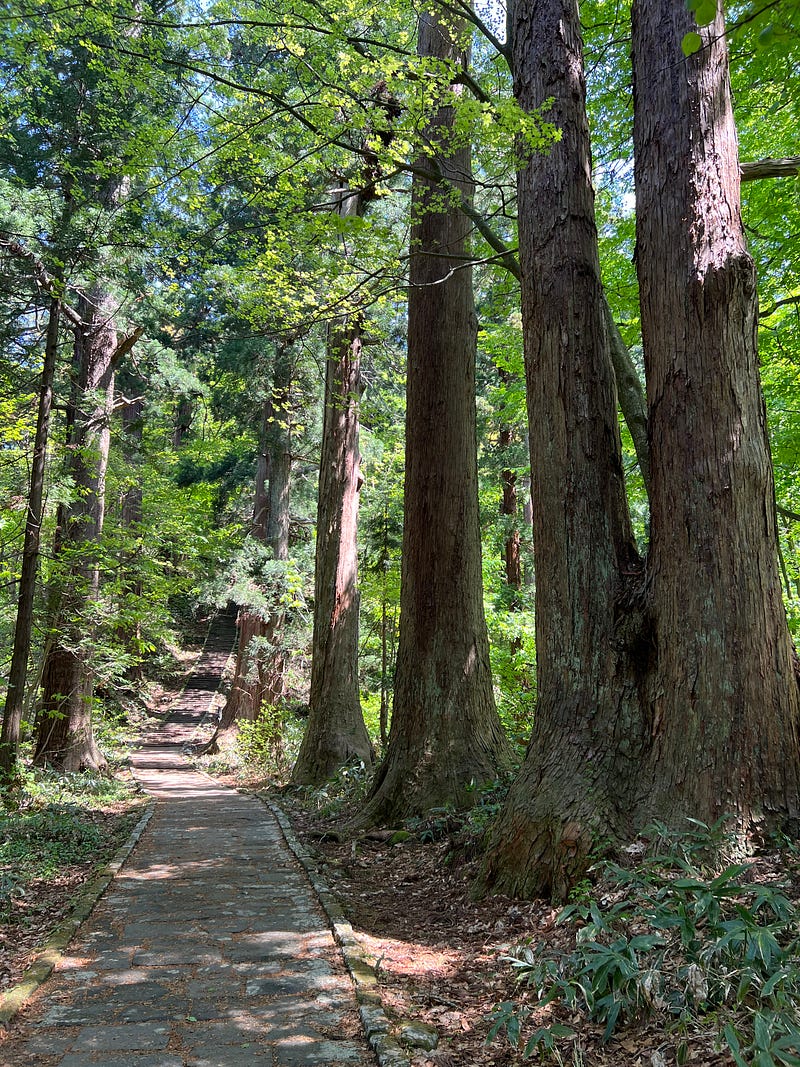
After taking time to admire these awe-inspiring sights, I head up the long staircase sided by hundreds of 400-year-old cryptomeria cedar trees.
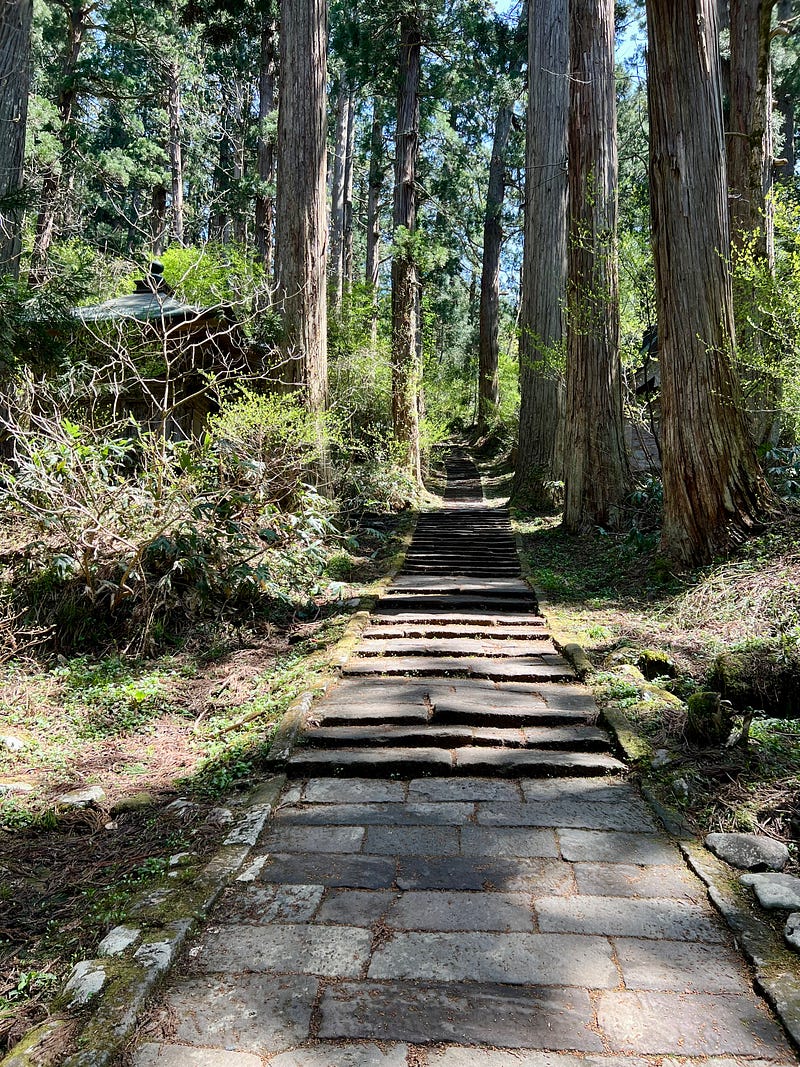
Walking through this beautiful forest, filled with the fragrance of cedar trees and joyous birdsong, I cannot think of a nicer way to spend a day.
I pass many small wooden shrines, then come upon unusual trees wrapped in a shimenawa rope, signifying that they are sacred.
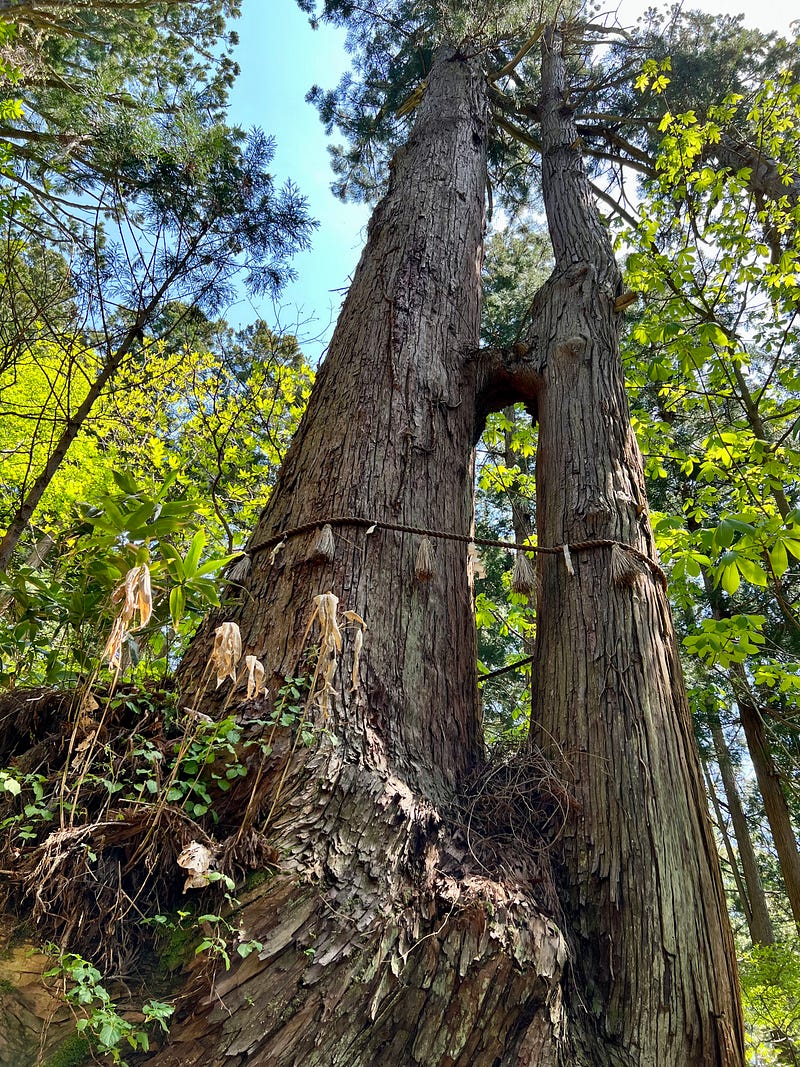
Originally two trees, through the years they reached out to each other and are now collectively known as Meoto-sugi, “The Couple Tree.” A wooden sign nearby tells us that those who hug this tree will be blessed with children.
There are three slopes along this path, each marked by a stone monument, and I have reached the third.
I pass a shrine dedicated to the kami, Haniya-Hime no Mikoto, who was created from the feces of the creator goddess, Izanami-no-Mikoto. (I’m not making this up.) Those looking for the divine blessing of lasting relationships come here to pray.
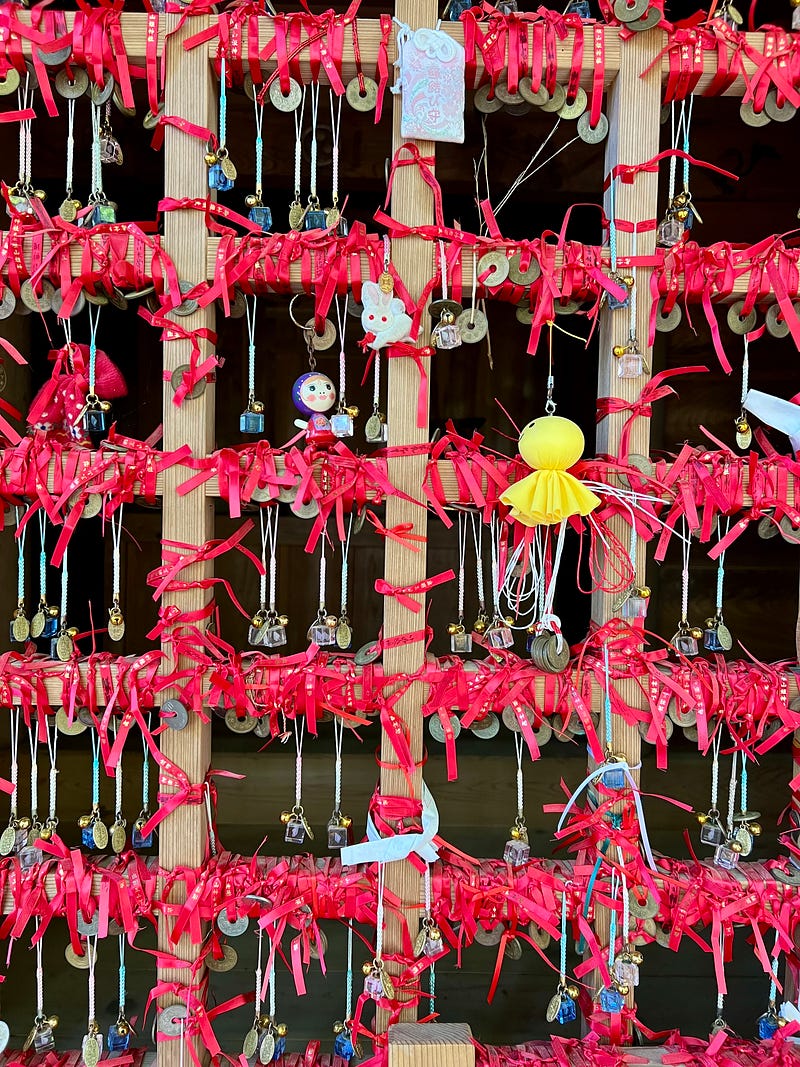
Soon, I reach the top of the mountain, welcomed by another torii gate.
Exploring the mountaintop
I’ve climbed the 2,445 stone steps that lead from the Zuishinmon Gate to the 414 meter-high summit of Mount Haguro. I bow and enter the grounds where all three deities of the Dewa Sanzan are enshrined.
The first thing that catches my eye is a magnificent wooden shrine, a marvel of craftsmanship. It is the Itsukushima Shrine dedicated to the three deities of Munakata (in Fukuoka), and was once shared with Benzaiten, their Buddhist equivalent. These deities are incarnations of the god of water and all that flows, and they are crucial to this island nation as providers of the bounties from the sea.
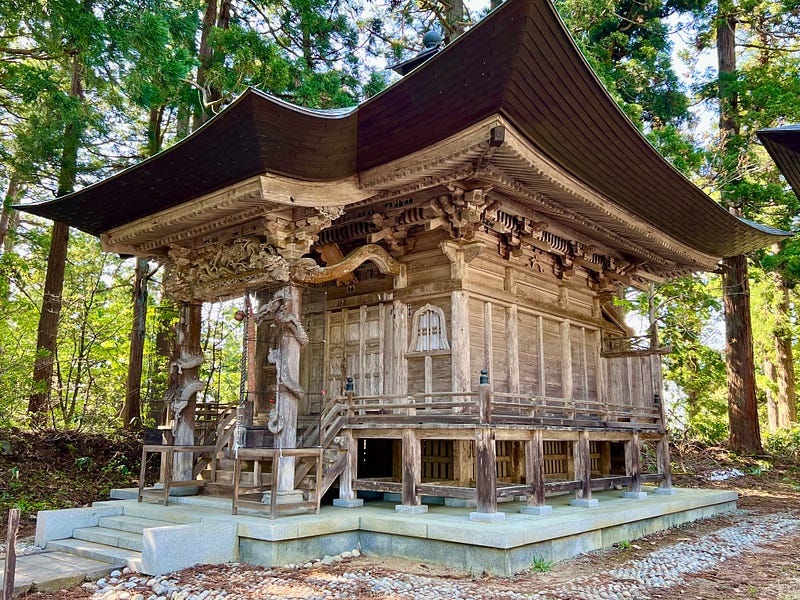
Among myriad intricate carvings are two dragons, one adorning each front pillar. Unlike the Western concept of dragons, these are helpful and wingless creatures. One is climbing up the pillar, symbolizing our struggles to attain Buddhahood through the continuous cycle of birth, death, and rebirth.
The other dragon descends, signifying its intention to come to earth and help aid the salvation of all living things.
No one knows when this building was constructed.
I pass the shrine to Prince Hachiko, then go up a few steps to pay my respects at the Sanjin-Gosaiden Shrine. This striking cedar structure was built in 1818, and it has an impressive 2.1 meter thick thatched roof, the thickest in Japan.
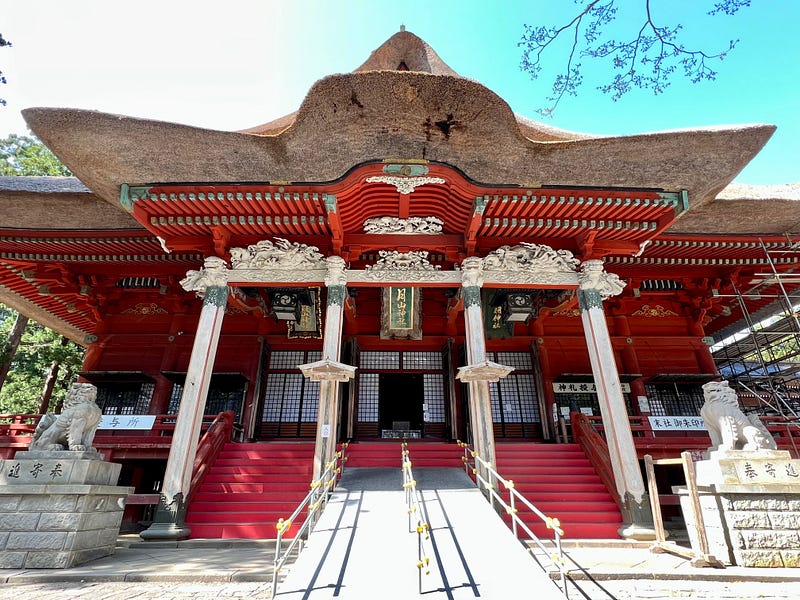
The gods of each of the Dewa Sanzan — Mount Haguro, Mount Gassan, and Mount Yudono — are enshrined within. This is the only mountaintop accessible all year round, so pilgrims can pay homage to all three deities here.
In front of the shrine is a pond called Kagami-ike, Mirror Pond. Although it beautifully reflects the shrine, this is not the source of its name.
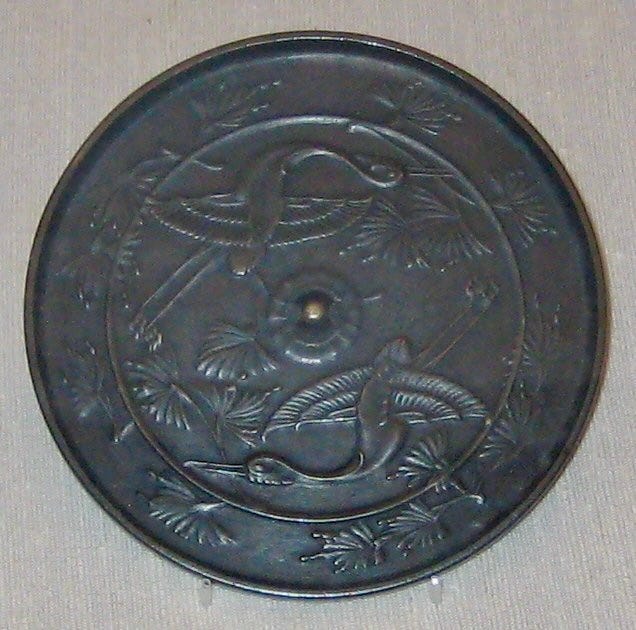
In the early 20th century, the pond was drained. Over 600 ornate, bronze mirrors were recovered from its muddy bottom. Worshippers are thought to have used the mirrors as vehicles for their prayers and tossed them into the pond. Today, those mirrors have traveled as far as the British Museum and the Smithsonian Institute. Nearly 200 are on display in the nearby Dewa Sanzan Historical Museum, which, unfortunately, was closed when I visited.
Beside the pond is an ancient bell. As Shinto shrines do not usually have bells, this one is clearly a remnant of the days when Buddhism flourished in Dewa Sanzan.
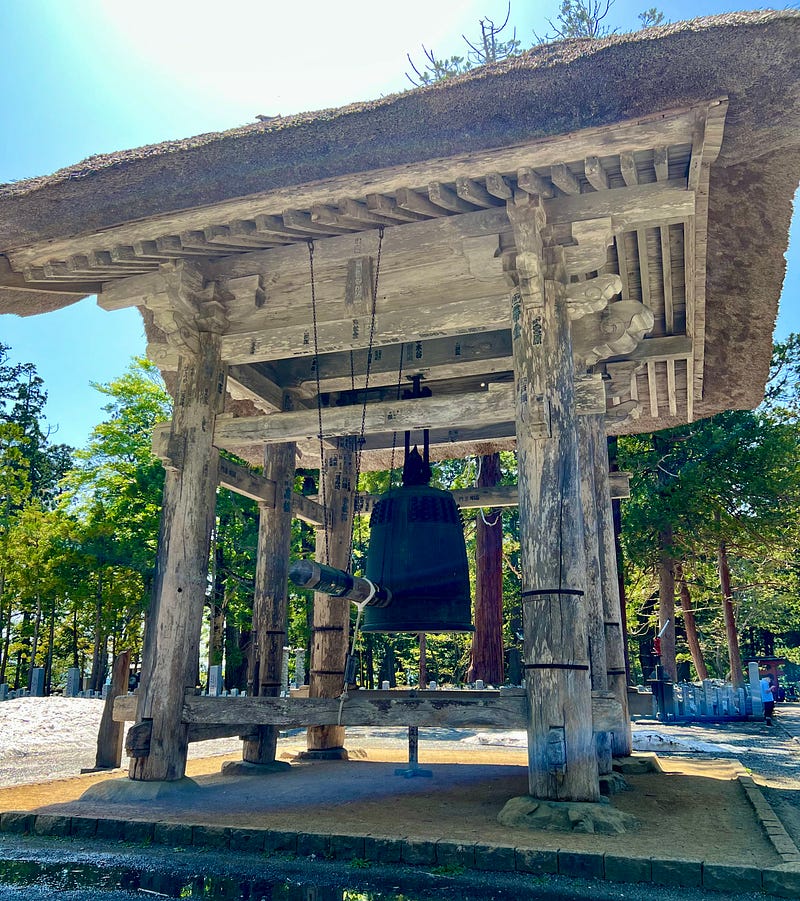
The bronze bell weighs 10 tons, the 3rd largest in Japan. It was donated by the regent Hojo Tokimune as thanks for prayers offered for victory during the Mongol invasions of 1274 and 1281.
The thatched roof belfry was built in 1617, replacing the former structure that was destroyed during a typhoon.
This bell is rung only once a year, on December 31. Imagine the reverberations that echo across the mountains.
Among the other shrines on the mountaintop is Tōshō Shrine, dedicated to the deified first shogun of the Edo era, Tokugawa Ieyasu.
Another is the Reisaiden, a shrine built to house ancestral spirits. There is a spectacular painting of a dragon on the ceiling of its entranceway and a collection of Buddhist sculptural masterpieces in the building beside it. No photography is allowed.
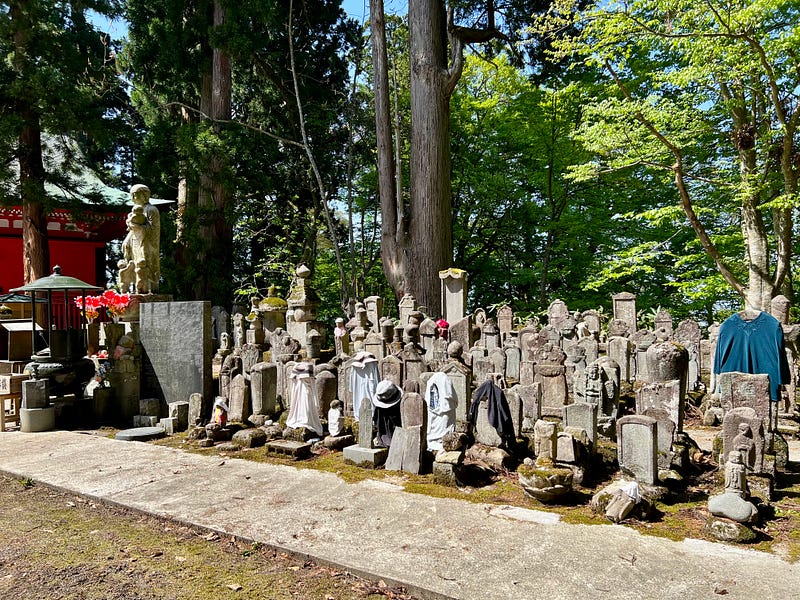
Beside Reisaiden is a small cemetery with some unusual clothed gravestones.
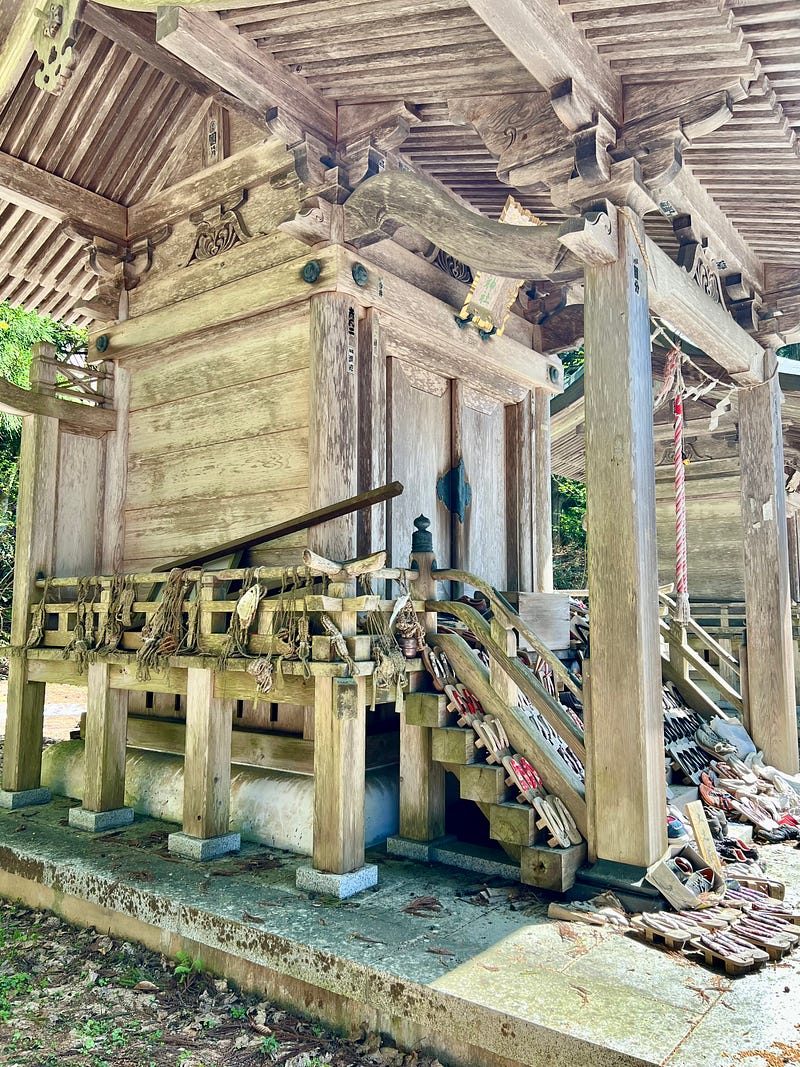
Along the east side of the mountaintop, sits a row of small shrines. One of these stood out because of its collection of footwear. It is the Kensumimi Shrine, dedicated to Kamo-Taketsu-Numi no Mikoto, who, according to legend, is the kami who was incarnated as the three-legged crow.
People visit the shrine and offer footwear imbued with prayers for safe travels and healing and strength for their legs.
The climb down
After paying my respects at the modest imperial grave of Prince Hachiko, I head back to the torii gate to begin my descent.
Along the way is a sign tempting me to explore the Minami-Dani, which means southern valley. Despite the “Watch out for Bears” sign, I brave the unused trail. About 500 meters into the woods I come to a clearing that once held a temple where the great poet, Matsuo Basho, stayed while on his famous “Narrow Road to the Deep North” poetic journey in the 17th century.
There was not much left of the pond or the gazebo, but the walk is beautiful.
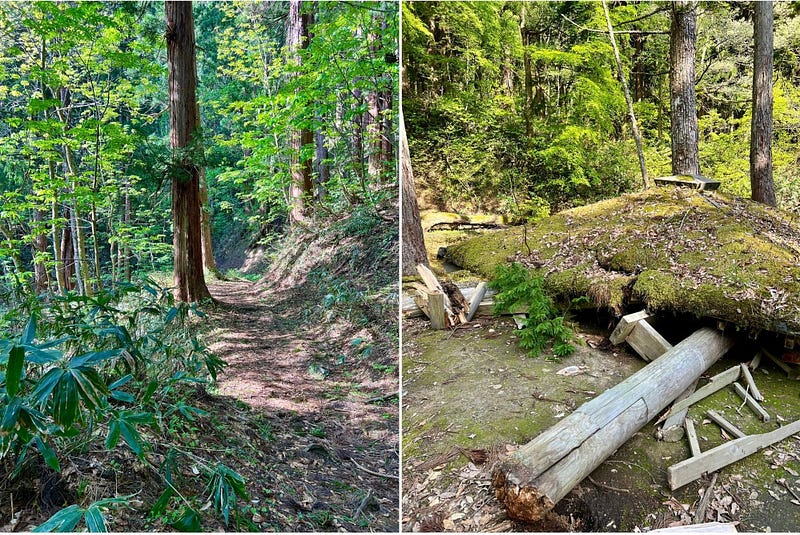
Back on the main path, I come across construction at a tea house. I peek into the grounds before one of the workers kindly tells me he would “appreciate me not entering.” I see enough to know that the rebuilt tea house will afford a fantastic view of the vast Shonai plains below.
Shukubo shrine stay
The innkeeper greets me at the door of the shrine lodging and shows me to my room. It is a huge 12 mat room, twice the size of a typical single room.
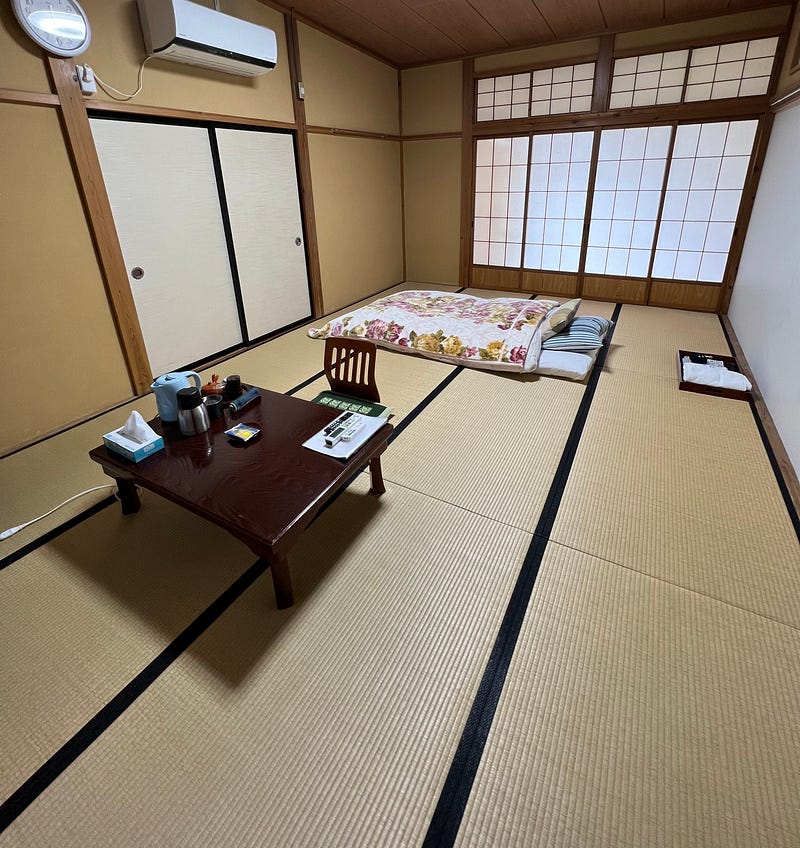
“Wow, this room is huge!” This is an unexpected surprise.
“You’re a foreigner, so I thought you would like a big room.”
I do!
She takes me down the hall to show me the shared bath and toilets, then back to show me the small room where my meals would be served. We agree on a 6:00 dinner, and she leaves me to wash up and relax.
Innkeepers in Japan prefer to serve dinner early, as the meals are rather elaborate, and they appreciate having plenty of time to clean up before they go to bed.
I bathe, put on the yukata robe the innkeeper provided, and before I know it, dinner is served.
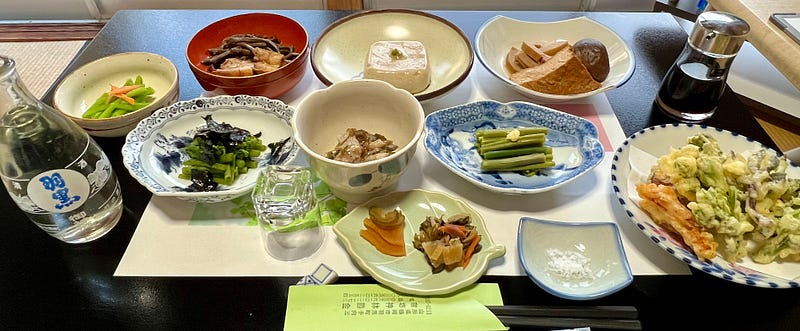
It’s a feast of wild mountain vegetables and various types of tofu, including a house specialty, sesame tofu. This type of cuisine was developed in the Kamakura era by Zen monks and is called shojin-ryori.
Although Dewa Sanzan became Shinto in 1869, shojin-ryori continued to be served and adapted. Enjoying shojin-ryori is an important part of any visit to the Dewa Sanzan.
After a peaceful sleep in that quiet room between comfortable and warm futons, I wake up refreshed.
I again visit the Jiji-sugi “Grandfather Cedar” and the Go-jū-no-toh. I see many people cleaning, and learn that the mountain is cleaned one day each year.
I visit the two shrines between my inn and the Zuishinmon Gate. One is called the Tenchikon Shrine. This iteration was built in 1779 and is decorated with remarkable carvings.
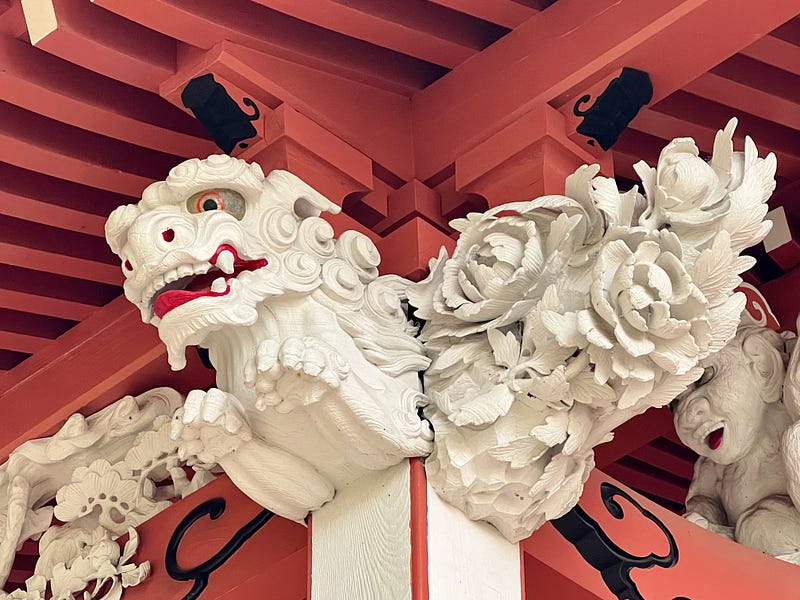
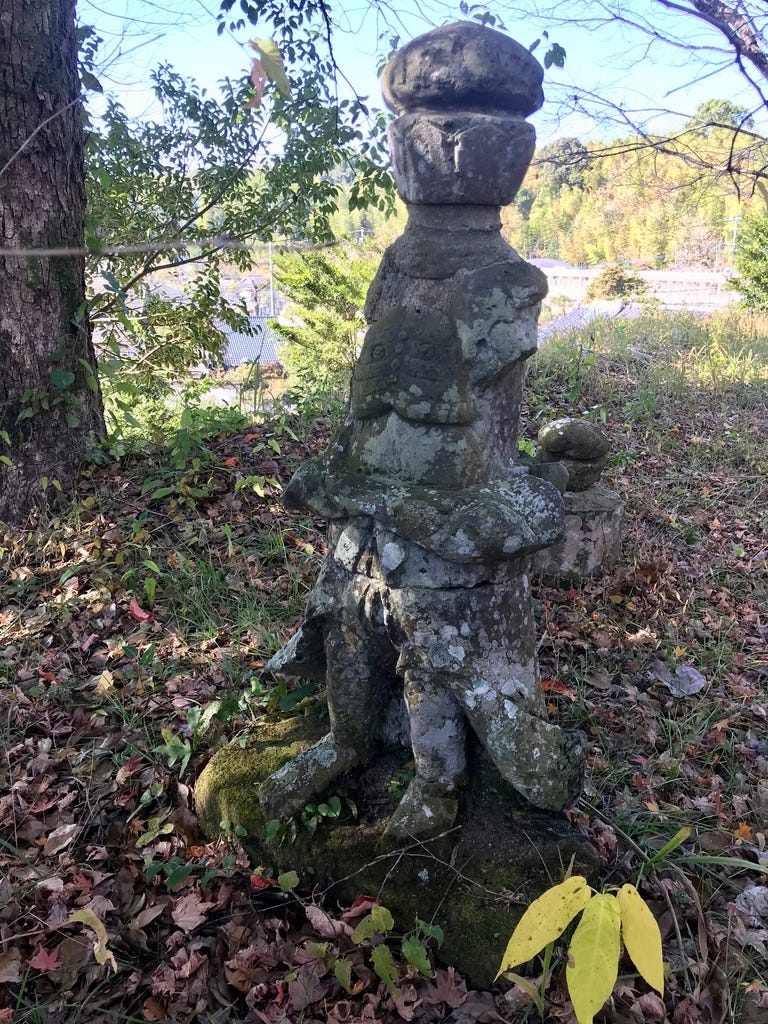
The other shrine is dedicated to “The Tofu Jizō.”
With a name like that, it had to have an interesting backstory.
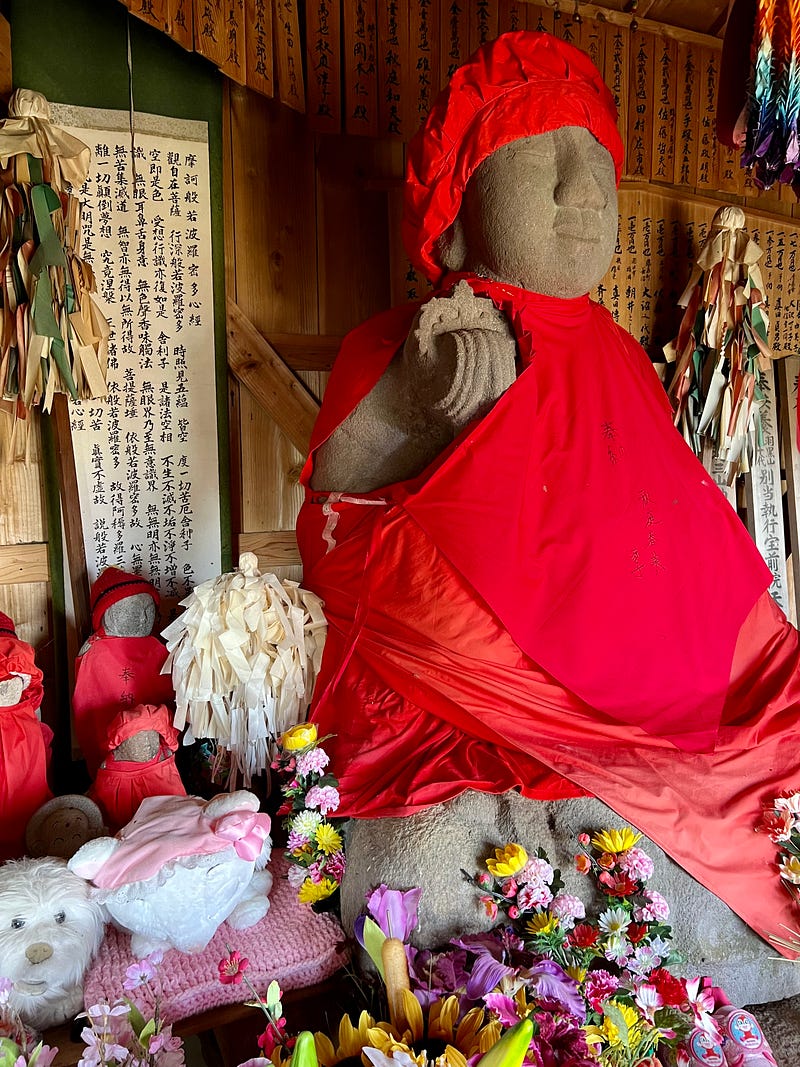
Before the late 19th century, this Jizō statue held pride of place on temple grounds, bringing prosperity to the worshippers on Mount Haguro and protecting pilgrims.
Sadly, when its temple compound was destroyed, this Jizō statue was cast into a ravine and forgotten.
Many years later, a mason was searching the forest for stone. He came upon the Jizō and mistook it for mere smooth stone. It seemed to him a perfect find to fashion into a stone used in making tofu. It was his lucky day — or so he thought.
The moment he struck the stone, he fell over unconscious. For three days and three nights he lay in a stupor, his mind filled with dreams.
In his dreams, Jizō appeared to him and warned him to repent of his disrespect.
When he awoke, repent, he did!
He moved the Jizō to its current position near the Zuishinmon Gate, built a shrine for him, and gave him the name “Tofu Jizō.” Today, people visit this Jizō to pray for long life, safe childbirth, and for help in raising children.
I go next door to the inn and partake of a wonderful shojin-ryori breakfast. I notice one of the dishes is a triangular chimaki, a type of rice dumpling wrapped and cooked in bamboo leaves and topped with soybean powder. It is a popular dish served on Children’s Day and one of my favorites.
After this delicious meal, I bid farewell to the kind innkeeper.
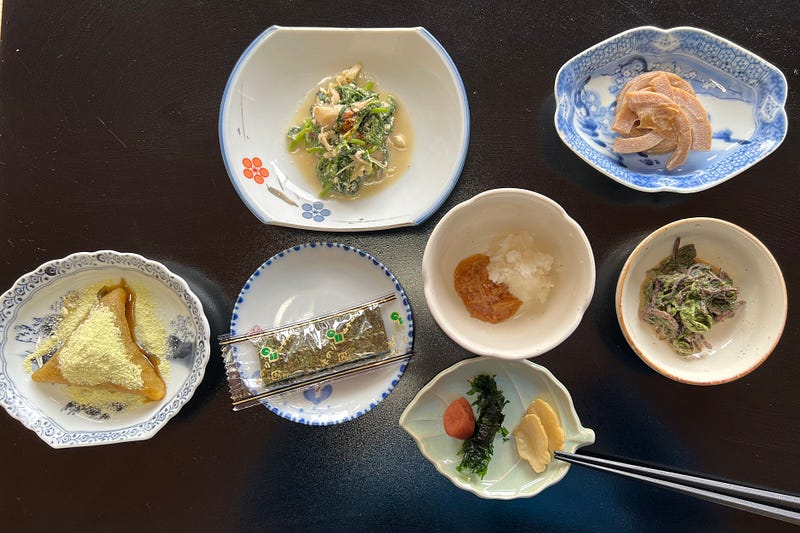
My time at Mount Haguro is up. I catch the 9:18 bus to Tsuruoka Town, satisfied after a perfect stay and looking forward to new adventures.
Mount Haguro embodies many of the reasons I write about rural Japan. Though off the beaten path, it truly is a treasure trove of culture and beauty for those who take the time to visit.
For what it’s like to stay at a Buddhist Temple, please see my article, “Shukubō — Tranquil Temple Stay in Japan.”
If you have questions about Japan or suggestions for articles, please add them in the comments. For more photos and information on Japan, follow me on instagram at: https://www.instagram.com/more_than_tokyo/


