

• Home
  • About
  • Discover
    • History
    • Culture
    • Nature
    • Food
    • Living in Japan
    • Destinations
    • Language
    • Tips
  • Interview
  • Recommended Books
Exploring the Wonders of Rural Japan
History Ghosts

Taira no Masakado—Japan’s Three Most Infamous Vengeful Ghosts, part 1

Wreaking Havoc in Tokyo from the 10th Century

Japan loves threes. Three Great Beautiful Places. Three Great Night Views. Three Great Mountains. In this three article series, I will introduce to you Japan’s Three Great Vengeful Ghosts.

The Japanese people have long believed in ghosts, hauntings, and spiritual realms. People generally will not move into a house or apartment where someone has died, and there is at least one website that lists such haunted residences to warn potential buyers. Television shows that recount ghost stories are a standard of prime-time viewing.

So please allow me to introduce you to the most famous ghost in Japan, who just happens to haunt Tokyo.

Vengeful Ghost #1 — Taira no Masakado
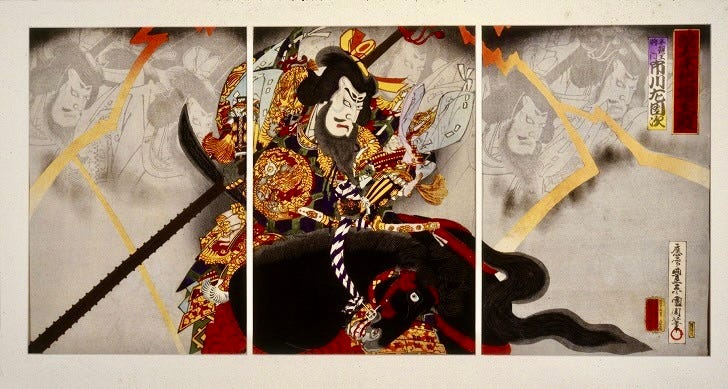
A samurai in armor on horseback, surrounded by ghostly apparitions of himself. He holds a lance, and lightning flashes around him.
Taira no Masakado surrounded by duplicates of himself in ghostly form, woodblock print by Toyohara Kunichika (Released to the public domain by Walters Art Museum)

In the early 10th century, the powerful samurai warlord, Taira no Masakado, staged various uprisings near the northern border of the Japanese state. Far away in the capital of Heian-kyo, now Kyoto, the emperor yawned and turned back to his tea. No need for the son of heaven to bother with petty local skirmishes.

A few years later, though, the situation became more serious. Masakado had captured the governor of Hitachi Province (Ibaraki Prefecture) and taken over Shimotsuke and Kōzuke (Tochigi and Gunma Prefectures). He then proclaimed himself the “New Emperor.”

Time to put down that teacup.

Emperor Suzaku placed a bounty on his head and sent an army to hunt down the arrogant Masakado.

The wily Masakado was hard to corner, but after weeks of pursuit and battles, the final showdown came.

With a strong north wind on his back, Masakado held the advantage. Nevertheless, the imperial forces felt confident in their superior numbers and launched a surprise attack on Masakado’s center. An intense battle raged. Masakado’s samurai repelled the enemy with horses racing, arrows flying, and spears thrusting. Men and horses scattered, and 2,900 of the emperor’s samurai were forced to retreat. Just 300 of their elite warriors remained.

Proud of his victory against a much larger force, Masakado was making his way back to camp when he felt the wind change. He readied himself for another battle.

Using the south wind to their advantage, the remaining imperial samurai quickly regrouped and sprang to the attack.

Masakado charged to meet them, but his fleet-footed horse lost its footing on the uneven ground. In that one moment of Masakado’s distraction, an arrow pierced through the middle of his forehead.

The imperial samurai severed Masakado’s head and brought it back to the capital to present to the emperor. Setting a new precedent in criminal law, Masakado’s head was put on public display in Kyoto’s marketplace as a grisly warning. Worse, the emperor expressly forbade that his remains be given a Buddhist burial or memorial service, condemning his spirit to wander this earthly realm with no hope of redemption.

This is when the rumors started.
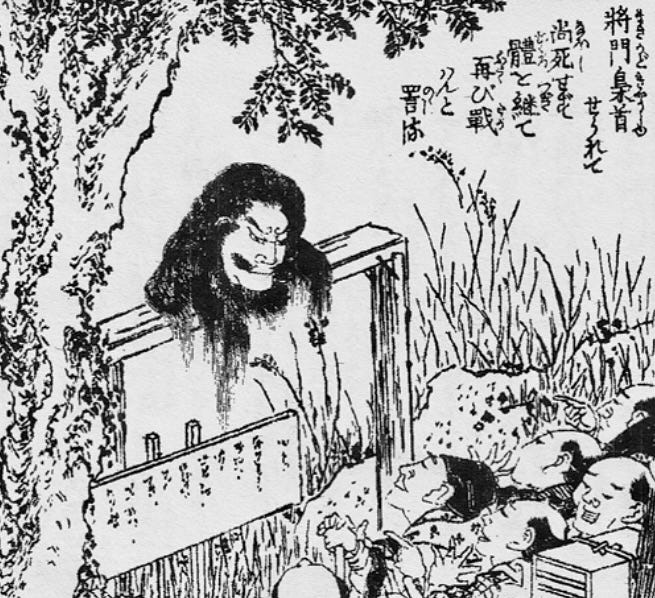
A long-haired head sits upon a wooden frame. There is a sign beneath it, presumably stating his crimes. A crowd looks on.
Taira no Masakado’s head on display. (Woodblock print by Katsushika Hokusai. Public Domain.)

Birth of a Vengeful Ghost

Some people reported seeing Masakado’s eyes open while his head was displayed.

A poet recorded he saw Masakado’s head turning left and right, groaning and looking for his body, whereupon his head broke away and flew off north in search of it.

Masakado’s head came to rest in the tiny fishing village of Shibazaki, later to become Edo, then Tokyo. The locals cleaned it and provided it with a proper burial at Kanda Shrine, inscribing his gravestone with prayers to keep Masakado’s troubled spirit appeased.

Yet each time unexplained trouble occurred, the villagers believed it was caused by the angry spirit of Masakado.

During the Edo era (1603–1867), Taira no Masakado grew in fame as Kabuki theater, woodblock prints, and books for the masses grew in popularity. Masakado’s ghost became a recurring theme in entertainment for the superstitious public, and even his daughter came to the fore. A famous Kabuki play portrayed her as a powerful sorceress, fighting off imperial pursuers with witchcraft.

A woman in kimono holding a scroll is on the left. A giant skeleton leers over two cowering aristocrats in colorful kimonos in the center.
Takiyasha the Witch and the Skeleton Spectre, woodblock print showing Masakado’s daughter summoning a spectre to frighten the emperor’s emissary, Ōya no Mitsukuni. (By Utagawa Kuniyoshi. Public Domain.)

Trouble at the Ministry of Finance

In the late 1800s, Kanda Shrine moved to its present location. The Ministry of Finance took over its former area, sharing its grounds with Masakado’s tomb. Each year, Masakado was treated with ceremonies as befitted a lord. A portable shrine was carried from Kanda Shrine, and priests prayed for the repose of his spirit. Masakado seemed pleased.

During the devastating Great Kanto Earthquake of 1923 and its resultant fires, the Ministry of Finance building burnt to the ground. Remarkably, although reduced to a bald mound of earth, Masakado’s underground tomb remained intact. Archeologists discovered that his tomb was built in the ancient keyhole style of the Kofun era (300–600 AD) and were keen to preserve it.

Grainy old photo of bare ground with a small square monument on the left and a mound on the right. A man stands on the top of the mound beside a taller stone monument.
Archaeologist standing on Masakado’s tomb mound and beside its stone monument, on the grounds of the destroyed Ministry of Finance, 1923. (Photo from Musashi no Sousho, Volume 1, found here.)

Sadly, there were no laws in place to protect historical properties, and within two years, the land was leveled. A temporary building to house the Ministry of Finance was constructed in its place.

That couldn’t be good.

Before two more years had passed, 14 people in the finance ministry had died under mysterious circumstances. Even the Vice-Minister of Finance, Hayashi Seiji, passed away after a brief and unexplained illness. People who worked above the former grave sight complained of pains in their feet.

Their disrespect for Masakado was deemed the cause of all these troubles.

Apology to a Ghost

“Even in this modern age of progress and science, bureaucrats apologize to Taira no Masakado,” reported the Yomiuri Newspaper in 1926.

The building that had been constructed upon Masakado’s tomb was torn down. Shinto priests were called in to perform a purification ceremony and to pray for the repose of Masakado’s soul. A hedge, a stone lantern, and a monument were erected in the hopes of appeasing his troublesome spirit.

Perhaps he would like the little garden offering?

Lightning Strike

In 1940, one thousand years after Masakado’s death, fires caused by lightning destroyed the Ministry of Finance and nine other adjacent government buildings. Kawada Isao, the Minister of Finance, hoping to undo the damage, erected a monument upon the exact spot of Masakado’s tomb that had been so thoughtlessly destroyed after the 1923 earthquake. A Shinto ceremony marking the 1,000th anniversary of Masakado’s death was held to comfort his spirit.

WWII and its Aftermath

During the firebombing of Tokyo in March 1945, the area around Masakado’s tomb was again burnt to the ground, but the monument remained relatively unscathed.

After the war, the Americans, unaware of the danger posed by angering the spirit of Masakado, bulldozed the area to make a parking lot. According to records at the Kanda Shrine, the bulldozer flipped over, killing the driver.

Members of the local community were appalled at the Americans’ actions. Fearing further retribution from Masakado, the community leader petitioned the Occupation Forces to allow them to preserve “the grave of an ancient great chieftain.” Their request was granted and the local people adopted the gravesite, keeping it clean and offering flowers and prayers.

From Vengeful Ghost to Shinto God

In 1984, Taira no Masakado’s reputation took a turn, and he became one of the three kami, or deities, enshrined at the Kanda Shrine in Tokyo.

The Bank of Tokyo-Mitsubishi UFJ, located in the building beside Masakado’s grave, opened an account in his name. Money placed into the donation box at his gravesite — to the tune of 800,000 yen per year ($7,000) — is kept there to be used for gravesite maintenance and care.

Although the monument — built in 1940 upon the spot where Masakado’s head was buried so many years before — today occupies prime real estate in downtown Tokyo, it is still carefully preserved, honored, and respected. You can find it near Otemachi Station, a stone’s throw from the Imperial Palace.

Why not stop by and pay your respects on your next visit to Japan?
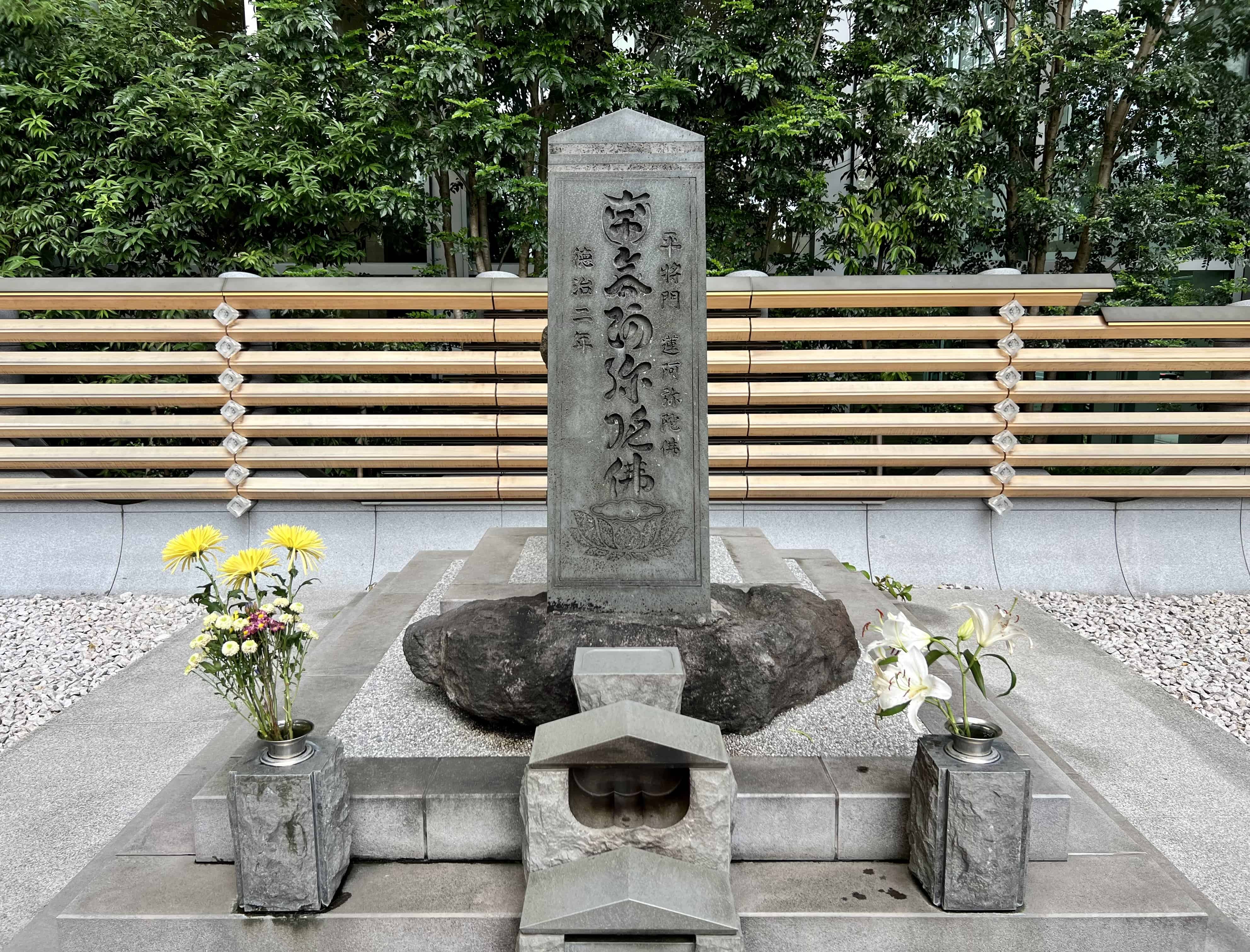
Monument marking the burial place of Taira no Masakado’s head, in Otemachi, Tokyo.
Burial place of Taira no Masakado’s head, in Otemachi, Tokyo. (©Diane Tincher)

P.S. Frogs

Until its 2020 renovation, Taira no Masakado’s grave was surrounded by many frog statues. In Japanese, both “frog” and “return home” are pronounced kaeru. Masakado’s head came to rest there because of his quest to “return home” to his body. People wishing for the safe return of missing loved ones, and people going on trips who wanted Masakado to bring them back home safely, placed frog statues around his grave as an offering of prayer.

Today, to keep the gravesite tidy, those frog statues have been moved to Kanda Shrine and can no longer be viewed by the public, nor can any more be given as offerings. A spokesman for the shrine said, “In these days of increased concern about hygiene, please refrain from leaving things at the shrine.”

Stone monument with buckets and pots holding flowers in front. Frog statues and one Buddhist statue on either side. Trees and bushes in back.
Old gravesite of Masakado, flanked by frog statues and a Jizō statue. (Photo by Asanagi. Public Domain.)

Links to the stories of the other two great vengeful ghosts:

Ghost #2, Emperor Sutoku, and ghost #3, Sugawara no Michizane.

Sources:

https://skawa68.com/2021/06/16/post-74501/, https://mag.japaaan.com/archives/102341, https://sakamichi.tokyo/?p=15968, https://www.goshuinbukuro.com/entry/2017/08/16/233000, https://bit.ly/34fTakP


If you have questions about Japan or suggestions for articles, please add them in the comments. For more photos and information on Japan, follow me on instagram at: https://www.instagram.com/more_than_tokyo/

Ghosts Japan Japan travel Japanese Customs Japanese History Samurai Shinto
Share
2 Comments
  1. Charles

    January 21, 2023 6:49 pm

    This is an interesting overview, entertaining, well written and illustrated with nice photographs. I regret that more of the interesting history of the rebellion is not included.
    Things that might be included:
    # The fact that the rebellion marked the beginning of what eventually would be the shift from imperial power in Kyoto to rule by Warriors in Kamakura
    # The fact that Masakado gave protection to Taira no Haruaki, who had attacked a rice storehouse and given rice to the peasants. Thus Masakado has been seen akin to Robin Hood.
    #The fact that Masakaso was the 6th descendent of the Kanmu Emperor, but belonged to a class of rural elites who had been made commoners. Masanobu journeyed to Kyoto to try to move up in position, but the court, under the thumb of the Fujiwara kanpaku system, was thoroughly corrupted.
    #The fact that Masakado took over 8 provinces and declared himself the New Emperor
    # The alternative account of the flying head that it was shot down by an arrow sent by the Hayato God who resided in Nanei Taisha in Mino no Kuni where people feared that the head would unite with its body and start another rebellion. Mikubi Shrine (The Shrine of the Noble Head) was built on the spot where the head landed. Today worshipers go to take care of whatever happens above the neck (hearing loss, academic advancement, etc).
    #The fact that the imperial court sent the monk Kukai (kobo daishi) to Narita-San to build a shrine that would pacify further local discontent, and that to this day those who honor the spirit of Masakado refuse to go on pilgrimages to Narita-San Shrine.

    Reply
    1. Diane Tincher

      January 22, 2023 7:21 am

      Thank you for your detailed and interesting comment! There’s only so much detail that one can put in an article, but I will be writing more about Masakado in the series about Japan’s Three Great Villains. I appreciate your interest and depth of knowledge of Japanese history.

      Reply
Leave a Reply Cancel reply

Your email address will not be published. Required fields are marked *

This site uses Akismet to reduce spam. Learn how your comment data is processed.

Previous Post

Gratitude Never Grows Old

Next Post

Emperor Sutoku — Japan’s Three Most Infamous Vengeful Ghosts, part 2

If you enjoy my work and would like to help me continue creating, consider supporting me.

Thank you!
PayPal - The safer, easier way to pay online!
Newsletter

Subscribe

Enter your email for notifications of our latest posts

Tags
architecture Buddhism Christianity Edo Era elderly festivals folklore Food Ghosts gratitude Haunting Hiking history holidays honesty Japan Japanese Japanese cuisine Japanese culture Japanese Customs Japanese Food Japanese History Japanese Language Japanese words that English needs Japan Tips Japan travel Japan Travel Tips Jizō Kagoshima Kōyō Living in Japan longevity Manners Nature New Year Ninja Samurai Shinto shogun Shrine Tips Trade Travel volcano Washoku
Featured Posts
History Religion

The Shimabara Rebellion—The Last Stand of Japan’s Christians

July 8, 2026
History

The Okamoto Daihachi Affair—The Scandal That Turned the Tide Against Christianity in Japan

July 6, 2026
History

The 47 Ronin—Disgrace, Revenge, and Death

June 23, 2026
Destinations Folklore Ghosts

Omatsu Daigongen—The Amazing Cat Temple of Shikoku

June 1, 2026
History

Oura Kei—Unstoppable Pioneering Tea Merchant

January 19, 2026
Most Popular

Shinto — The Peaceful Spiritual Heart of Japan

Shinto gate Lake Biwa

Komorebi—A Beautiful Japanese Word that English Needs

Nakasendo Way

Dondoyaki—Burning New Year’s Decorations to Send off the God of the New Year

Dondoyaki fire

The Jizo Statues of Nashi-no-Ki—1,000s of Unique Offerings of Thanks

Jizo statues at Nashi no Jizo, Sado.

Sugawara no Michizane —Japan’s Three Most Infamous Vengeful Ghosts, part 3

Sugawara Michizane
You might also like
Nakasendo Way
Nature Language

Komorebi—A Beautiful Japanese Word that English Needs

1 Min read
November 11, 2021
temple pagoda
Culture Living in Japan

Death in Japan

8 Mins read
March 22, 2022
Elephant by Kano Furunobu
History

The Incredible Tale of the Elephant Who Had an Audience with the Japanese Emperor

7 Mins read
April 6, 2022
Exploring the wonders of rural Japan
Exploring the Wonders of Rural Japan
  • Home
  • About
  • Recommended Books
  • Interview
  • Privacy Policy
Exploring the Wonders of Rural Japan
  • Home
  • About
  • Discover
    • History
    • Culture
    • Nature
    • Food
    • Living in Japan
    • Destinations
    • Language
    • Tips
  • Interview
  • Recommended Books
We use cookies on our website to give you the most relevant experience by remembering your preferences and repeat visits. By clicking “Accept”, you consent to the use of ALL the cookies.
Do not sell my personal information.
Cookie SettingsAccept
Manage consent

Privacy Overview

This website uses cookies to improve your experience while you navigate through the website. Out of these, the cookies that are categorized as necessary are stored on your browser as they are essential for the working of basic functionalities of the website. We also use third-party cookies that help us analyze and understand how you use this website. These cookies will be stored in your browser only with your consent. You also have the option to opt-out of these cookies. But opting out of some of these cookies may affect your browsing experience.
Necessary
Always Enabled
Necessary cookies are absolutely essential for the website to function properly. These cookies ensure basic functionalities and security features of the website, anonymously.
CookieDurationDescription
cookielawinfo-checkbox-analytics11 monthsThis cookie is set by GDPR Cookie Consent plugin. The cookie is used to store the user consent for the cookies in the category "Analytics".
cookielawinfo-checkbox-functional11 monthsThe cookie is set by GDPR cookie consent to record the user consent for the cookies in the category "Functional".
cookielawinfo-checkbox-necessary11 monthsThis cookie is set by GDPR Cookie Consent plugin. The cookies is used to store the user consent for the cookies in the category "Necessary".
cookielawinfo-checkbox-others11 monthsThis cookie is set by GDPR Cookie Consent plugin. The cookie is used to store the user consent for the cookies in the category "Other.
cookielawinfo-checkbox-performance11 monthsThis cookie is set by GDPR Cookie Consent plugin. The cookie is used to store the user consent for the cookies in the category "Performance".
viewed_cookie_policy11 monthsThe cookie is set by the GDPR Cookie Consent plugin and is used to store whether or not user has consented to the use of cookies. It does not store any personal data.
Functional
Functional cookies help to perform certain functionalities like sharing the content of the website on social media platforms, collect feedbacks, and other third-party features.
Performance
Performance cookies are used to understand and analyze the key performance indexes of the website which helps in delivering a better user experience for the visitors.
Analytics
Analytical cookies are used to understand how visitors interact with the website. These cookies help provide information on metrics the number of visitors, bounce rate, traffic source, etc.
Advertisement
Advertisement cookies are used to provide visitors with relevant ads and marketing campaigns. These cookies track visitors across websites and collect information to provide customized ads.
Others
Other uncategorized cookies are those that are being analyzed and have not been classified into a category as yet.
SAVE & ACCEPT