

• Home
  • About
  • Discover
    • History
    • Culture
    • Nature
    • Food
    • Living in Japan
    • Destinations
    • Language
    • Tips
  • Interview
  • Recommended Books
Exploring the Wonders of Rural Japan
History Ghosts

Emperor Sutoku — Japan’s Three Most Infamous Vengeful Ghosts, part 2

Hell Hath no Fury like an Emperor Scorned

Japan loves threes. Three Great Beautiful Places. Three Great Night Views. Three Great Mountains. In this three article series, I introduce you to Japan’s Three Great Vengeful Ghosts.

Vengeful Ghost #2 — Emperor Sutoku
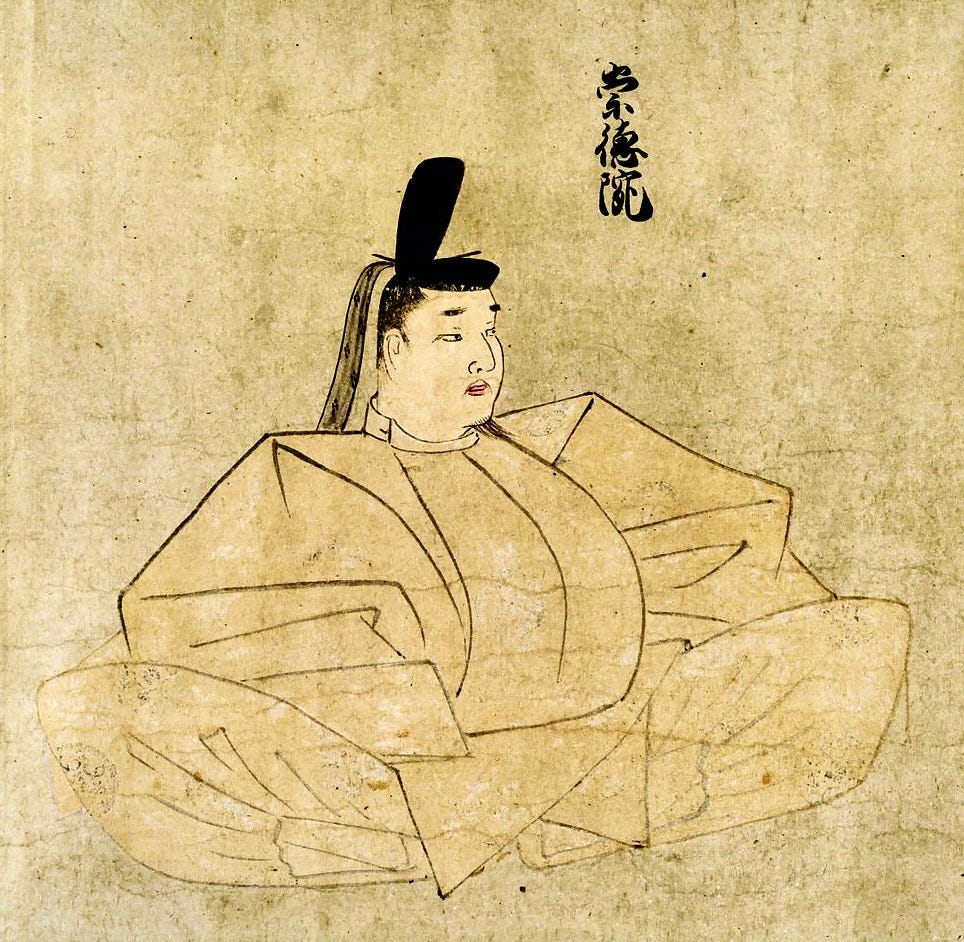
Emperor Sutoku, sitting in layers of pale ochre kimonos, wearing a black hat with a rounded tall protrusion extending up and tassel hanging down the back.
Emperor Sutoku, by Fujiwara no Tamenobu. (Public Domain)

The central Heian government in Kyoto was beginning to fall apart by the 12th century. A succession dispute in 1156, known as the Hogen no Ran, turned into a fierce battle between the younger Emperor Go-Shirakawa and his older brother, the retired Emperor Sutoku.

This ended badly for Sutoku, and he was banished in disgrace as a criminal to Sanuki (Kagawa Prefecture) on the island of Shikoku.

While under house arrest in Sanuki, Sutoku applied himself to Buddhist study. He made offerings for the souls of those who had died in battle. He reflected on his life and prayed for his rebirth in the Buddhist Pure Land. And he spent months diligently writing out the five main Buddhist texts, or sutras. Some accounts claim that these sutras were written in his blood, so dedicated was he to the purifying of his soul.

Sutoku sent these painstakingly prepared sutras to Kyoto as an offering for a temple. First, though, they were presented at the Imperial Court.

The suspicious Emperor Go-Shirakawa took one look at them and wondered aloud, “Has Sutoku sent us a curse?!” Without even opening them, he had the sutras returned to Sutoku.

This blatant disrespect sent Sutoku into a rage. “If it’s a curse you want, a curse you shall get!” He gnawed his tongue, and with his blood he wrote this curse, “I shall become a mighty demon! I shall cause the Emperor to be made low, and the lowly peasant to be exalted!”

After this, Sutoku changed. He fell into a deep melancholy. His hair, beard, and nails went untrimmed, and he lived out his life in lonely exile away from his beloved Kyoto. Many say he came to appear more like a goblin of the mountains than the once mighty emperor of Japan.

Sitting on a low chair in the center of the room is long-haired man with a scruffy beard wearing a green patterned kimono. Two men in dark kimonos are on either side, on their knees facing the man in the center. An open window revealing the moon partially hidden by a cloud is behind the central figure.
Sutoku in exile, filled with melancholy. Woodblock print by Tsukioka Yoshitoshi. (Public Domain)

Back in the capital, Emperor Go-Shirakawa retired in 1158, but he continued to keep a tight grip on power through the reigns of the next five emperors — each of whom was one of his sons or grandsons.

In 1164, Sutoku died.

As a final insult, Go-Shirakawa paid no respects and held no funeral services for his older brother, the former Emperor Sutoku. No royal tomb was built for him in Kyoto. He was banished even in death.

The governor of Sanuki Province saw to Sutoku’s funeral.

Birth of a Vengeful Ghost

Emperor Sutoku, clothed in flowing robes with hair blowing upwards and a crazed pale face, stands on an outcropping of rock over a raging sea.
The Spirit of Emperor Sutoku, woodblock print by Utagawa Kuniyoshi. (Public Domain)

Twelve years after Sutoku’s death, bad things started happening in the capital.

In 1176, Go-Shirakawa was shaken by the sudden deaths of four of his closest allies in the court. They had died one after the other.

The following year, the powerful warrior monks of Mount Hiei raised their heads, threatening the authority of the emperor. A brazen plot to overthrow the influential Taira clan was exposed. Worse, a massive fire reduced one third of the city of Kyoto to ashes.

A prominent court noble recorded in his diary that all these events were surely the work of the disrespected and banished ghost of Emperor Sutoku.

From that time on, the name Sutoku appeared often in the writings of the aristocracy in connection with any unfortunate event.

At last, the fearful and superstitious nobles pressured Go-Shirakawa to allow Buddhist memorial services to be held for the comfort of Sutoku’s spirit.

He acquiesced.

A mausoleum was built for Sutoku on the site of the Hogen no Ran battle. This was later incorporated into Hirano Shrine, which still stands in Kyoto today.

“Emperors Made Low”
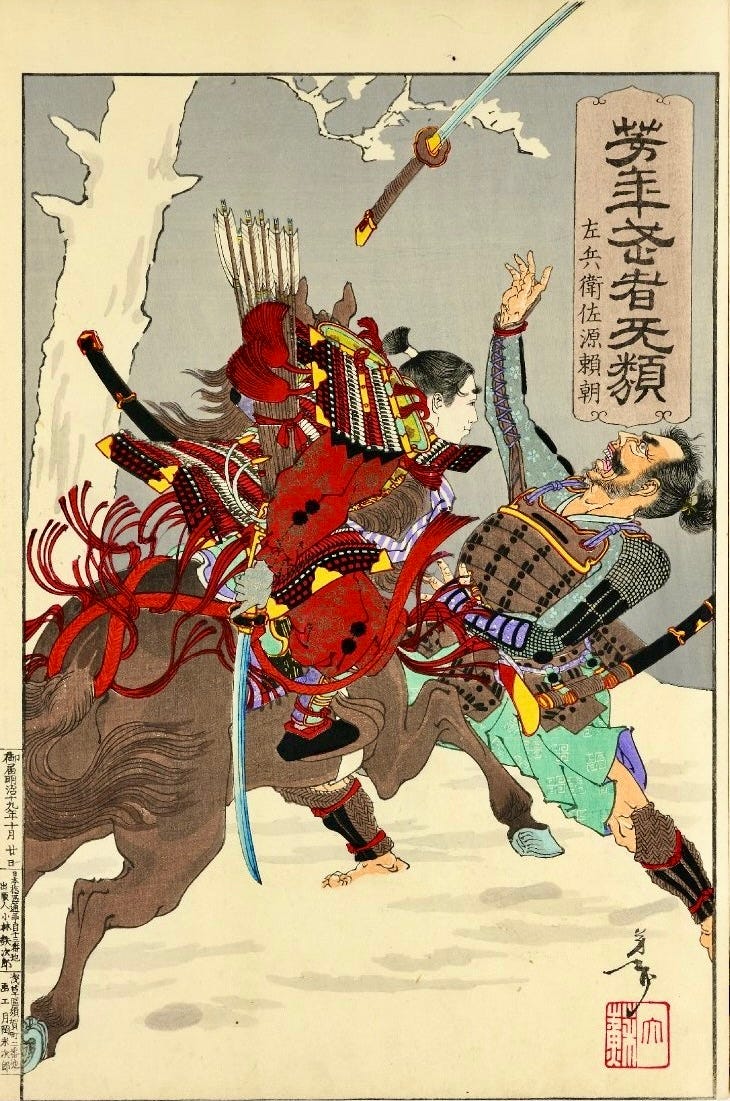
Samurai on horseback wearing armor and elegant red clothing, attacking a man in armor bending backwards from the onslaught. His sword is flying out of his grasp above him.
The first shogun, Minamoto no Yoritomo, on horseback attacking an enemy. Woodblock print by Tsukioka Yoshitoshi. (Public Domain)

While the nobles in Kyoto were enjoying their sophisticated culture, fine clothing, and poetry, the samurai in the countryside were gradually gaining power. Wars were fought between rival clans, and in 1184, the victorious warlord Minamoto no Yoritomo set up his shogunate in Kamakura. This marked the beginning of the feudal age that lasted until the mid-19th century.

For nearly 700 years, the emperor was reduced to a mere figurehead, cloistered in his palace in Kyoto. All power was held by the shogun.

Sutoku Becomes a Guardian Deity

In the early 13th century, Go-Shirakawa’s great grandson, the retired Emperor Tsuchimikado, was banished to Shikoku Island. He made a point to visit Sutoku’s grave to commiserate with his spirit, and to comfort him by playing his lute. Like Sutoku before him, Tsuchimikado was troubled and lonely, far from his loved ones in Kyoto.

That night, Sutoku appeared to Tsuchimikado in a dream, consoling him and promising that he would look after and protect his family.

Although Tsuchimikado’s family lost power after his exile, about 20 years later through an unexpected turn of events, the baby that Tsuchimikado was forced to leave behind in Kyoto became the emperor Go-Saga. Sutoku’s promise was remembered.

In the 14th century, the powerful samurai Hosokawa Yoriyuki also paid a visit to Sutoku’s grave on Shikoku and made offerings for his happiness in the afterlife. He then prayed for Sutoku’s guidance and help in conquering the island. He succeeded in subjugating Shikoku, and thereafter Sutoku became the guardian deity of the Hosokawa clan.

Sutoku’s Spirit Lives On

In 1868, Emperor Meiji took the throne, ending feudalism and long centuries of samurai rule. Power was restored to the emperor.

The teenage emperor, not wanting any trouble from unappeased angry ghosts, sent an imperial envoy to Sanuki to bring the spirit of Sutoku to Kyoto. Back in his former capital, Sutoku was deified and enshrined at Shiramine Shrine.

Japanese shrine with green curved roof and many hanging white lanterns beneath its eaves. Two stone lanterns flank the sides. Green leafy trees stand behind and beside the shrine.
Shiramine Shrine, Kyoto. (Public Domain via Wikimedia Commons)

On the 800th anniversary of Sutoku’s death, just prior to the 1964 Tokyo Olympics, Emperor Hirohito sent emissaries to Sutoku’s tomb in Kagawa Prefecture. On the emperor’s orders, they honored Sutoku with an imperial memorial service and prayed for the repose of his spirit. Like his grandfather the emperor Meiji, Hirohito wanted no trouble from an aggrieved Sutoku.

The 1964 Olympics were a milestone in post-war Japan, bringing the country to the world stage as a peaceful, progressive, and prosperous nation.

Perhaps Sutoku’s spirit finally was at peace.


Here is part one of this series about Taira no Masakado, the ghost who haunted Tokyo.

Part three is the story of my favorite ghost, Sugawara no Michizane.


If you have questions about Japan or suggestions for articles, please add them in the comments. For more photos and information on Japan, follow me on instagram at: https://www.instagram.com/more_than_tokyo/

Ghosts Haunting Japan Japanese culture Japanese History Shinto
Share
Write Comment
Leave a Reply Cancel reply

Your email address will not be published. Required fields are marked *

This site uses Akismet to reduce spam. Learn how your comment data is processed.

Previous Post

Taira no Masakado—Japan’s Three Most Infamous Vengeful Ghosts, part 1

Next Post

Amabie —The Yōkai Who Became Japan’s Unexpected Covid Guardian

If you enjoy my work and would like to help me continue creating, consider supporting me.

Thank you!
PayPal - The safer, easier way to pay online!
Newsletter

Subscribe

Enter your email for notifications of our latest posts

Tags
architecture Buddhism Christianity Edo Era elderly festivals folklore Food Ghosts gratitude Haunting Hiking history holidays honesty Japan Japanese Japanese cuisine Japanese culture Japanese Customs Japanese Food Japanese History Japanese Language Japanese words that English needs Japan Tips Japan travel Japan Travel Tips Jizō Kagoshima Kōyō Living in Japan longevity Manners Nature New Year Ninja Samurai Shinto shogun Shrine Tips Trade Travel volcano Washoku
Featured Posts
History Religion

The Shimabara Rebellion—The Last Stand of Japan’s Christians

July 8, 2026
History

The Okamoto Daihachi Affair—The Scandal That Turned the Tide Against Christianity in Japan

July 6, 2026
History

The 47 Ronin—Disgrace, Revenge, and Death

June 23, 2026
Destinations Folklore Ghosts

Omatsu Daigongen—The Amazing Cat Temple of Shikoku

June 1, 2026
History

Oura Kei—Unstoppable Pioneering Tea Merchant

January 19, 2026
Most Popular

Shinto — The Peaceful Spiritual Heart of Japan

Shinto gate Lake Biwa

Komorebi—A Beautiful Japanese Word that English Needs

Nakasendo Way

Dondoyaki—Burning New Year’s Decorations to Send off the God of the New Year

Dondoyaki fire

The Jizo Statues of Nashi-no-Ki—1,000s of Unique Offerings of Thanks

Jizo statues at Nashi no Jizo, Sado.

Sugawara no Michizane —Japan’s Three Most Infamous Vengeful Ghosts, part 3

Sugawara Michizane
You might also like
Nakasendo Way
Nature Language

Komorebi—A Beautiful Japanese Word that English Needs

1 Min read
November 11, 2021
temple pagoda
Culture Living in Japan

Death in Japan

8 Mins read
March 22, 2022
Elephant by Kano Furunobu
History

The Incredible Tale of the Elephant Who Had an Audience with the Japanese Emperor

7 Mins read
April 6, 2022
Exploring the wonders of rural Japan
Exploring the Wonders of Rural Japan
  • Home
  • About
  • Recommended Books
  • Interview
  • Privacy Policy
Exploring the Wonders of Rural Japan
  • Home
  • About
  • Discover
    • History
    • Culture
    • Nature
    • Food
    • Living in Japan
    • Destinations
    • Language
    • Tips
  • Interview
  • Recommended Books
We use cookies on our website to give you the most relevant experience by remembering your preferences and repeat visits. By clicking “Accept”, you consent to the use of ALL the cookies.
Do not sell my personal information.
Cookie SettingsAccept
Manage consent

Privacy Overview

This website uses cookies to improve your experience while you navigate through the website. Out of these, the cookies that are categorized as necessary are stored on your browser as they are essential for the working of basic functionalities of the website. We also use third-party cookies that help us analyze and understand how you use this website. These cookies will be stored in your browser only with your consent. You also have the option to opt-out of these cookies. But opting out of some of these cookies may affect your browsing experience.
Necessary
Always Enabled
Necessary cookies are absolutely essential for the website to function properly. These cookies ensure basic functionalities and security features of the website, anonymously.
CookieDurationDescription
cookielawinfo-checkbox-analytics11 monthsThis cookie is set by GDPR Cookie Consent plugin. The cookie is used to store the user consent for the cookies in the category "Analytics".
cookielawinfo-checkbox-functional11 monthsThe cookie is set by GDPR cookie consent to record the user consent for the cookies in the category "Functional".
cookielawinfo-checkbox-necessary11 monthsThis cookie is set by GDPR Cookie Consent plugin. The cookies is used to store the user consent for the cookies in the category "Necessary".
cookielawinfo-checkbox-others11 monthsThis cookie is set by GDPR Cookie Consent plugin. The cookie is used to store the user consent for the cookies in the category "Other.
cookielawinfo-checkbox-performance11 monthsThis cookie is set by GDPR Cookie Consent plugin. The cookie is used to store the user consent for the cookies in the category "Performance".
viewed_cookie_policy11 monthsThe cookie is set by the GDPR Cookie Consent plugin and is used to store whether or not user has consented to the use of cookies. It does not store any personal data.
Functional
Functional cookies help to perform certain functionalities like sharing the content of the website on social media platforms, collect feedbacks, and other third-party features.
Performance
Performance cookies are used to understand and analyze the key performance indexes of the website which helps in delivering a better user experience for the visitors.
Analytics
Analytical cookies are used to understand how visitors interact with the website. These cookies help provide information on metrics the number of visitors, bounce rate, traffic source, etc.
Advertisement
Advertisement cookies are used to provide visitors with relevant ads and marketing campaigns. These cookies track visitors across websites and collect information to provide customized ads.
Others
Other uncategorized cookies are those that are being analyzed and have not been classified into a category as yet.
SAVE & ACCEPT