

• Home
  • About
  • Discover
    • History
    • Culture
    • Nature
    • Food
    • Living in Japan
    • Destinations
    • Language
    • Tips
  • Interview
  • Recommended Books
Exploring the Wonders of Rural Japan
History

The Kumaso Cave and How a Cross-Dressing Prince Ended a Great Tribe

Cave of the Bear-People, Kumaso no Ana

Climbing up a steep path in the forests of Kirishima, in the southwestern Japanese prefecture of Kagoshima, one comes upon an amazing cave with an interesting history.
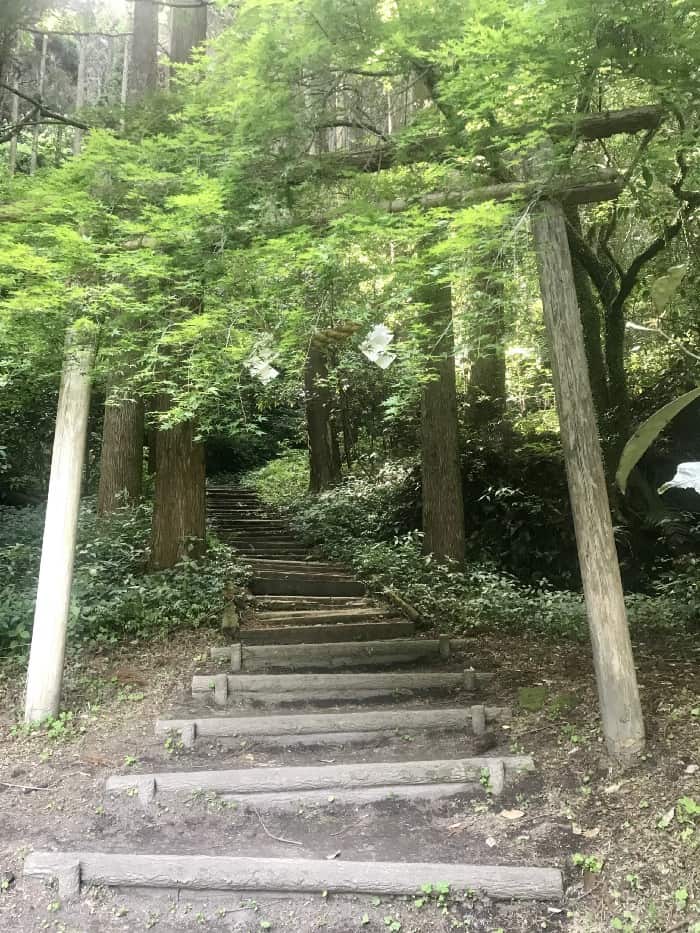
Path to Kumaso Cave
The path to the cave passes through a wooden Torii gate, hung with a shimenawa rope and shide papers, which symbols purify those who enter and signify the entrance to the realm of the divine.

Long ago, southwestern Japan was inhabited by a fierce people called the Kumaso, led by Kawakami Takeru, who lived in an extensive cave. Kuma means “bear,” and some scholars suggest that these people were called kuma, or “bear-like,” due to their violent interactions or because of the distinctive physical appearance of this ethnic group. So refers to the ancient country that was once southwestern Japan. Kawakami’s name, Takeru, is an honorary title meaning a “brave and valorous person.”

Kumaso Cave entrance
The Cave of the Kumaso

Southern Kyushu is a mountainous region formed by ancient volcanic eruptions. The pyroclastic sediment that makes up its soil is not suitable for growing rice, the main occupation in Japan from the Yayoi Period (roughly 600 BC to 300 AD*).

The Kumaso were said to sweat blood in their efforts to grow rice, half of which was required to be paid as tribute, brought to the capital in far away Yamato, now Nara Prefecture. This onerous task had become too much for the Kumaso.

Enter, the Prince

Because of their neglect to send tribute, Keiko, the 12th emperor, sent his 16-year-old son, Ousu-no-Mikoto (小碓命), to subjugate the independent Kumaso.

At that time, the leaders of the 55 tribes of southern Kyushu had gathered for a party in Kawakami’s enormous cave, the interior of which was measured at 1,000 tatami mats (1,653 square meters).

Ousu arrived as the party was underway. Knowing that Kawakami was too fierce to defeat in battle, at the peak of festivities, the fair-skinned and courtly-mannered Ousu put on women’s clothing and joined the women in pouring drinks for the men.

When Kawakami saw Ousu, he said, “I have never seen such a beautiful woman before! Come, drink with me,” and he led Ousu into a private cavern.

Pretending to pour Kawakami a drink, the disguised Ousu stabbed him in the back.
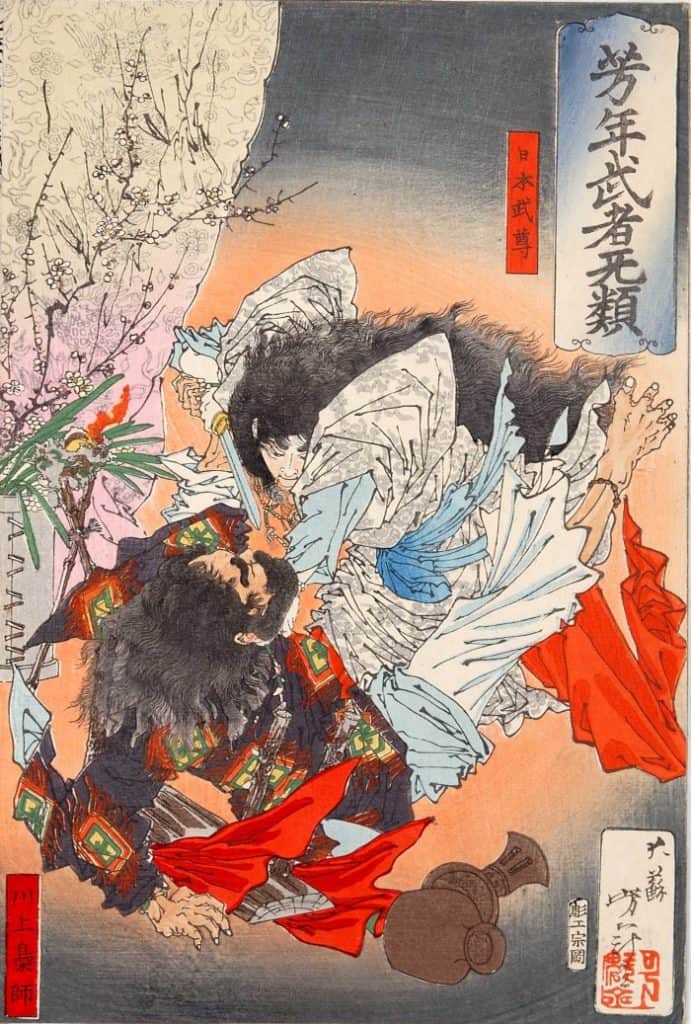
Kawakami Takeru being stabbed by Yamato Takeru
Kawakami Takeru being stabbed by the disguised Prince Ousu. Woodblock print by Matsuoka Yoshitoshi. (public domain)

Kawakami cried out, “Who are you?”

“I am the son of the emperor. I have come to kill you for your defiance in refusing to pay tribute.”

Kawakami said, “You are a better man than I. Your name, Ousu, is too small for you. Please accept my name and become ‘Yamato Takeru.’” (小碓, Ousu, means “small millstone.”)

As Ousu received this honorary name, Yamato Takeru, “brave leader of the Japanese people,” Kawakami’s younger brother entered the room. Ousu stabbed him. He cried out. Hearing this from the next cavern, the 55 drunken tribal leaders rushed in. Shocked to see a woman holding a bloody sword beside the dying Kawakami and his dead brother, they readied their swords to attack.

The wounded Kawakami spoke, “Do not harm him. This is the emperor’s son. He has righteously come to kill me because of my refusal to pay tribute. I have given him my name. See that he makes it safely back to his father.”

Then, breathing his last breath, he declared, “From this day, the Kumaso tribe is dissolved.”

Thus, the last leader of the Kumaso, Kawakami Takeru, died.

The tribal leaders obeyed the final words of Kawakami, and they saw Yamato Takeru safely back to his father, Emperor Keikō.

Kawakami Takeru’s cave today
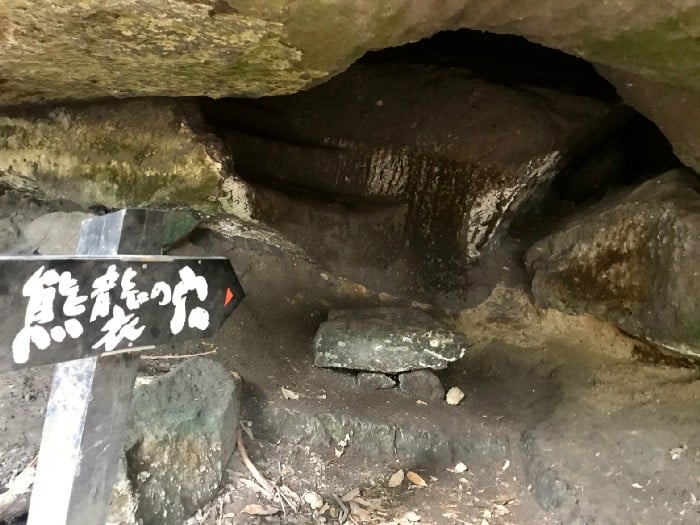
Kumaso Cave today
Kumaso no Ana Cave entrance

You can visit Kawakami’s cave today. Although the huge cavern where Kawakami lived is now blocked by a rockfall, the smaller 10 by 22 meter outer cave is accessible. It has been made a Shinto holy place.

Murals inside Kumaso Cave
Art by Hagihara Sadayuki on Kumaso Cave walls

Perhaps as a nod to the Kumaso’s Austronesian origins and their rock paintings, in 1990 the cave was decorated with modern-style murals, painted by Sakurajima native, Hagihara Sadayuki.

The Kumaso Cave is located about 15 minutes from Kagoshima Airport.


*Although most history books date the Yayoi period from 300 BC to 300 AD, recent archeological evidence has shown that the Yayoi period (characterized by the introduction of wet-field rice farming from Korea) started at varying dates throughout Japan. In northern Kyushu, the date is now from 900 BC, in southern Kyushu from 600 BC, the Kansai region from 800 BC, the Kanto area from 500 BC, and the Aomori area from 400 BC.


If you have questions about Japan or suggestions for articles, please add them in the comments. For more photos and information on Japan, follow me on instagram at: https://www.instagram.com/more_than_tokyo/

Japan Japan travel Japanese culture Japanese History Kawakami Takeru Shinto Takeru
Share
Write Comment
Leave a Reply Cancel reply

Your email address will not be published. Required fields are marked *

This site uses Akismet to reduce spam. Learn how your comment data is processed.

Previous Post

Children’s Day in Japan—Carp Streamers, Samurai, and Sweets

Next Post

Ta no Kami—Japan’s Rice Field God Statues offer a Remarkable Window into the Past

If you enjoy my work and would like to help me continue creating, consider supporting me.

Thank you!
PayPal - The safer, easier way to pay online!
Newsletter

Subscribe

Enter your email for notifications of our latest posts

Tags
architecture Buddhism Christianity Edo Era elderly festivals folklore Food Ghosts gratitude Haunting Hiking history holidays honesty Japan Japanese Japanese cuisine Japanese culture Japanese Customs Japanese Food Japanese History Japanese Language Japanese words that English needs Japan Tips Japan travel Japan Travel Tips Jizō Kagoshima Kōyō Living in Japan longevity Manners Nature New Year Ninja Samurai Shinto shogun Shrine Tips Trade Travel volcano Washoku
Featured Posts
History Religion

The Shimabara Rebellion—The Last Stand of Japan’s Christians

July 8, 2026
History

The Okamoto Daihachi Affair—The Scandal That Turned the Tide Against Christianity in Japan

July 6, 2026
History

The 47 Ronin—Disgrace, Revenge, and Death

June 23, 2026
Destinations Folklore Ghosts

Omatsu Daigongen—The Amazing Cat Temple of Shikoku

June 1, 2026
History

Oura Kei—Unstoppable Pioneering Tea Merchant

January 19, 2026
Most Popular

Shinto — The Peaceful Spiritual Heart of Japan

Shinto gate Lake Biwa

Komorebi—A Beautiful Japanese Word that English Needs

Nakasendo Way

Dondoyaki—Burning New Year’s Decorations to Send off the God of the New Year

Dondoyaki fire

The Jizo Statues of Nashi-no-Ki—1,000s of Unique Offerings of Thanks

Jizo statues at Nashi no Jizo, Sado.

Sugawara no Michizane —Japan’s Three Most Infamous Vengeful Ghosts, part 3

Sugawara Michizane
You might also like
Nakasendo Way
Nature Language

Komorebi—A Beautiful Japanese Word that English Needs

1 Min read
November 11, 2021
temple pagoda
Culture Living in Japan

Death in Japan

8 Mins read
March 22, 2022
Elephant by Kano Furunobu
History

The Incredible Tale of the Elephant Who Had an Audience with the Japanese Emperor

7 Mins read
April 6, 2022
Exploring the wonders of rural Japan
Exploring the Wonders of Rural Japan
  • Home
  • About
  • Recommended Books
  • Interview
  • Privacy Policy
Exploring the Wonders of Rural Japan
  • Home
  • About
  • Discover
    • History
    • Culture
    • Nature
    • Food
    • Living in Japan
    • Destinations
    • Language
    • Tips
  • Interview
  • Recommended Books
We use cookies on our website to give you the most relevant experience by remembering your preferences and repeat visits. By clicking “Accept”, you consent to the use of ALL the cookies.
Do not sell my personal information.
Cookie SettingsAccept
Manage consent

Privacy Overview

This website uses cookies to improve your experience while you navigate through the website. Out of these, the cookies that are categorized as necessary are stored on your browser as they are essential for the working of basic functionalities of the website. We also use third-party cookies that help us analyze and understand how you use this website. These cookies will be stored in your browser only with your consent. You also have the option to opt-out of these cookies. But opting out of some of these cookies may affect your browsing experience.
Necessary
Always Enabled
Necessary cookies are absolutely essential for the website to function properly. These cookies ensure basic functionalities and security features of the website, anonymously.
CookieDurationDescription
cookielawinfo-checkbox-analytics11 monthsThis cookie is set by GDPR Cookie Consent plugin. The cookie is used to store the user consent for the cookies in the category "Analytics".
cookielawinfo-checkbox-functional11 monthsThe cookie is set by GDPR cookie consent to record the user consent for the cookies in the category "Functional".
cookielawinfo-checkbox-necessary11 monthsThis cookie is set by GDPR Cookie Consent plugin. The cookies is used to store the user consent for the cookies in the category "Necessary".
cookielawinfo-checkbox-others11 monthsThis cookie is set by GDPR Cookie Consent plugin. The cookie is used to store the user consent for the cookies in the category "Other.
cookielawinfo-checkbox-performance11 monthsThis cookie is set by GDPR Cookie Consent plugin. The cookie is used to store the user consent for the cookies in the category "Performance".
viewed_cookie_policy11 monthsThe cookie is set by the GDPR Cookie Consent plugin and is used to store whether or not user has consented to the use of cookies. It does not store any personal data.
Functional
Functional cookies help to perform certain functionalities like sharing the content of the website on social media platforms, collect feedbacks, and other third-party features.
Performance
Performance cookies are used to understand and analyze the key performance indexes of the website which helps in delivering a better user experience for the visitors.
Analytics
Analytical cookies are used to understand how visitors interact with the website. These cookies help provide information on metrics the number of visitors, bounce rate, traffic source, etc.
Advertisement
Advertisement cookies are used to provide visitors with relevant ads and marketing campaigns. These cookies track visitors across websites and collect information to provide customized ads.
Others
Other uncategorized cookies are those that are being analyzed and have not been classified into a category as yet.
SAVE & ACCEPT