

• Home
  • About
  • Discover
    • History
    • Culture
    • Nature
    • Food
    • Living in Japan
    • Destinations
    • Language
    • Tips
  • Interview
  • Recommended Books
Exploring the Wonders of Rural Japan
Culture Language

Gaman — The Gritty Japanese Word for an Integral National Characteristic

Children who learn this from an early age become remarkably resilient adults

Bonsai pine. It takes a lot of gaman to produce a bonsai tree.
Bonsai trees take decades of regular care. That is a lot of gaman. (IlonaBurschl via Pixabay.)

In 2016, Angela Duckworth published her research on what she called “Grit” — a winning combination of passion and perseverance — that she posited as a crucial component of success.

That is the closest thing I can think of to what the Japanese have been calling gaman (我慢) for centuries.

What is gaman?

My dictionary defines gaman as “patience, endurance, perseverance, tolerance, self-control, and self-denial.”

Gaman is a characteristic that is imbued into children so deeply that it becomes a given. It is why we see adults lining up in an orderly fashion at train stations and stoically dealing with natural disasters like the 2011 Tohoku earthquake and tsunami.

Restraint, self-control, tolerance. These are characteristics built into Japanese character.

We, humans, are not born with this high level of patience and endurance, as anyone who had cared for a baby or toddler well knows. So how do children in Japan develop this important trait?

Speaking from my own experience in raising my children in Japan while retaining my Western sensibilities, allow me to present you with a few examples.

Learning to gaman
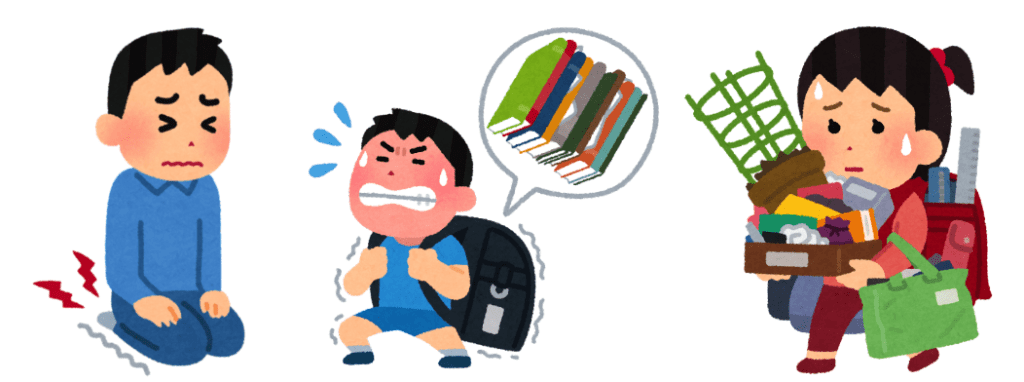
Screen Shot 2022 09 01 at 7.09.06
Left to right: Kneeling in seiza position. Carrying books to and from school in a regulation backpack. Carrying everything from school home for summer vacation, including a morning glory plant in a pot. (All illustrations courtesy of irasutoya.com.)
  • In elementary school, I observed students kneeling on the wooden floor in the formal Japanese sitting position of seiza — sitting on feet —while listening to long speeches in the school auditorium.
  • Elementary and junior high school students are required to walk to and from school, carrying all books and equipment that they may need for school each day — regardless of the weather.
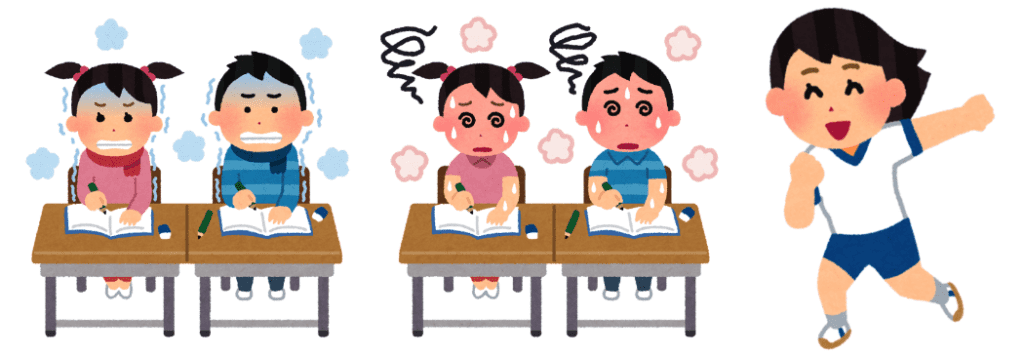
Screen Shot 2022 09 01 at 7.09.23
Left to right: No heaters or air conditioning in schools. All-weather PE clothes.
  • When my children were in school, there were no heaters or air conditioners in the classrooms. 
  • For their PE uniforms, my daughter and her classmates wore little underwear-like bloomers and thin T-shirts, no matter what the weather. The illustration above is a more recent version of the PE uniform, having replaced the underwear-style bloomers for girls with shorts.

How kids learn to gaman. Eating all their school lunches. Waiting to use the restroom. Doing summer vacation homework.
Left to right: Children with their school lunches. Boy having to gaman and wait to use the restroom. A boy working diligently on his summer vacation homework.
  • Students must eat every bite of their school lunches, whether they like it or not. This was particularly troublesome for my youngest son’s teachers, as he would sit at his desk with his lunch before him and refuse to open his mouth to eat even one bite of fish. He would rather gaman and miss recess than eat fish. lol
  • Kids are taught not to challenge authority or question rules that don’t seem to make sense. They learn to simply suck it up, or rather, gaman.
  • Elementary school students have six weeks of summer vacation during which they are required to do homework assignments daily. Part of that assignment for first graders is to care for a morning glory plant which they must bring back to school in September.

Screen Shot 2022 09 01 at 7.09.48
Left to right: Sleeping through a test is a mistake. A student taking an entrance exam. “Ronin” student studying into the wee hours to prepare for next year’s entrance tests.
  • If you are sick on the day of a test and miss taking it, you get a zero. At least that was my children’s situation in school. I hear that today, some schools will allow students to make up a missed test.
  • High School in Japan is not compulsory. You have one chance to take the entrance test for a public high school, and one chance to take the entrance test for a private high school. If you flunk, or if you get sick and miss the test, you have to wait until the tests are held the next year to try again. Curiously, kids that have to wait for the next year’s tests are called ronin (yes, the same word used for a masterless samurai).

Perhaps it says something that I was so easily able to locate Japanese illustrations for every point on my list.

The results of learning to gaman

Although my motherly and lenient viewpoint clashed with many of the restrictions forced on my children in public schools, I can now appreciate much of their value.

People standing in straight lines waiting for the subway at Tokyo station.
Passengers waiting in lines for the subway at Tokyo station. (Depositphotos)

So, next time you sit down to a meticulously prepared and beautiful Japanese meal, or see photos of Japanese people lining up in an orderly fashion, cleaning sports stadiums after events, or doing any job with scrupulous attention to detail, think about the years those adults spent as children honing their patience — and practicing gaman.
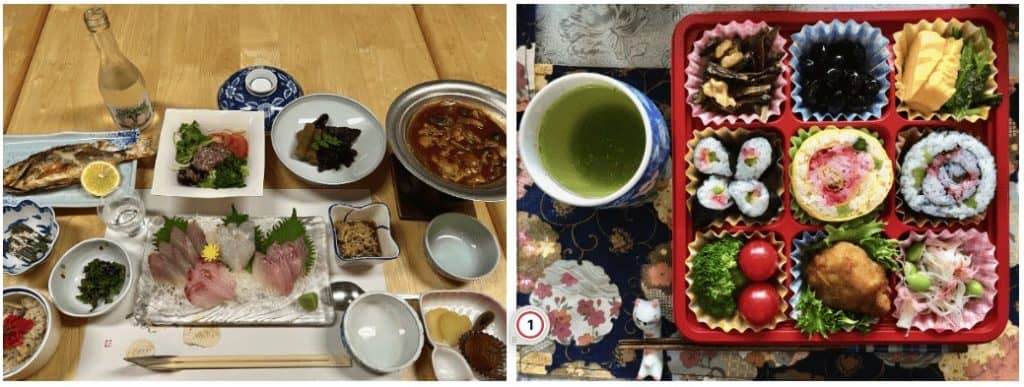
Beautiful small servings of a wide variety of food, and an intricately beautiful packed lunch.
Left: dinner at a small rural inn. Right: Bento lunch. (©Diane Tincher)

If you have questions about Japan or suggestions for articles, please add them in the comments. For more photos and information on Japan, follow me on instagram at: https://www.instagram.com/more_than_tokyo/

Japan Japanese culture Japanese Customs Japanese Language Japanese schools Raising children in Japan
Share
4 Comments
  1. Lonely Soul

    June 30, 2023 4:10 pm

    I am utterly astounded by the persistence of the archaic notion known as “gaman.” It is a concept deeply ingrained in Japanese culture, propagated as a virtue, but its consequences are nothing short of damaging and regressive. This outdated ideology demands that individuals should silently endure hardships without complaint or resistance, promoting a dangerous culture of repressed emotions and perpetuating systemic injustices. “Gaman” glorifies suffering and suppresses the very essence of human expression. It fosters an environment where individuals are expected to bury their true feelings, bear the burdens of discrimination, inequality, and social pressure, all while maintaining a stoic façade. This toxic mindset prevents any meaningful dialogue and dismisses the importance of acknowledging and addressing issues at their core. By idealizing “gaman,” we reinforce harmful power dynamics and normalize the perpetuation of injustice. Instead of challenging oppressive structures and advocating for change, we are encouraged to silently accept the status quo, thereby stifling progress and perpetuating a cycle of systemic inequality. The onus is placed on the marginalized to endure suffering rather than on society to rectify its flaws. Moreover, “gaman” contributes to the mental and emotional burden that individuals bear. The suppression of emotions can lead to psychological distress, creating a ticking time bomb of unresolved feelings. By demanding “gaman” in the face of adversity, we deny individuals the opportunity to heal and grow, trapping them in a perpetual state of emotional turmoil. It is high time we break free from the shackles of “gaman” and embrace a culture that values authenticity, empathy, and active resistance against injustice. We must encourage open dialogue, support one another in times of hardship, and collectively strive for a society where fairness and equality are not mere aspirations but tangible realities. Let us reject the myth of “gaman” and dismantle the structures that perpetuate suffering. We should embrace a new paradigm that celebrates human dignity, resilience, and the power to effect positive change. It is only by challenging the status quo and rejecting harmful expectations that we can build a truly inclusive and compassionate society.

    Reply
    1. Diane Tincher

      September 2, 2023 10:46 am

      You’ve raised some common criticisms of the concept of “gaman.” From the perspective of an individualist society, like the US, gaman can seem over-the-top, controlling, and smothering.

      Yet, I see it as integral to a collectivist society. I appreciate living in a culture where people clean up after themselves and others, where I can trust the trains to run on time, and where I know that my smartphone will be right where I had forgotten it.

      Reply
      1. Kym

        February 4, 2024 1:52 pm

        I agree and wish Australian students showed a little more gaman. If parents encouraged their children to show more patience and resilience when in group situations, kids would realise sooner that their own needs won’t always be met before those of others. That’s life in a caring, “compassionate” society – it’s not all about me, is how I see it.

        Reply
      2. Kym

        February 4, 2024 1:55 pm

        *Actually, rather than “needs”, I should have written, their own needs / wants. Kids are not focused on what they need to do, for a lot of them it’s still about what they *want* to do, and life doesn’t work like that.

        Reply
Leave a Reply Cancel reply

Your email address will not be published. Required fields are marked *

This site uses Akismet to reduce spam. Learn how your comment data is processed.

Previous Post

Nanzoin Temple — Little-Known Home of the Biggest Bronze Statue in the World

Next Post

Shinto — The Peaceful Spiritual Heart of Japan

If you enjoy my work and would like to help me continue creating, consider supporting me.

Thank you!
PayPal - The safer, easier way to pay online!
Newsletter

Subscribe

Enter your email for notifications of our latest posts

Tags
architecture Buddhism Christianity Edo Era elderly festivals folklore Food Ghosts gratitude Haunting Hiking history holidays honesty Japan Japanese Japanese cuisine Japanese culture Japanese Customs Japanese Food Japanese History Japanese Language Japanese words that English needs Japan Tips Japan travel Japan Travel Tips Jizō Kagoshima Kōyō Living in Japan longevity Manners Nature New Year Ninja Samurai Shinto shogun Shrine Tips Trade Travel volcano Washoku
Featured Posts
History Religion

The Shimabara Rebellion—The Last Stand of Japan’s Christians

July 8, 2026
History

The Okamoto Daihachi Affair—The Scandal That Turned the Tide Against Christianity in Japan

July 6, 2026
History

The 47 Ronin—Disgrace, Revenge, and Death

June 23, 2026
Destinations Folklore Ghosts

Omatsu Daigongen—The Amazing Cat Temple of Shikoku

June 1, 2026
History

Oura Kei—Unstoppable Pioneering Tea Merchant

January 19, 2026
Most Popular

Shinto — The Peaceful Spiritual Heart of Japan

Shinto gate Lake Biwa

Komorebi—A Beautiful Japanese Word that English Needs

Nakasendo Way

Dondoyaki—Burning New Year’s Decorations to Send off the God of the New Year

Dondoyaki fire

The Jizo Statues of Nashi-no-Ki—1,000s of Unique Offerings of Thanks

Jizo statues at Nashi no Jizo, Sado.

Sugawara no Michizane —Japan’s Three Most Infamous Vengeful Ghosts, part 3

Sugawara Michizane
You might also like
Nakasendo Way
Nature Language

Komorebi—A Beautiful Japanese Word that English Needs

1 Min read
November 11, 2021
temple pagoda
Culture Living in Japan

Death in Japan

8 Mins read
March 22, 2022
Elephant by Kano Furunobu
History

The Incredible Tale of the Elephant Who Had an Audience with the Japanese Emperor

7 Mins read
April 6, 2022
Exploring the wonders of rural Japan
Exploring the Wonders of Rural Japan
  • Home
  • About
  • Recommended Books
  • Interview
  • Privacy Policy
Exploring the Wonders of Rural Japan
  • Home
  • About
  • Discover
    • History
    • Culture
    • Nature
    • Food
    • Living in Japan
    • Destinations
    • Language
    • Tips
  • Interview
  • Recommended Books
We use cookies on our website to give you the most relevant experience by remembering your preferences and repeat visits. By clicking “Accept”, you consent to the use of ALL the cookies.
Do not sell my personal information.
Cookie SettingsAccept
Manage consent

Privacy Overview

This website uses cookies to improve your experience while you navigate through the website. Out of these, the cookies that are categorized as necessary are stored on your browser as they are essential for the working of basic functionalities of the website. We also use third-party cookies that help us analyze and understand how you use this website. These cookies will be stored in your browser only with your consent. You also have the option to opt-out of these cookies. But opting out of some of these cookies may affect your browsing experience.
Necessary
Always Enabled
Necessary cookies are absolutely essential for the website to function properly. These cookies ensure basic functionalities and security features of the website, anonymously.
CookieDurationDescription
cookielawinfo-checkbox-analytics11 monthsThis cookie is set by GDPR Cookie Consent plugin. The cookie is used to store the user consent for the cookies in the category "Analytics".
cookielawinfo-checkbox-functional11 monthsThe cookie is set by GDPR cookie consent to record the user consent for the cookies in the category "Functional".
cookielawinfo-checkbox-necessary11 monthsThis cookie is set by GDPR Cookie Consent plugin. The cookies is used to store the user consent for the cookies in the category "Necessary".
cookielawinfo-checkbox-others11 monthsThis cookie is set by GDPR Cookie Consent plugin. The cookie is used to store the user consent for the cookies in the category "Other.
cookielawinfo-checkbox-performance11 monthsThis cookie is set by GDPR Cookie Consent plugin. The cookie is used to store the user consent for the cookies in the category "Performance".
viewed_cookie_policy11 monthsThe cookie is set by the GDPR Cookie Consent plugin and is used to store whether or not user has consented to the use of cookies. It does not store any personal data.
Functional
Functional cookies help to perform certain functionalities like sharing the content of the website on social media platforms, collect feedbacks, and other third-party features.
Performance
Performance cookies are used to understand and analyze the key performance indexes of the website which helps in delivering a better user experience for the visitors.
Analytics
Analytical cookies are used to understand how visitors interact with the website. These cookies help provide information on metrics the number of visitors, bounce rate, traffic source, etc.
Advertisement
Advertisement cookies are used to provide visitors with relevant ads and marketing campaigns. These cookies track visitors across websites and collect information to provide customized ads.
Others
Other uncategorized cookies are those that are being analyzed and have not been classified into a category as yet.
SAVE & ACCEPT