

“The beauty of flowers is to know when to fall”
Many are familiar with James Clavell’s novel, Shogun. This fantastic work of historical fiction is based on the story of William Adams, an English pilot whose crippled Dutch vessel washed ashore in Kyushu in 1600. Like the novel’s hero, Anjin-san, Adams was made a hatamoto by Tokugawa Ieyasu, Japan’s future shogun, the fictional Toranaga Yoshii. Many other characters are based on historical people: Ishido on Ishida Mitsunari, Lady Ochiba on Yodo-dono, and even the tea house madam who requested the setting aside of land for Edo’s pleasure quarters.
But of all Shogun’s characters, none evoke more sympathy than Mariko-sama, the tragic Lady Maria. She, too, has her roots in history, modeled after a Christian samurai named Hosokawa Gracia.
Background
Throughout the 15th and 16th centuries in Japan, ambitious warlords vied for power amidst constant conflict. The Ashikaga shogunate, based in the Muromachi district of Kyoto, was powerless to stop the chaos. In 1543, Portuguese sailors landed on a southern island and introduced firearms to the country. The powerful warlord, Oda Nobunaga, used these formidable weapons in his quest to unify the nation. Known as Japan’s first great unifier, Nobunaga was supported by three generals: Toyotomi Hideyoshi, Tokugawa Ieyasu, and Akechi Mitsuhide. By 1580, Nobunaga stood on the verge of realizing his ambition to unite the fractured land.
Hosokawa Gracia
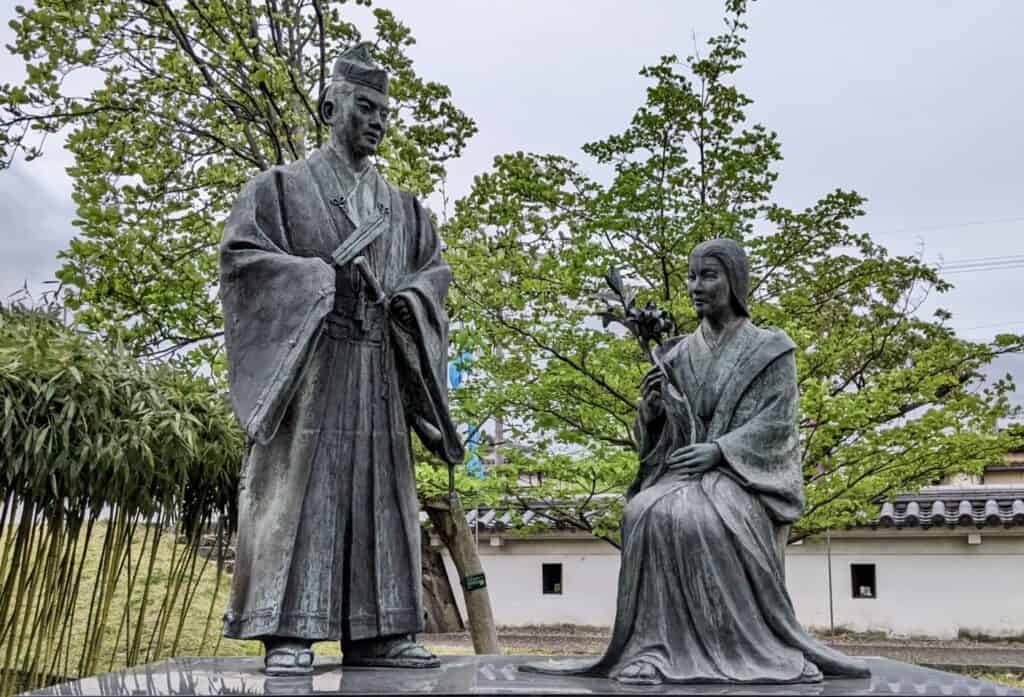
Hosokawa Gracia, born Akechi Tama in 1563, was the daughter of Akechi Mitsuhide, a samurai who rose to become one of Oda Nobunaga’s trusted generals. When Tama was 16, Nobunaga arranged her marriage to Hosokawa Tadaoki, the 16-year-old son of Fujitaka, a prominent retainer of the last Ashikaga shogun. Though young, Tadaoki was already a respected warrior.
The young couple settled at Tango Hachimanyama Castle in what is now northern Kyoto Prefecture. When Tadaoki was awarded the wealthy province of Tango, they moved to Miyazu Castle. There, Tama and Tadaoki had two children and enjoyed a quiet domestic life.
Akechi Mitsuhide, the Traitor
In 1582, Tama’s father, Akechi Mitsuhide, defied an order from his lord, Oda Nobunaga, who had instructed him to join Toyotomi Hideyoshi in southwestern Honshu to subjugate the Mōri clan. Instead, Mitsuhide turned his troops toward Kyoto, where Nobunaga was staying.
Before dawn on June 21, 1582, Mitsuhide and his army of 13,000 samurai surrounded Honnōji temple. Inside, Nobunaga and his loyal servants were taken by surprise. Despite overwhelming odds, the defenders put up a fierce resistance. As the battle raged, Mitsuhide ordered the temple to be set ablaze. Amid the confusion and flames, Nobunaga ensured the safe escape of the women under his care. The he retreated to an inner chamber where he instructed his trusted aide, “Don’t let them take my head.” Nobunaga knelt, drew his dagger, and committed seppuku, the samurai’s honorable suicide. Fire consumed the temple. Nobunaga’s remains were never recovered.
Upon hearing of Mitsuhide’s betrayal and Nobunaga’s death, Toyotomi Hideyoshi swiftly negotiated peace with the Mōri and set out to avenge his lord. Meanwhile, Mitsuhide had looted Nobunaga’s luxurious Azuchi Castle on the east coast of Lake Biwa, hoping to maintain his soldiers’ loyalty with the spoils. He expected strong support from his daughter’s father-in-law, the influential Hosokawa Fujitaka, but Fujitaka severed ties with the traitor.
Hideyoshi’s 20,000-strong army caught up with Mitsuhide’s dwindling forces after only four days, catching them off guard. Many of Mitsuhide’s soldiers had deserted, leaving him with just 10,000 men. The battle was brief, and Mitsuhide’s forces were quickly routed. Mitsuhide himself met an inglorious end at the hands of a bandit leader who cut him down as he fled. His retainers recovered his head, which is interred in Kyoto on a quiet back street not far from Chion-in temple.
Repercussions
Tama’s father’s betrayal of Oda Nobunaga had profound consequences. Overnight, she became the daughter of a traitor, and with that label came the sentence of death. Mitsuhide’s entire family faced extermination. To save her, Tadaoki hid his pregnant wife deep in the mountains, in the hamlet of Midono at the foot of the sacred mountain, Kongodojiyama, in the center of the Tango Peninsula.
In this remote village, Tama lived anonymously, far enough from the capital that the locals were unaware of her father’s treachery. Protected and supported by her husband, who regularly sent provisions, she endured separation from him and their two young children. In Midono, under the influence of her lady’s maid Kiyohara Maria, Tama found solace in Christianity.
Despite the precariousness of her situation, Tama trusted in her husband’s care. Living in what locals now call the Female Castle, guarded by samurai from the Male Castle across the valley, she immersed herself in village life, teaching the local children to read and write and making charms to ward off epidemics.
While at the hamlet of Midono, Tama gave birth to her third child. Although her days were busy, she was plagued by loneliness, finding comfort in her dreams. Of this, she penned the following poem:
I thought it was real, yet
No scent of Tadaoki lingered on my sleeve.
Alas, it was just a dream.
As the months drifted by, Tama spent days contemplating the meaning of life and the inevitability of death. Aware that discovery would mean certain execution, she sought to prepare herself for the imminent end.
From Tama to Gracia
After two years in Midono, Tadaoki deemed it safe for Tama to be moved to his family’s Osaka residence where he could look after her. However, he was soon called to join his lord, Toyotomi Hideyoshi, in the conquest of Kyushu. Tama seized the opportunity of her husband’s absence to secretly visit a church with her maid, Maria. There, she engaged a Japanese priest in deep discussions on matters of faith. She desired to be baptized, but the priest was hesitant. Tama’s noble bearing and appearance had given him pause, and, not knowing her true identity, he postponed her baptism.
At home, Tadaoki’s vassals grew concerned about Tama’s late-night outings, so one evening, they went to the church to bring her home in a palanquin. The priest assigned a young man to follow her, and through him, he discovered she was the wife of Hosokawa Tadaoki. No longer allowed to visit the church, Tama remained unbaptized. She communicated with the priest through Maria and diligently studied the books he sent her. During this period, she arranged for her attendants to visit the church and be baptized.
Things changed drastically for the Catholics in 1587, when Toyotomi Hideyoshi issued the “Bateren Edict,” banning Jesuit missionaries from Japan. Disturbed by this news, and guided by her maid and confidante, Maria, Tama was baptized at her home. She took the Christian name, Gracia.
When Tadaoki returned from his campaign with Hideyoshi’s army in Kyushu, he was furious to learn of his wife’s baptism, especially in light of Hideyoshi’s edict against Christianity. He demanded she renounce her faith, but Gracia remained steadfast.
Eventually, Tadaoki acquiesced, though he treated his wife with disdain, wounding her by threatening to take on concubines. Troubled by her husband’s behavior, Gracia confided in her priest, expressing a desire to leave him. The priest told her that divorce was not permitted in the Catholic Church and encouraged her to withstand the trials, exhorting her that “virtue is only refined in the fires of temptation.”
Meanwhile, tensions were mounting between the eastern and western factions of the country, as each strove for control. In 1598, Toyotomi Hideyoshi died, leaving his five-year-old son as heir. Hideyoshi had arranged for a council of five regents to rule until his son came of age, but they were soon splintered. Ishida Mitsunari, Hideyoshi’s senior advisor and administrator—utterly lacking in battlefield experience—rose to lead the Western faction loyal to the young heir. Tokugawa Ieyasu, an experienced general who had proven his worth in numerous battles and campaigns, commanded the Eastern faction.
In 1600, Tokugawa Ieyasu ordered his general Hosokawa Tadaoki to subdue a powerful northern warlord. Before departing, Tadaoki issued a solemn command to his retainers, “If, while I am away, my wife’s honor is threatened, kill her and then yourselves, as is our samurai custom.”
Taking advantage of Tadaoki’s absence, Tokugawa’s enemy, Ishida Mitsunari, ordered Gracia to be taken hostage in an attempt to coerce Tadaoki’s loyalty. But Gracia refused to be taken. The following day, Mitsunari’s forces surrounded her mansion. When Tadaoki’s vassals told Gracia they were surrounded, she prayed, then gathered the ladies of her house and declared, “Let me be the only one to die,” and she sent her tearful maids out.
Knowing that suicide was forbidden by her Christian faith, Gracia engaged the help of Tadaoki’s chief retainer, who fulfilled her wish by beheading her. He then ignited an explosion that engulfed her house in flames before taking his own life through seppuku.
Hosokawa Gracia left the following death poem:
The beauty of flowers is to know when to fall.
Would that we could have such grace.
In these lines, Gracia touches on the Japanese concept of mono no aware, the deep, often melancholic appreciation of the fleeting beauty of the world, an awareness of the impermanence of things, and the bittersweet beauty found in that transience.
Hours after Gracia’s tragic death, the Jesuit priest Gnecchi-Soldo Organtino visited the charred remains of the Hosokawa residence. There, he carefully collected Gracia’s bones and buried them in the Christian cemetery in Sakai. When Tadaoki learned of his wife’s passing, he was devastated. He sought out Father Organtino and requested a church funeral for Gracia, which he attended. He later had her remains reburied closer to his Osaka residence, at Sozenji temple.
Two months later, Ishida Mitsunari, the effective catalyst for Gracia’s death, was defeated at the Battle of Sekigahara by Tokugawa Ieyasu. After execution in Kyoto, his severed head was publicly displayed, marking an ignominious end to his life. Tokugawa and his descendants went on to rule over a peaceful Japan for 265 years until the Meiji Restoration of 1867.
For more on the difficult history of Christianity in Japan, see “26 Tragic Christian Martyrs—and Mending Relations with an Elephant.“
If you have questions about Japan or suggestions for articles, please add them in the comments. For more photos and information on Japan, follow me on instagram at: https://www.instagram.com/more_than_tokyo/


