

• Home
  • About
  • Discover
    • History
    • Culture
    • Nature
    • Food
    • Living in Japan
    • Destinations
    • Language
    • Tips
  • Interview
  • Recommended Books
Exploring the Wonders of Rural Japan
Culture Folklore

For a Healthy Happy Year, Dream of Mount Fuji, Hawks, or Eggplants

According to a Japanese proverb, your first dream of the year is filled with portent

If your first dream of the year contains Mount Fuji, a hawk, or an eggplant, good fortune will come your way.
Mount Fuji, hawks, and eggplants are auspicious things to appear in your first dream of the year. (Illustration courtesy of irasutoya.)

一富士二鷹三茄子, Ichi Fuji, Ni Taka, San Nasubi

First, Mount Fuji

Second, Hawks

Third, Eggplants

This proverb implies that when these three things — Mount Fuji, hawks, and eggplants — appear in one’s first dream of the year, 初夢 hatsuyume, they foretell a year of good fortune. Mount Fuji augurs the best fortune, then hawks, then eggplants.

Like many things Japanese, at first glance, this proverb seems inexplicable. To gain understanding, one must look into it a bit to get a grasp of how these things are connected and why Mount Fuji, hawks, and eggplants (of all things!) are auspicious.

Theories as to why

Our first theory relates to Tokugawa Ieyasu, the first shogun of the Edo era (1603–1867), and Japan’s third great unifier. He hailed from Suruga, now Shizuoka Prefecture, home of the magnificent and revered, Mount Fuji. Ieyasu loved hawks and kept many which he used for hunting, and he was fond of eating the first eggplants harvested each year.

Because of being three of the mighty Shogun Tokugawa’s favorite things, these things became auspicious portents.

Our second theory relies on homonyms. 

Fuji 富士, is read similarly to 不死 meaning “no death” and by extension, long life. Its reading is also similar to 無事 “without incident,” meaning peace, safety, and security. 

Taka, the Japanese word for hawk, is read the same as 高, “tall, high, or lofty.”

Nasu, eggplant, is read the same as 成す, meaning “to succeed in, to accomplish.”

All these are easily wished-for outcomes for anyone’s new year.

We also must not forget that Mount Fuji has been considered sacred since ancient times, the mountain itself being a Shinto deity. 

Auspicious, indeed.

When to dream

Just so you know when to dream of eggplants, the first dream of the year is considered to occur on the night of January first, or back in the old days before the introduction of the Gregorian calendar in the late 19th century, the night of Setsubun, the day preceding the first day of spring.

But what if your first dream of the New Year is a nightmare? 
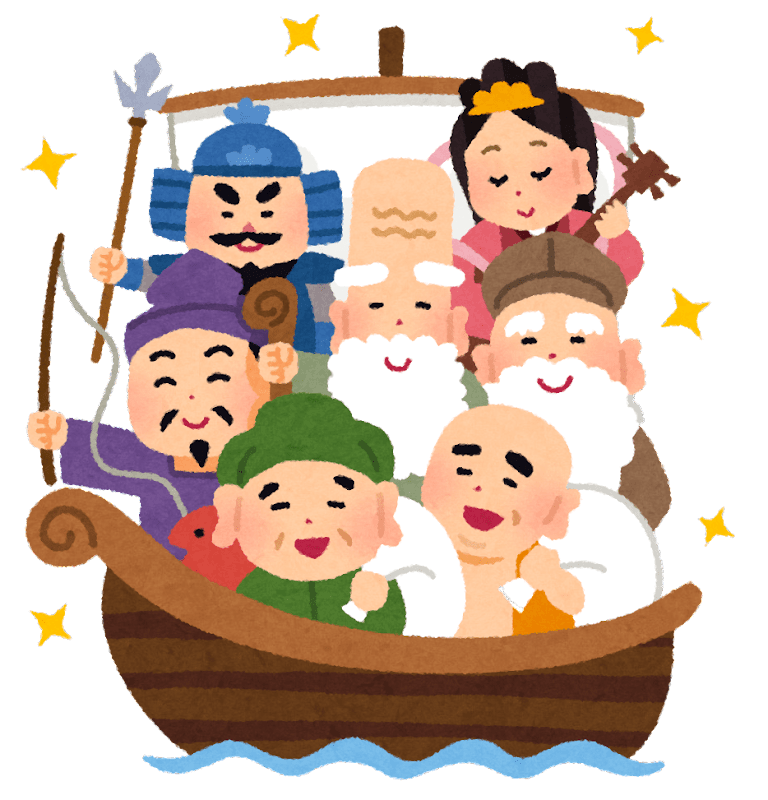
The Seven Lucky Gods will take away the bad fortune brought by a nightmare.
The Seven Lucky Gods in their Treasure Ship. (Illustration courtesy of irasutoya.)

Don’t worry, there’s a solution. 

Upon awakening, draw a picture of the Treasure Ship bearing the Seven Lucky Gods, and set it adrift upon a stream. The image will drift away, carrying your bad fortune with it.

References:

https://jpnculture.net/hatsuyume/, https://kotowaza-dictionary.jp/k0964/, https://boxil.jp/beyond/a5493/


If you have questions about Japan or suggestions for articles, please add them in the comments. For more photos and information on Japan, follow me on instagram at: https://www.instagram.com/more_than_tokyo/

Dreams Eggplant Hawks Japan Japanese culture Japanese Language Mount Fuji New Year Shinto
Share
Write Comment
Leave a Reply Cancel reply

Your email address will not be published. Required fields are marked *

This site uses Akismet to reduce spam. Learn how your comment data is processed.

Previous Post

Takkoku Seikoji Temple, One of Iwate Prefecture’s Hidden Treasures

Next Post

Kagami-Biraki, Opening the Rice Cakes for a Prosperous and Healthy Year

If you enjoy my work and would like to help me continue creating, consider supporting me.

Thank you!
PayPal - The safer, easier way to pay online!
Newsletter

Subscribe

Enter your email for notifications of our latest posts

Tags
architecture Buddhism Christianity Edo Era elderly festivals folklore Food Ghosts gratitude Haunting Hiking history holidays honesty Japan Japanese Japanese cuisine Japanese culture Japanese Customs Japanese Food Japanese History Japanese Language Japanese words that English needs Japan Tips Japan travel Japan Travel Tips Jizō Kagoshima Kōyō Living in Japan longevity Manners Nature New Year Ninja Samurai Shinto shogun Shrine Tips Trade Travel volcano Washoku
Featured Posts
History Religion

The Shimabara Rebellion—The Last Stand of Japan’s Christians

July 8, 2026
History

The Okamoto Daihachi Affair—The Scandal That Turned the Tide Against Christianity in Japan

July 6, 2026
History

The 47 Ronin—Disgrace, Revenge, and Death

June 23, 2026
Destinations Folklore Ghosts

Omatsu Daigongen—The Amazing Cat Temple of Shikoku

June 1, 2026
History

Oura Kei—Unstoppable Pioneering Tea Merchant

January 19, 2026
Most Popular

Shinto — The Peaceful Spiritual Heart of Japan

Shinto gate Lake Biwa

Komorebi—A Beautiful Japanese Word that English Needs

Nakasendo Way

Dondoyaki—Burning New Year’s Decorations to Send off the God of the New Year

Dondoyaki fire

The Jizo Statues of Nashi-no-Ki—1,000s of Unique Offerings of Thanks

Jizo statues at Nashi no Jizo, Sado.

Sugawara no Michizane —Japan’s Three Most Infamous Vengeful Ghosts, part 3

Sugawara Michizane
You might also like
Nakasendo Way
Nature Language

Komorebi—A Beautiful Japanese Word that English Needs

1 Min read
November 11, 2021
temple pagoda
Culture Living in Japan

Death in Japan

8 Mins read
March 22, 2022
Elephant by Kano Furunobu
History

The Incredible Tale of the Elephant Who Had an Audience with the Japanese Emperor

7 Mins read
April 6, 2022
Exploring the wonders of rural Japan
Exploring the Wonders of Rural Japan
  • Home
  • About
  • Recommended Books
  • Interview
  • Privacy Policy
Exploring the Wonders of Rural Japan
  • Home
  • About
  • Discover
    • History
    • Culture
    • Nature
    • Food
    • Living in Japan
    • Destinations
    • Language
    • Tips
  • Interview
  • Recommended Books
We use cookies on our website to give you the most relevant experience by remembering your preferences and repeat visits. By clicking “Accept”, you consent to the use of ALL the cookies.
Do not sell my personal information.
Cookie SettingsAccept
Manage consent

Privacy Overview

This website uses cookies to improve your experience while you navigate through the website. Out of these, the cookies that are categorized as necessary are stored on your browser as they are essential for the working of basic functionalities of the website. We also use third-party cookies that help us analyze and understand how you use this website. These cookies will be stored in your browser only with your consent. You also have the option to opt-out of these cookies. But opting out of some of these cookies may affect your browsing experience.
Necessary
Always Enabled
Necessary cookies are absolutely essential for the website to function properly. These cookies ensure basic functionalities and security features of the website, anonymously.
CookieDurationDescription
cookielawinfo-checkbox-analytics11 monthsThis cookie is set by GDPR Cookie Consent plugin. The cookie is used to store the user consent for the cookies in the category "Analytics".
cookielawinfo-checkbox-functional11 monthsThe cookie is set by GDPR cookie consent to record the user consent for the cookies in the category "Functional".
cookielawinfo-checkbox-necessary11 monthsThis cookie is set by GDPR Cookie Consent plugin. The cookies is used to store the user consent for the cookies in the category "Necessary".
cookielawinfo-checkbox-others11 monthsThis cookie is set by GDPR Cookie Consent plugin. The cookie is used to store the user consent for the cookies in the category "Other.
cookielawinfo-checkbox-performance11 monthsThis cookie is set by GDPR Cookie Consent plugin. The cookie is used to store the user consent for the cookies in the category "Performance".
viewed_cookie_policy11 monthsThe cookie is set by the GDPR Cookie Consent plugin and is used to store whether or not user has consented to the use of cookies. It does not store any personal data.
Functional
Functional cookies help to perform certain functionalities like sharing the content of the website on social media platforms, collect feedbacks, and other third-party features.
Performance
Performance cookies are used to understand and analyze the key performance indexes of the website which helps in delivering a better user experience for the visitors.
Analytics
Analytical cookies are used to understand how visitors interact with the website. These cookies help provide information on metrics the number of visitors, bounce rate, traffic source, etc.
Advertisement
Advertisement cookies are used to provide visitors with relevant ads and marketing campaigns. These cookies track visitors across websites and collect information to provide customized ads.
Others
Other uncategorized cookies are those that are being analyzed and have not been classified into a category as yet.
SAVE & ACCEPT