

• Home
  • About
  • Discover
    • History
    • Culture
    • Nature
    • Food
    • Living in Japan
    • Destinations
    • Language
    • Tips
  • Interview
  • Recommended Books
Exploring the Wonders of Rural Japan
Culture Folklore Food

Kagami-Biraki, Opening the Rice Cakes for a Prosperous and Healthy Year

Blessings from the God of the New Year
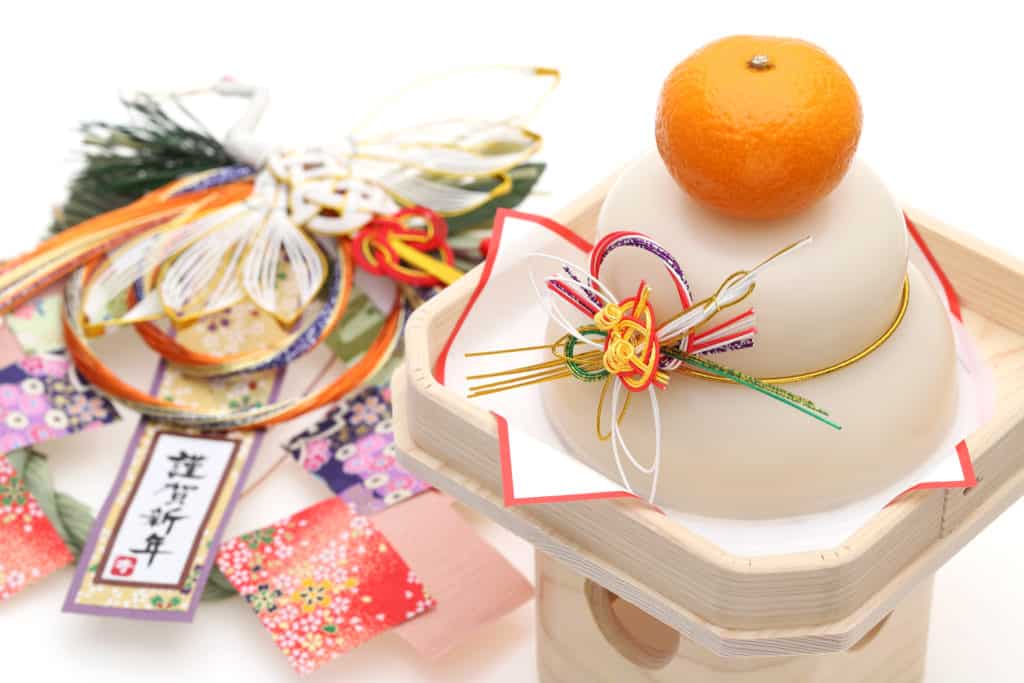
Japanese New Year's decorations, including kagami mochi which will be broken and eaten.
Kagami mochi and New Year’s decorations. (Depositphotos)

Kagami-biraki refers to the Japanese practice of cracking open the hard, dried kagami mochi at the end of the New Year’s holidays, as well as the opening of sake barrels at celebratory events.

Kagami mochi, “Mirror rice cakes”

During Japan’s New Year’s holidays, people display half spheres of mochi, pounded rice cakes, called kagami mochi, “mirror rice cakes.” Two rounded cakes are placed on a wooden offering stand, a smaller cake stacked upon a larger, and topped with a daidai, Japanese bitter orange.

These may look like mere festive decorations, but they play an important role in New Year’s traditions. They are where the Toshi-kami, the God of the New Year, stays during his holiday visit. Kagami mochi also hold symbolic meaning.

Kagami means mirror. This name could have been given due to the shape of the mochi which resembles the round mirrors used for centuries in Japan, or it could be an allusion to Amaterasu’s mirror, one of Japan’s Three Imperial Treasures.

Mirrors are deeply significant in the Shinto religion. They reflect the spirit of Kami, the all-encompassing life force deity, and are often found in shrine sanctuaries.

On top of the “mirror mochi” is a daidai, bitter orange. Daidai is a homonym for “generations.” Much like the many symbolisms of New Year’s osechi-ryori foods, the daidai‘s use on the top of the kagami-mochi represents a prayer for the family’s continuance from generation to generation.

The visit of the Toshi-kami, the God of the New Year
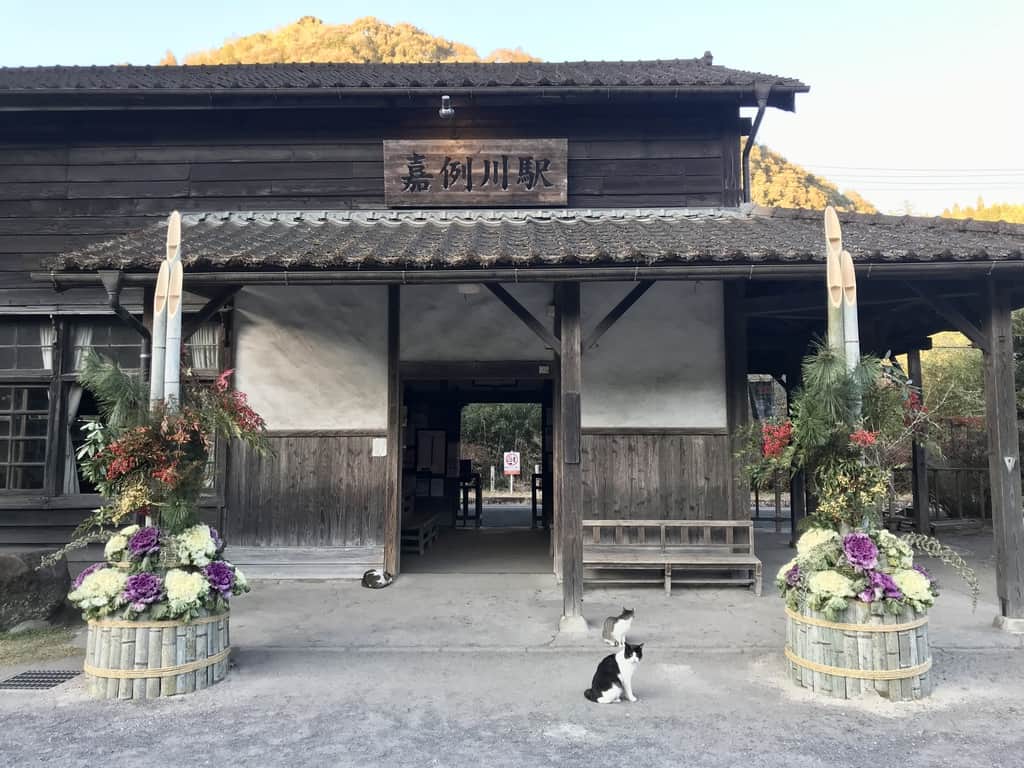
Kadomatsu on either side of the entrance to an ancient train station, with cats.
Kadomatsu, pine decorations, in front of Kareigawa Station, Kagoshima. (©Diane Tincher)

The Toshi-kami is first welcomed into households through the kadomatsu, pine and bamboo decorations that adorn both sides of the front door. The Toshi-kami is not only the god who brings blessings and bountiful harvests in the new year, but he merges with the collective spirit of a household’s ancestors, the sorei, who visits the family at this time.

The period during which the Toshi-kami visits over the new year’s holidays is called Matsu no Uchi, 松の内, “within the pines.”

Burning the kadomatsu
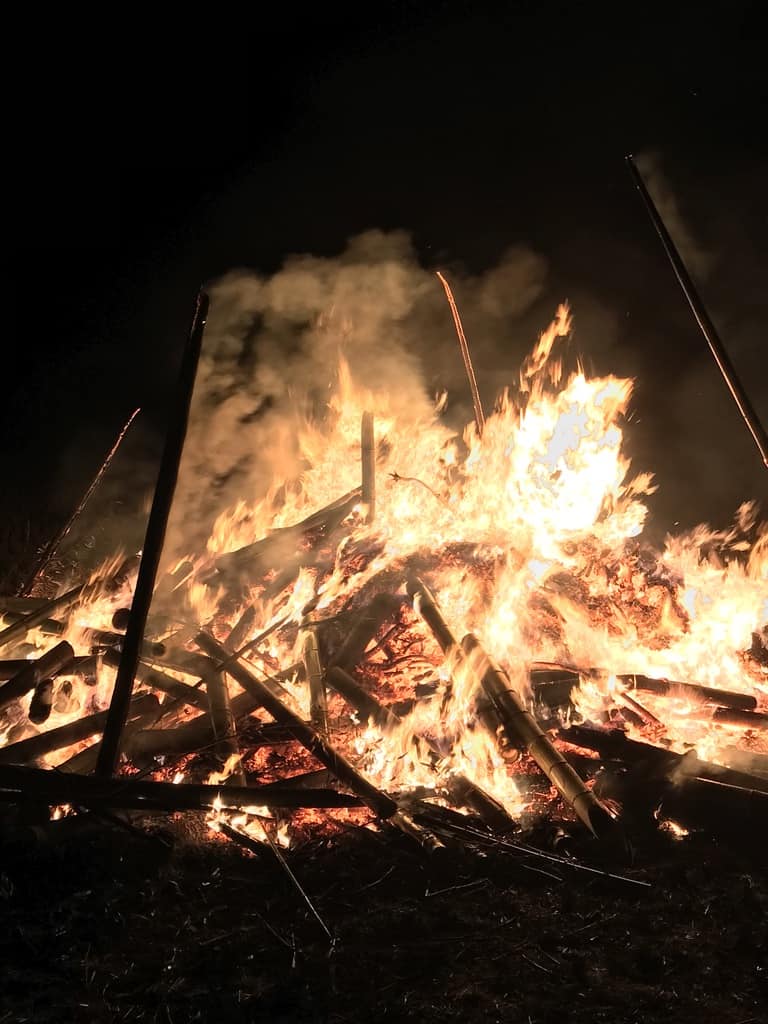
Blazing bonfire in a rice field.
Burning New Year’s decorations and bamboo, Kagoshima. (©Diane Tincher)

At the end of the Matsu no Uchi, New Year’s decorations are burned, sending the Toshi-kami back to the realm of the spirits. 

After the Great Meireki Fire of 1657 that destroyed approximately 60% of Edo (now Tokyo), in addition to other fire preventative measures, the shogun shortened Matsu no Uchi so that the flammable pine decorations would be disposed of sooner. He declared that from henceforth, Matsu no Uchi would end on the seventh day of the first month.

Eating kagami-mochi

Shortly after the kadomatsu are burned, generally around January 11 depending on local customs, the now dried and cracked kagami-mochi is broken into pieces, added to soups or roasted, and eaten by family and friends. This custom is called kagami-biraki, 鏡開き, opening the rice cakes. 

By eating the mochi that has been home to the Toshi-kami, people are imbued with spiritual power and blessings for a safe, healthy year.

How the mochi is broken is important, though.

In the age of the samurai, from the 14th to the 19th centuries, it was considered an ill omen to cut the rice cake with a blade as it evoked the image of seppuku, the samurai’s noble suicide, so a wooden hammer was used to break the hard rice cakes.

This method of breaking the rice cakes continues to this day, although the word waru 割る, to split or break, is not used because it is felt to bode evil. Instead, the Japanese use the more positive word hiraku 開く, to open, considered a more auspicious description.

A WORD ABOUT JAPANESE: The verb hiraku takes the ending “i,” hiraki, when used in its noun form, and the first letter changes to “b,” biraki, when joined to another word. For more on the intricacies of the Japanese language, see my article, “Why is Learning Japanese So Hard?”

Another kagami-biraki
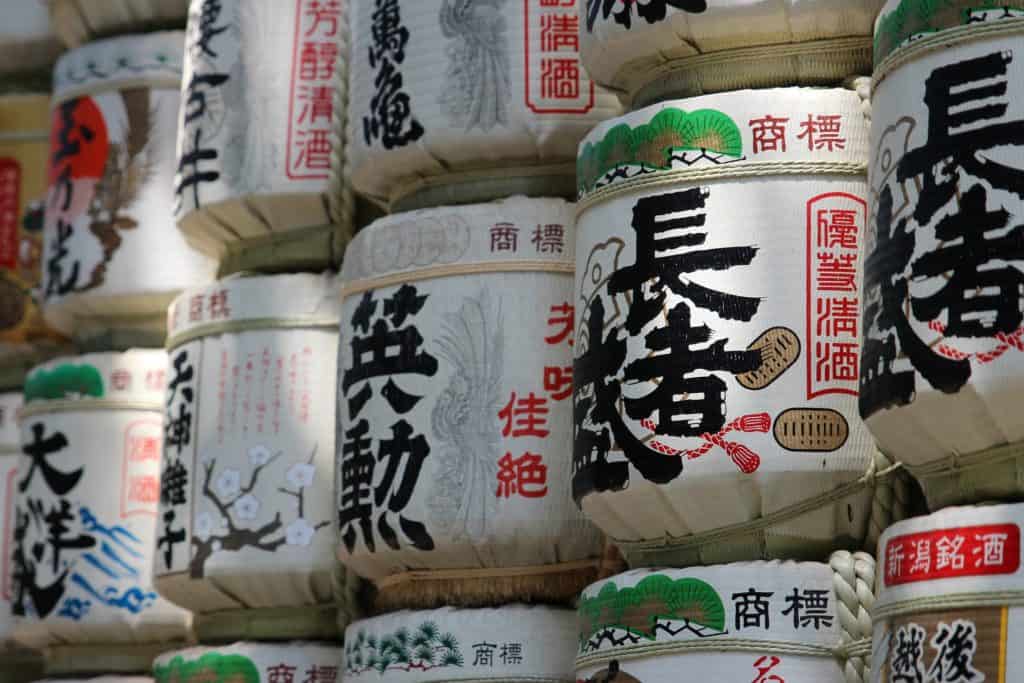
Another kagami-biraki is when sake casks are broken open in celebration. These sake casks are offered at a shrine.
Sake casks. (Samuele Schirò via Pixabay. No attribution required.)

Since ancient times, sake has been offered to the kami, or deity, when performing Shinto rituals. Afterward, the attendees and the priest drink sake together and pray for the fulfillment of their prayers. 

This sharing of sake is another type of kagami-biraki. The round wooden lids of sake casks, called kagami 鏡, are cracked open, hiraki 開き, with a wooden mallet and their contents shared. In this case, kagami takes on the meaning of harmony, and hiraki, of prosperity.

The practice of kagami-biraki by opening sake casks has since spread and has become part of many celebrations that mark new beginnings, such as weddings, the start of the new season for martial arts studios or sports teams, and the official opening of new businesses.

A similar custom, kura-biraki 蔵開き, opening store rooms, started in ages past when feudal lords and merchants would celebrate the opening of their storage rooms for the new year, and share sake and rice cakes with their subordinates and customers. 

Kagami-biraki is a celebratory event, whether referring to the cracking open of the New Year’s kagami mochi and being imbued with the spirit of the Toshi-kami, or cracking the lid of a 72-liter sake cask and having a grand time drinking it with your community.

https://www.gekkeikan.co.jp/enjoy/qa/sake/sake06.html, https://www.jalan.net/news/article/500808/, The Essence of Shinto,* by Motohisa Yamakage

*affiliate link


If you have questions about Japan or suggestions for articles, please add them in the comments. For more photos and information on Japan, follow me on instagram at: https://www.instagram.com/more_than_tokyo/

Japan Japanese culture Japanese Customs Japanese History Japanese Language Kagami biraki Kagami mochi New Year's Oshogatsu Shinto
Share
Write Comment
Leave a Reply Cancel reply

Your email address will not be published. Required fields are marked *

This site uses Akismet to reduce spam. Learn how your comment data is processed.

Previous Post

For a Healthy Happy Year, Dream of Mount Fuji, Hawks, or Eggplants

Next Post

The Japanese Phenomenon of Kentucky Fried Chicken for Christmas

If you enjoy my work and would like to help me continue creating, consider supporting me.

Thank you!
PayPal - The safer, easier way to pay online!
Newsletter

Subscribe

Enter your email for notifications of our latest posts

Tags
architecture Buddhism Christianity Edo Era elderly festivals folklore Food Ghosts gratitude Haunting Hiking history holidays honesty Japan Japanese Japanese cuisine Japanese culture Japanese Customs Japanese Food Japanese History Japanese Language Japanese words that English needs Japan Tips Japan travel Japan Travel Tips Jizō Kagoshima Kōyō Living in Japan longevity Manners Nature New Year Ninja Samurai Shinto shogun Shrine Tips Trade Travel volcano Washoku
Featured Posts
History Religion

The Shimabara Rebellion—The Last Stand of Japan’s Christians

July 8, 2026
History

The Okamoto Daihachi Affair—The Scandal That Turned the Tide Against Christianity in Japan

July 6, 2026
History

The 47 Ronin—Disgrace, Revenge, and Death

June 23, 2026
Destinations Folklore Ghosts

Omatsu Daigongen—The Amazing Cat Temple of Shikoku

June 1, 2026
History

Oura Kei—Unstoppable Pioneering Tea Merchant

January 19, 2026
Most Popular

Shinto — The Peaceful Spiritual Heart of Japan

Shinto gate Lake Biwa

Komorebi—A Beautiful Japanese Word that English Needs

Nakasendo Way

Dondoyaki—Burning New Year’s Decorations to Send off the God of the New Year

Dondoyaki fire

The Jizo Statues of Nashi-no-Ki—1,000s of Unique Offerings of Thanks

Jizo statues at Nashi no Jizo, Sado.

Sugawara no Michizane —Japan’s Three Most Infamous Vengeful Ghosts, part 3

Sugawara Michizane
You might also like
Nakasendo Way
Nature Language

Komorebi—A Beautiful Japanese Word that English Needs

1 Min read
November 11, 2021
temple pagoda
Culture Living in Japan

Death in Japan

8 Mins read
March 22, 2022
Elephant by Kano Furunobu
History

The Incredible Tale of the Elephant Who Had an Audience with the Japanese Emperor

7 Mins read
April 6, 2022
Exploring the wonders of rural Japan
Exploring the Wonders of Rural Japan
  • Home
  • About
  • Recommended Books
  • Interview
  • Privacy Policy
Exploring the Wonders of Rural Japan
  • Home
  • About
  • Discover
    • History
    • Culture
    • Nature
    • Food
    • Living in Japan
    • Destinations
    • Language
    • Tips
  • Interview
  • Recommended Books
We use cookies on our website to give you the most relevant experience by remembering your preferences and repeat visits. By clicking “Accept”, you consent to the use of ALL the cookies.
Do not sell my personal information.
Cookie SettingsAccept
Manage consent

Privacy Overview

This website uses cookies to improve your experience while you navigate through the website. Out of these, the cookies that are categorized as necessary are stored on your browser as they are essential for the working of basic functionalities of the website. We also use third-party cookies that help us analyze and understand how you use this website. These cookies will be stored in your browser only with your consent. You also have the option to opt-out of these cookies. But opting out of some of these cookies may affect your browsing experience.
Necessary
Always Enabled
Necessary cookies are absolutely essential for the website to function properly. These cookies ensure basic functionalities and security features of the website, anonymously.
CookieDurationDescription
cookielawinfo-checkbox-analytics11 monthsThis cookie is set by GDPR Cookie Consent plugin. The cookie is used to store the user consent for the cookies in the category "Analytics".
cookielawinfo-checkbox-functional11 monthsThe cookie is set by GDPR cookie consent to record the user consent for the cookies in the category "Functional".
cookielawinfo-checkbox-necessary11 monthsThis cookie is set by GDPR Cookie Consent plugin. The cookies is used to store the user consent for the cookies in the category "Necessary".
cookielawinfo-checkbox-others11 monthsThis cookie is set by GDPR Cookie Consent plugin. The cookie is used to store the user consent for the cookies in the category "Other.
cookielawinfo-checkbox-performance11 monthsThis cookie is set by GDPR Cookie Consent plugin. The cookie is used to store the user consent for the cookies in the category "Performance".
viewed_cookie_policy11 monthsThe cookie is set by the GDPR Cookie Consent plugin and is used to store whether or not user has consented to the use of cookies. It does not store any personal data.
Functional
Functional cookies help to perform certain functionalities like sharing the content of the website on social media platforms, collect feedbacks, and other third-party features.
Performance
Performance cookies are used to understand and analyze the key performance indexes of the website which helps in delivering a better user experience for the visitors.
Analytics
Analytical cookies are used to understand how visitors interact with the website. These cookies help provide information on metrics the number of visitors, bounce rate, traffic source, etc.
Advertisement
Advertisement cookies are used to provide visitors with relevant ads and marketing campaigns. These cookies track visitors across websites and collect information to provide customized ads.
Others
Other uncategorized cookies are those that are being analyzed and have not been classified into a category as yet.
SAVE & ACCEPT