

• Home
  • About
  • Discover
    • History
    • Culture
    • Nature
    • Food
    • Living in Japan
    • Destinations
    • Language
    • Tips
  • Interview
  • Recommended Books
Exploring the Wonders of Rural Japan
Nature Destinations History Living in Japan

Living in the Shade of Sakurajima—The Most Active Volcano in Japan

Where ash-fall is an everyday occurrence

Have you ever imagined living next to—or even on—an active volcano? For the people of Kagoshima, Japan, this is part of daily life.

Sakurajima is an active stratovolcano four kilometers across Kagoshima Bay from downtown Kagoshima City, in southern Japan. Although its name means “cherry blossom island,” it is no longer an island as a result of a major eruption in 1914.
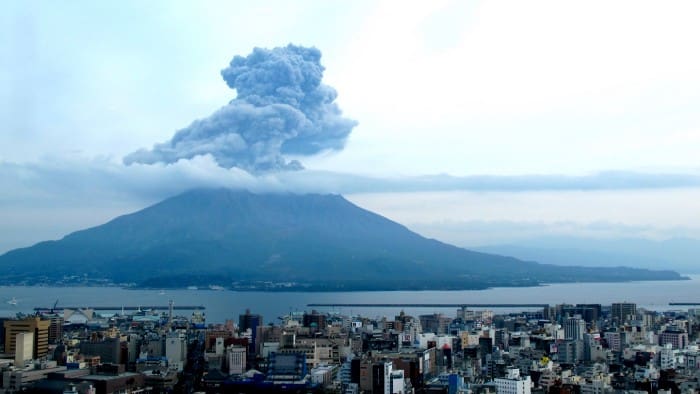
Sakurajima volcano erupting
Sakurajima is situated across Kagoshima Bay from Kagoshima City.

Sakurajima is one of the most active volcanoes in the world. Between 2009 and 2015, it averaged more than 1,000 eruptions each year. In 2020, it calmed down to a reasonable—for local residents—432 eruptions.
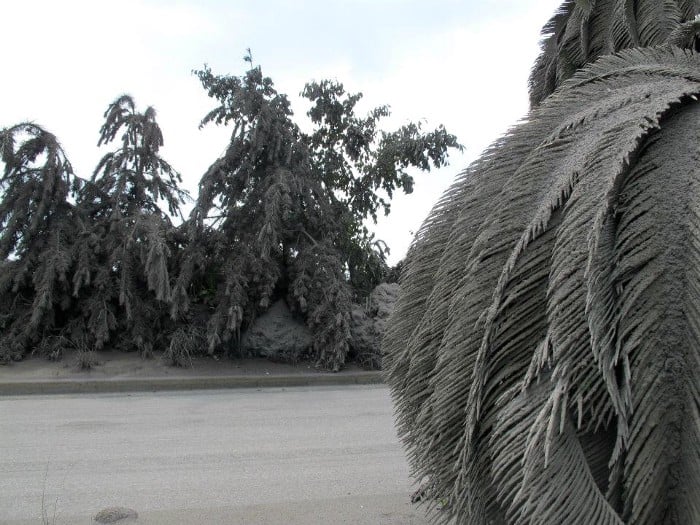
Ash covers trees after the Sakurajima volcano erupted
Color photo taken on Sakurajima in 2012. The trees are heavy with ash.

Despite its frequent eruptions, Sakurajima has been inhabited since ancient times. Archaeologists have uncovered shell heaps—piles of discarded shells and food waste—dating back to the Jomon Era (14,000–600 BC in southern Kyushu), evidence of early human settlement.

Before the major eruption of 1914, more than 20,000 people lived on Sakurajima. Today, that number has declined to around 4,000, largely due to Japan’s shrinking population, a trend that most severely affects rural areas. Fewer than 100 elementary school children live on the volcano. They wear helmets to and from school to protect themselves from falling ash and pumice.

Residents of Kagoshima City sweep volcanic ash from streets and sidewalks daily. The ash is put in yellow ash bags provided by the government and placed at designated collection centers in each neighborhood.

A low-cost ferry runs every 15 minutes between Sakurajima and downtown Kagoshima, making the 10-minute trip easy and convenient. For Sakurajima residents, access to higher education, jobs, shopping, and restaurants in the city is always within reach.
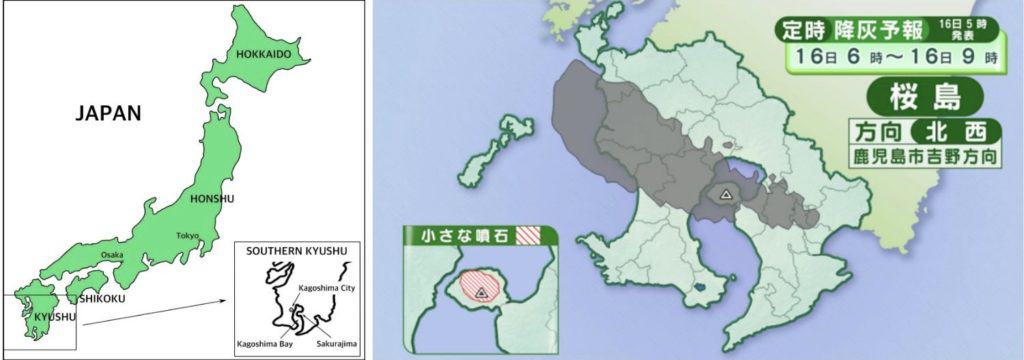
60718C71 40B1 4D84 9B3A 3F1C4769B7E7 1 201 a
LEFT: LOCATION OF KAGOSHIMA IN RELATION TO THE FOUR MAIN ISLANDS OF JAPAN. RIGHT: FROM THE MBC WEATHER WEB PAGE FOR JUNE 16, 2021, 6:00 TO 9:00. THE GRAY SHOWS THE PREDICTED AREA OF ASHFALL; THE RED STRIPED AREA SHOWS WHERE SMALL VOLCANIC ROCKS ARE LIKELY TO FALL.

Living with ashfall

Each morning, Kagoshima residents check the weather report—not just for rain or sunshine, but to see the predicted areas of ashfall. This daily habit helps them decide whether to open windows, hang out laundry, or wash their cars. In my experience, washing the car all but guarantees ash the next day.

When ashfall is heavy, cars use windshield wipers and people wear masks and carry umbrellas to shield themselves. Sweeping up ash is part of life—as normal as washing laundry.
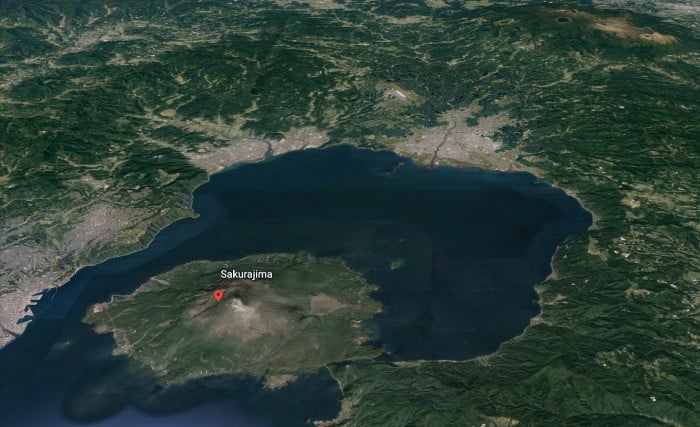
Sakurajima volcano as seen on Google Earth.
Sakurajima is on the southern rim of the Aira Caldera, now under Kagoshima Bay. The Kirishima volcanoes are visible in the upper right-hand corner. (Google Earth)

Geology

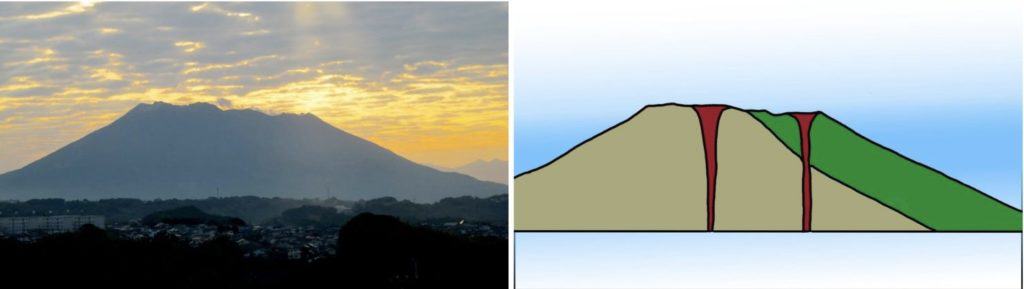
Sakurajima is actually two volcanoes that formed side by side along a north-south axis. It sits on the southern rim of the Aira Caldera, the vast remains of a supervolcano that erupted approximately 30,000 years ago.

That ancient eruption left a lasting mark on the region. It produced the deep layer of white, pumice-rich soil known as shirasu, which covers much of southern Kyushu. The massive release of magma caused the ground to collapse, forming the Aira Caldera. Seawater rushed in, filling the depression and creating what is now the northern half of Kagoshima Bay. Underneath the bay is a large magma chamber that feeds Sakurajima and is responsible for its ongoing volcanic activity.
F5B47A30 ABB6 4E85 BC45 E831FEC45A5F 1 201 a
Sakurajima is two volcanoes that have grown into one.

The northern peak (to the left in the pictures) is the oldest and is inactive. Over time, erosion from this peak created a fertile alluvial fan on the volcano’s eastern side. This well-drained soil supports the cultivation of Sakurajima’s famous agricultural products: the world’s largest radishes and the world’s smallest oranges.

The southern peak, by contrast, is younger and still active. It is from this side that ash, gas, and pumice regularly spew.
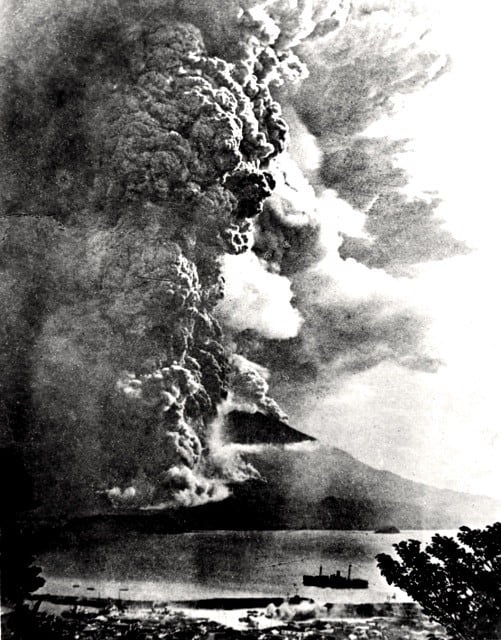
A large volcanic eruption occurred in 1914, connecting the volcano to the mainland.
Taisho eruption as seen from Kagoshima City. (public domain)

Taisho Eruption, 1914–1915

On January 10, 1914, Sakurajima and the surrounding areas were shaken by four strong earthquakes. The next day, 250 smaller quakes occurred. The 23,000 people who lived on the island literally felt what was coming. Using whatever boats they could get their hands on, the islanders worked together to evacuate themselves and their farm animals safely to Kagoshima City. The Imperial Navy provided more ships the next day.

At 10:05 on January 12, a fissure opened halfway up the southwestern flank of the volcano facing the city across the bay. Ash, pumice stone, and gas thundered out horizontally, then shifted to spiraling upwards. The roar of this explosion was heard all across the islands of Kyushu and Shikoku. This eruption was soon joined by another opening on the eastern flank of the volcano, violently ejecting ash and gas.

By 11:00, these two plumes had risen five to eight kilometers into the atmosphere, and within days the ashfall had reached all of Kyushu, and as far away as Osaka, Tokyo, and even the Bonin Islands, more than 1,000 kilometers southeast of Kyushu.

On the night of January 12, a 7.1 magnitude earthquake occurred, centered beneath Kagoshima Bay. This quake broke the seismograph in Kagoshima City, collapsed houses, caused a tsunami, and killed 35 people. Ash and pumice continued falling.
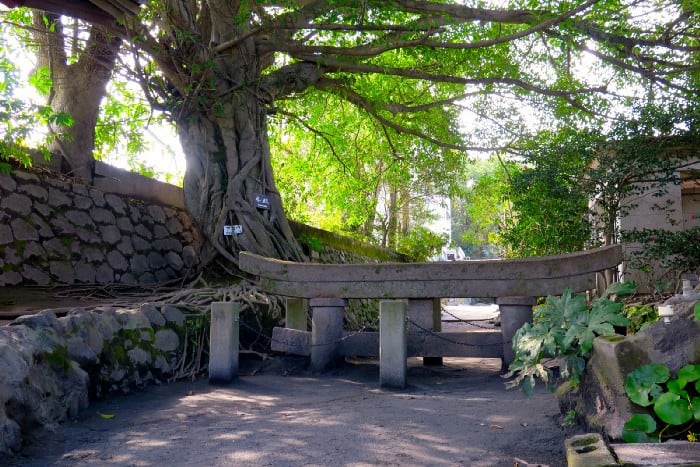
Buried torii gate on Sakurajima
Kurokami Torii gate, on the east side of Sakurajima, buried under two meters of ash from the Taisho eruption.

Yet another large earthquake occurred on January 13, bringing with it lava flowing from both east and west vents. Along with continued ash and pumice eruptions, lava flowed for months, burying fields and villages, shallowing Kagoshima Bay, and covering nearby islands.

As the flow continued, parts of the bay heated to more than 750°C, cooking fish and other sea life. Rafts of pumice stones intermingled with dead sea creatures bobbed on the surface and washed up on the shore.

By January 13, the people of Kagoshima City had also been evacuated. Aid came from the Japanese government and other nations. The destruction that was caused by the volcano was significant, although few lives were lost.

Through the months of ash and pumice fall, large areas of farmland were buried, thousands of buildings were destroyed, and people’s livelihoods were shattered.

With the wind blowing from the west, houses on the Osumi peninsula, east of the volcano, were buried up to the roofs in ash. Many houses in Kagoshima City to the west that had survived the 7.1 magnitude earthquake, collapsed under the weight of the ashfall.
DB2B9474 ED39 4BB4 AF29 D0D450996AE8 1 201 a
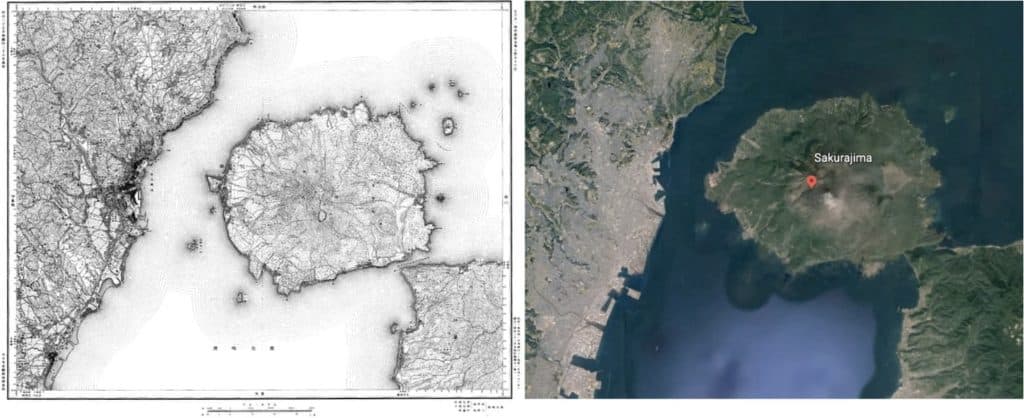
Left: 1909 map of Sakurajima by the Imperial Japanese Land Survey, based on survey data taken in 1902. (©Ministry of Land, Infrastructure, Transport, and Tourism. Used with permission.) Right: Sakurajima today. The land bridge on the west and the increased land area on the east from the Taisho lava flows are clearly visible. (Google Earth)

By early April 1914, Sakurajima was no longer an island. The lava flow had filled in the Seto Straight that had divided Sakurajima from the Osumi peninsula, connecting the island to the mainland.

Eruptions continued sporadically, decreasing in frequency over the next year. By November 1915, the volcano was quiet. The residents of Sakurajima were provided with money by the government, and more than half of them returned to their ancestral homes.

After the eruption subsided, it was discovered that the entire area had sunk about 60 centimeters—in some places, as much as a meter. The lava that had been stored under the bay in the magma chamber of the Aira caldera had been released and the land above it sunk.

Preparing for the next big eruption

About ten kilometers beneath the bay, the once-emptied magma chamber has been slowly refilling. Today, researchers monitoring the volcano report that the amount of accumulated magma is roughly equal to what had built up before the 1914 eruption. They predict that an eruption of similar scale could occur by 2030.

Knowing the inevitability of future devastating eruptions, local and national governments have taken steps to try to lessen their impact and improve early warning capabilities.
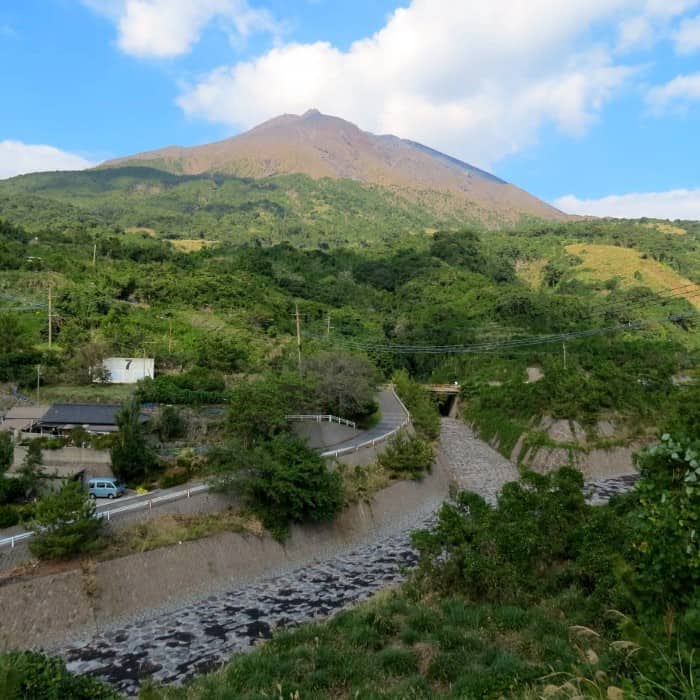
Canals have been built on the slopes of the Sakurajima volcano.
Canal built on the southern slope of Sakurajima. (Photo by Rose.)

Canals for channeling mudslides and lava have been built on the slopes of Sakurajima, and each January, evacuation drills are held for the entire population.

The tiniest rumblings, changes in the volume of the magma pool, and increases in the size of the volcano are carefully monitored by high-tech equipment on Sakurajima. The data is analyzed by specialists in Kagoshima and at Kyoto and Tohoku Universities, and appropriate warning levels are announced.

How would you feel about living on or near an active volcano?

All photos ©Diane Tincher unless otherwise specified.

Sources:

Sakurajima eruption data, population statistics, Taisho eruption, more on the Taisho eruption, geology, general information from Sakurajima Visitors’ Center, and 26 years of living in Kagoshima City.


If you have questions about Japan or suggestions for articles, please add them in the comments. For more photos and information on Japan, follow me on instagram at: https://www.instagram.com/more_than_tokyo/

ashfall geology Japan Japan travel Japanese History kagoshima bay kagoshima city sakurajima volcano
Share
4 Comments
  1. Mike

    May 2, 2022 7:03 pm

    >>The fewer than 100 elementary school children who live on the volcano wear helmets for protection from falling pumice and ash as they walk to and from school.<<

    Please pardon the tangent.

    How much of a risk is the pumice?

    Reply
    1. Diane Tincher

      May 3, 2022 10:21 am

      When there is a big eruption, falling pumice and rock can kill and destroy. During the normal, everyday eruptions, it’s not such a worry.

      Several of my adult students lived on Sakurajima as children, before helmet wearing was required. They used to enjoy going outside during eruptions with pots and pans on their heads. The clunking sound of the volcanic pebbles falling on their pots was apparently a fun thing to experience.

      Reply
  2. Bob Bello

    December 19, 2023 12:24 am

    Thanks for the great article! I’m writing a story about Satsuma in 1619, and I have a question. Do you know how many people lived on Sakurajima Island when the warlord Yoshihiro Shimazu retired there in the local shrine? Wikipedia only mentions this fact and nothing else. Was there a city or a village at the time (since the strongest eruption was in 1471-1476 and the majority was evacuated), or was there just a shrine/monastery of monks? Or do you know of any website that has such information about Sakurajuma before the 1914 eruption, when it stopped being an island? Thanks!

    Reply
    1. Diane Tincher

      December 23, 2023 4:15 pm

      I cannot answer your question with certainty, but I would think that plenty of people were living on Sakurajima in 1619. After the tremendous eruption of 1914, people returned to their ancestral homes on the volcano and went on with their lives.

      I checked with a historian, and she said that population records were not kept in those days. The earliest record I can find is from 1871 when 11,429 people lived on Sakurajima.

      Reply
Leave a Reply Cancel reply

Your email address will not be published. Required fields are marked *

This site uses Akismet to reduce spam. Learn how your comment data is processed.

Previous Post

Ta no Kami—Japan’s Rice Field God Statues offer a Remarkable Window into the Past

Next Post

Surprising Secrets of Iconic Japanese Inari Shrines

If you enjoy my work and would like to help me continue creating, consider supporting me.

Thank you!
PayPal - The safer, easier way to pay online!
Newsletter

Subscribe

Enter your email for notifications of our latest posts

Tags
architecture Buddhism Christianity Edo Era elderly festivals folklore Food Ghosts gratitude Haunting Hiking history holidays honesty Japan Japanese Japanese cuisine Japanese culture Japanese Customs Japanese Food Japanese History Japanese Language Japanese words that English needs Japan Tips Japan travel Japan Travel Tips Jizō Kagoshima Kōyō Living in Japan longevity Manners Nature New Year Ninja Samurai Shinto shogun Shrine Tips Trade Travel volcano Washoku
Featured Posts
History Religion

The Shimabara Rebellion—The Last Stand of Japan’s Christians

July 8, 2026
History

The Okamoto Daihachi Affair—The Scandal That Turned the Tide Against Christianity in Japan

July 6, 2026
History

The 47 Ronin—Disgrace, Revenge, and Death

June 23, 2026
Destinations Folklore Ghosts

Omatsu Daigongen—The Amazing Cat Temple of Shikoku

June 1, 2026
History

Oura Kei—Unstoppable Pioneering Tea Merchant

January 19, 2026
Most Popular

Shinto — The Peaceful Spiritual Heart of Japan

Shinto gate Lake Biwa

Komorebi—A Beautiful Japanese Word that English Needs

Nakasendo Way

Dondoyaki—Burning New Year’s Decorations to Send off the God of the New Year

Dondoyaki fire

The Jizo Statues of Nashi-no-Ki—1,000s of Unique Offerings of Thanks

Jizo statues at Nashi no Jizo, Sado.

Sugawara no Michizane —Japan’s Three Most Infamous Vengeful Ghosts, part 3

Sugawara Michizane
You might also like
Nakasendo Way
Nature Language

Komorebi—A Beautiful Japanese Word that English Needs

1 Min read
November 11, 2021
temple pagoda
Culture Living in Japan

Death in Japan

8 Mins read
March 22, 2022
Elephant by Kano Furunobu
History

The Incredible Tale of the Elephant Who Had an Audience with the Japanese Emperor

7 Mins read
April 6, 2022
Exploring the wonders of rural Japan
Exploring the Wonders of Rural Japan
  • Home
  • About
  • Recommended Books
  • Interview
  • Privacy Policy
Exploring the Wonders of Rural Japan
  • Home
  • About
  • Discover
    • History
    • Culture
    • Nature
    • Food
    • Living in Japan
    • Destinations
    • Language
    • Tips
  • Interview
  • Recommended Books
We use cookies on our website to give you the most relevant experience by remembering your preferences and repeat visits. By clicking “Accept”, you consent to the use of ALL the cookies.
Do not sell my personal information.
Cookie SettingsAccept
Manage consent

Privacy Overview

This website uses cookies to improve your experience while you navigate through the website. Out of these, the cookies that are categorized as necessary are stored on your browser as they are essential for the working of basic functionalities of the website. We also use third-party cookies that help us analyze and understand how you use this website. These cookies will be stored in your browser only with your consent. You also have the option to opt-out of these cookies. But opting out of some of these cookies may affect your browsing experience.
Necessary
Always Enabled
Necessary cookies are absolutely essential for the website to function properly. These cookies ensure basic functionalities and security features of the website, anonymously.
CookieDurationDescription
cookielawinfo-checkbox-analytics11 monthsThis cookie is set by GDPR Cookie Consent plugin. The cookie is used to store the user consent for the cookies in the category "Analytics".
cookielawinfo-checkbox-functional11 monthsThe cookie is set by GDPR cookie consent to record the user consent for the cookies in the category "Functional".
cookielawinfo-checkbox-necessary11 monthsThis cookie is set by GDPR Cookie Consent plugin. The cookies is used to store the user consent for the cookies in the category "Necessary".
cookielawinfo-checkbox-others11 monthsThis cookie is set by GDPR Cookie Consent plugin. The cookie is used to store the user consent for the cookies in the category "Other.
cookielawinfo-checkbox-performance11 monthsThis cookie is set by GDPR Cookie Consent plugin. The cookie is used to store the user consent for the cookies in the category "Performance".
viewed_cookie_policy11 monthsThe cookie is set by the GDPR Cookie Consent plugin and is used to store whether or not user has consented to the use of cookies. It does not store any personal data.
Functional
Functional cookies help to perform certain functionalities like sharing the content of the website on social media platforms, collect feedbacks, and other third-party features.
Performance
Performance cookies are used to understand and analyze the key performance indexes of the website which helps in delivering a better user experience for the visitors.
Analytics
Analytical cookies are used to understand how visitors interact with the website. These cookies help provide information on metrics the number of visitors, bounce rate, traffic source, etc.
Advertisement
Advertisement cookies are used to provide visitors with relevant ads and marketing campaigns. These cookies track visitors across websites and collect information to provide customized ads.
Others
Other uncategorized cookies are those that are being analyzed and have not been classified into a category as yet.
SAVE & ACCEPT