
How a headless woman sparked a medical revolution
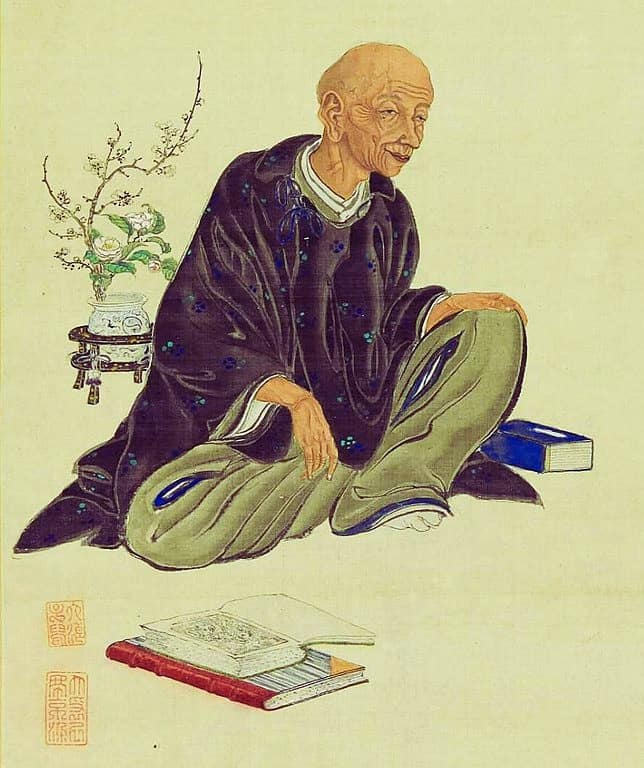
Sugita Genpaku was born in 1733, while his father was in attendance to the Lord of Wakasa, now Fukui, at his Edo estate. Although the official physician of the Wakasa Domain, Genpaku’s father stood in helpless anguish as his wife suffered and died giving birth to her third son.
He was a physician of the highest order, having studied Chinese medicine and was well-versed in herbal cures, yet he knew little of real human anatomy. His son, Genpaku, would grow up to banish that ignorance and revolutionize medicine in Japan.
At age 8, Genpaku moved from Edo to Obama, in what is today Fukui Prefecture. There he attended school, studying Confucianism and traditional Chinese medicine. Western books had been banned by Tokugawa Iemitsu in the early 17th century, and classical Chinese studies continued to be the basis of education.
When Genpaku was 25, he returned to Edo and set up his first clinic. By then, Tokugawa Yoshimune had relaxed the ban on Western books, permitting the import of scientific literature while retaining a strict ban on anything related to Christianity.
Yoshimune had even assigned two scholars, Aoki Konyo and Noro Genjo, to learn the Dutch language. This they did through interviewing the hereditary interpreters from Dejima, the Dutch trading port in Nagasaki. These men visited Edo once a year, accompanying delegations of Dutch traders on their required visits to the shogun.
With a generous gift from his lord to pay for its purchase, the young doctor Sugita Genpaku obtained a rare treasure, a copy of Tafel Anatomie. This was a 1734 Dutch translation of the illustrated German encyclopedia of human anatomy, Anatomische Tabellen.
What came next revolutionized medicine in Japan.
A cadaver, an execution ground, and a plan
Sugita Genpaku, his junior colleague Nakagawa Jun’an, and his fellow physician, Maeno Ryōtaku, gathered in the dark of early morning and walked to the execution grounds of Kotsukahara, north of the great temple of Sensoji. As they drew near, they passed a freshly cut woman’s head displayed on a pike — a gruesome Edo-era warning of the fate of criminals.
As the temple bell rang the dawn, they arrived at the execution grounds. They had come to witness something extraordinary — the autopsy of an executed woman. Called the “Green Tea Hag,” this woman had been convicted of murdering her foster children, and retribution had been swift. Her headless body now lay before them on a mat.
Both Ryōtaku and Genpaku carried their copies of Tafel Anatomie. Unable to read its words, they were nevertheless fascinated by the book’s meticulously detailed illustrations and wanted to check their accuracy.
A 70-year-old Burakumin, a member of the Edo-era caste designated to deal with impurity — butchers, executioners, undertakers, and tanners — stood with sword in hand. With practiced ease, he split open the fresh cadaver to reveal the organs within.
The men’s curiosity drew them closer.
“What is that?” Genpaku asked, pointing to a small organ.
“I don’t know, but I see it every time I open a body,” the elderly executioner replied. He went on, pointing with his sword, “Here is the heart. Here is the stomach. And here is the liver.”
The men compared the woman’s organs with the illustrations in Tafel Anatomie and found them astonishingly accurate — a far cry from the stylized drawings they had been referring to in their Chinese medical books.
It was both shocking and humbling for these highly educated doctors to realize that their knowledge of anatomy was woefully lacking compared to that of a lowly executioner.
After the autopsy, Genpaku and his friends walked around the execution grounds like children in a macabre treasure hunt, picking up bones and comparing them with illustrations in Tafel Anatomie.
A new world had opened to them, and they could hardly contain their excitement.
As the doctors walked home, Genpaku voiced their shared sentiment, “I am ashamed of myself that I didn’t even know how the human body was structured, although it should be the fundamental knowledge required for doctors.”
Then and there, the three friends vowed to translate Tafel Anatomie into Japanese.
There was just one problem. None of them could read Dutch.
Translating Tafel Anatomie
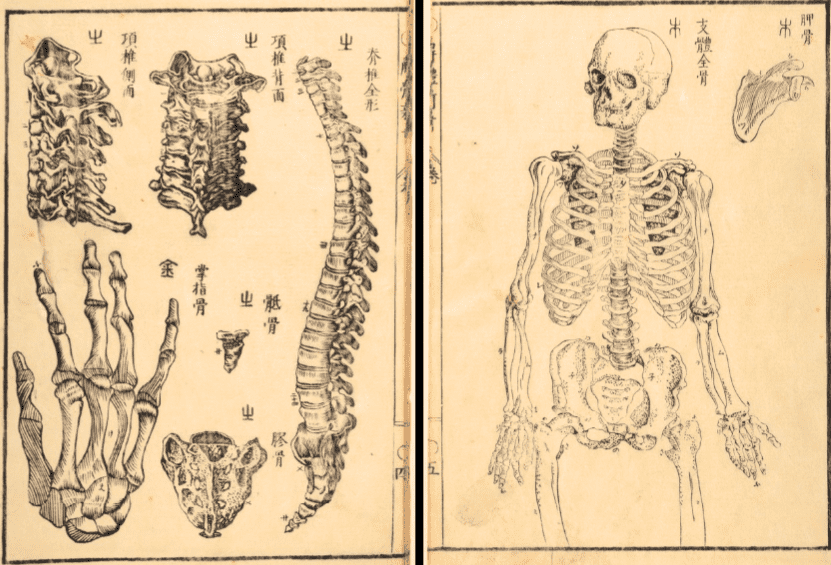
In the spring of 1771, the three determined doctors sat in Ryōtaku’s house, staring mystified at their two copies of the Dutch book, the secrets of the human body tantalizingly close.
Hours passed in utter frustration. Sugita Genpaku later wrote, “I felt as if we had sailed out to sea on a boat without a rudder or an oar, and there was nothing in sight but the boundless views ahead. We were lost on the waves.”
Their only hope was Maeno Ryōtaku’s rudimentary knowledge of Dutch. He had stayed in Nagasaki for 100 days, studying Dutch with one of the official interpreters, yet he could not read a word of Tafel Anatomie. Like the other interpreters, his teacher had only learned spoken Dutch. He utterly lacked reading or writing abilities.
Fortunately, Ryōtaro had the foresight to buy a Dutch dictionary in Nagasaki before returning to Edo.
He had also studied in Edo under Aoki Konyo, the scholar Yoshimune had assigned to learn Dutch. From him, he learned the alphabet.
Starting with the outside of the body, the men struggled for hours and even days over such simple words as “nose” and “eyebrow,” each moment of understanding was a cause for childlike rejoicing.
They came across many terms that had no equivalent in Japanese, so they coined words for such things as cartilage, nankotsu, 軟骨, “soft bone,” and nerve, shinkei, 神経, “spirit path.”
As the group’s foremost Dutch scholar, Ryōtaku wanted to translate the book from cover to cover, which led to days of inactivity. At last, Genpaku convinced him to start with the illustrations. The captions were short, and the drawings would be crucial for the education of doctors in Japan.
Even this relatively simple task led to hours of frustration. When they couldn’t understand the caption under an illustration, they turned to the Dutch dictionary, which defined the word using more words they didn’t know. After hours of painstaking work, discourse, and deduction, they would come up with what they felt was a reasonable Japanese explanation and move on to the next.
Progress
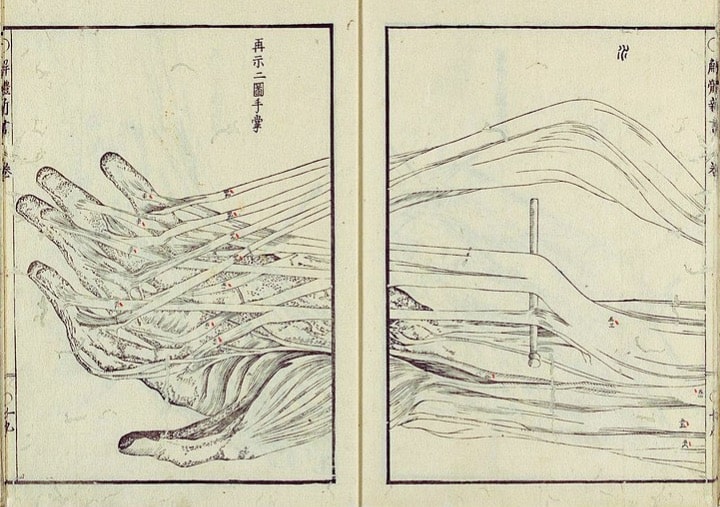
With the blooming of the cherry blossoms in the spring of 1772, Sugita Genpaku and his friends paid a call on the yearly delegation from Nagasaki. They presented their translated work for the interpreters’ inspection and asked for their help with words they could not understand.
The interpreters were at a loss. It seems the doctors’ translation work had exceeded the ability of these hereditary interpreters, although they had heard the Dutch language from childhood. Ryōtaku, as paltry as his knowledge was, had reached the height of Dutch translation in the country.
News of their accomplishment spread, and Genpaku and his friends were soon being visited by doctors from around the country eager to learn Dutch to open the doors of Western learning for themselves.
This is when the term rangaku, 蘭学, or Dutch learning, was coined, and curiosity for things Western spread like wildfire.
Kaitai Yakuzu, Kaitai Shinsho preview
Sugita Genpaku proposed to publish only the annotated illustrations first, to test the waters to see how the book would be received. This booklet, Kaitai Yakuzu, listed Genpaku, Ju’nan, and the illustrator’s names — all from the Obama domain. This was to protect Ryōtaku, a native of Kyushu, and their precious translation in case their work was attacked. A few years prior, a translation of Dutch stories had been banned and its author punished.
Genpaku spent a month of sleepless nights, but no backlash came from the Chinese medical community or the shogun’s police. On the contrary, interested scholars came calling on him, hungry to learn more.
Kaitai Shinsho, New Text on Anatomy
In 1774, Genpaku felt the time was right to publish their translation, imperfect as it was, of Tafel Anatomie, which they named Kaitai Shinsho, 解体新書, “New Text on Anatomy.” To prevent possible resistance, he boldly gave copies to the shogun’s senior councilor, the imperial household in Kyoto, and even Shogun Tokugawa Ieharu himself.
With the publication of Kaitai Shinso, Sugita Genpaku became an instant celebrity. He spent the rest of his long life as the leading scholar of rangaku and a practicing physician.
Although the primary translator of the work, the reserved Maeno Ryōtaku would not allow his name to be listed in the credits of Kaitai Shinso. He dedicated the remainder of his life to the quiet acquisition of Western learning.
Sugita Genpaku’s legacy
During the Edo era, there was a rigid class system — samurai, farmers, craftsmen, and merchants. Deviation from one’s class was punishable by death, yet Genpaku dared to write,
There are no distinctive differences between human beings, from the emperor to all commoners. Where there are no differences, humans have artificially created above and below, and the names of the four social statuses. Yet there is no difference between us because we are all human.
from Genpaku’s book, Keiei Yawa
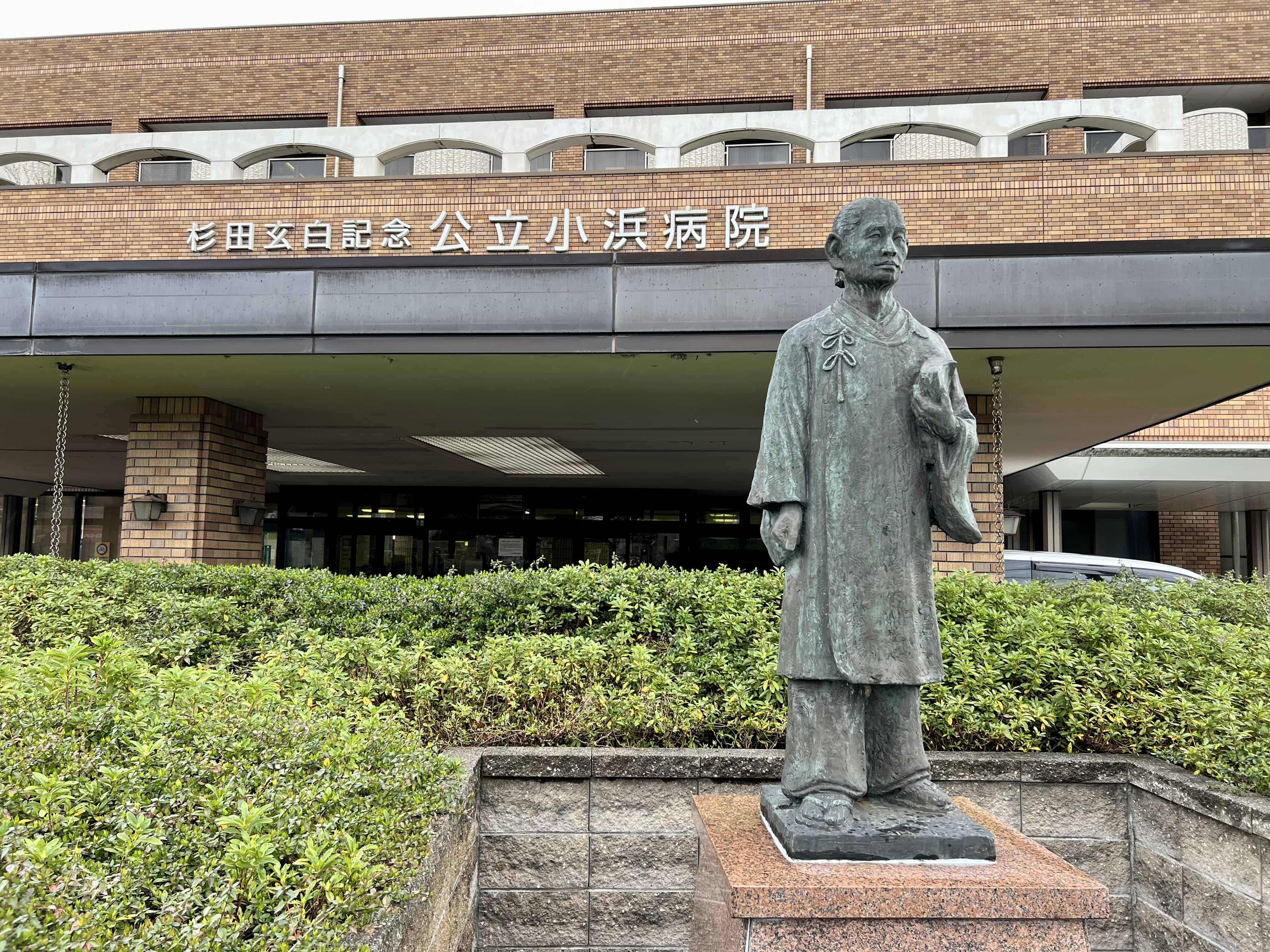
In the town of Obama on the coast of Fukui Prefecture stands the Sugita Genpaku Memorial Obama Municipal Hospital. A bronze image of Genpaku holding Kaitai Shinsho stands in front, reminding passersby of this great man and his invaluable contribution to medicine in Japan.
References:
The Dawn of Western Science in Japan, Kan Kikuchi, Feb 1924; The Emergence of an International Humanitarian Organization in Japan: The Tokugawa Origins of the Japanese Red Cross, Sho Konishi, Oct 2014; How the ‘modern’ code was cracked, Masaru Fujimoto, Feb 2003.
If you have questions about Japan or suggestions for articles, please add them in the comments. For more photos and information on Japan, follow me on instagram at: https://www.instagram.com/more_than_tokyo/


