

• Home
  • About
  • Discover
    • History
    • Culture
    • Nature
    • Food
    • Living in Japan
    • Destinations
    • Language
    • Tips
  • Interview
  • Recommended Books
Exploring the Wonders of Rural Japan
Folklore History

Baku — Weird, Wonderful, Nightmare-Eating Friends

The Japanese chimera with magical powers
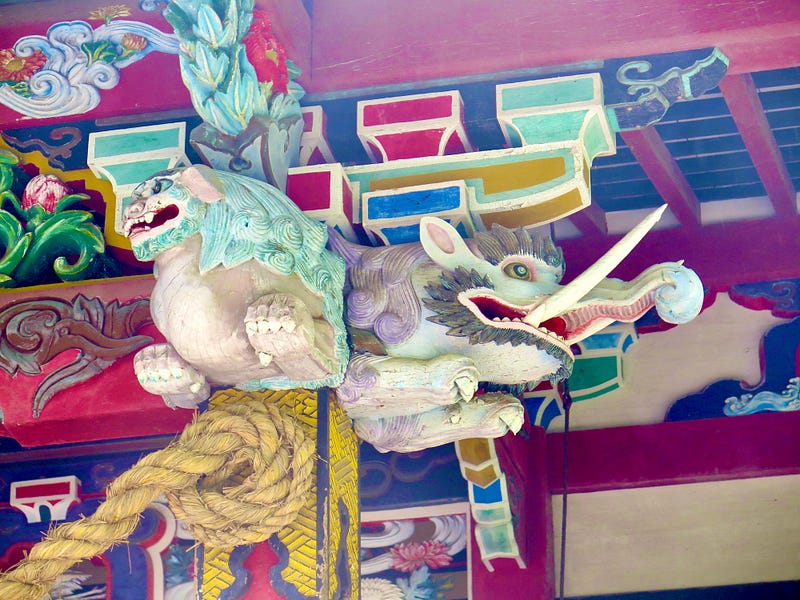
Colorful baku and shishi carvings under the eaves of a shrine.
Shishi lion and baku. Hanao Shrine, Kagoshima. (©Diane Tincher)

If you’ve ever visited a Japanese Shinto shrine or Buddhist temple, you may have noticed some rather unusual creatures just under the eaves.

At first glance, they seem to be elephants. But there were no elephants in Japan until recent history, so where did that idea come from?

A little closer inspection reveals a different type of feet. Paws. They are paws with claws. A tiger’s feet — or are they from a Chinese shishi lion?

The eyes aren’t quite right either. And sometimes the ears are not an elephant’s at all. Both eyes and ears seem more like those of a rhinoceros. 

What’s going on?

Legend tells us that when the gods finished creating the animals, they took all the leftover bits, threw them together, and created this animal, the baku.

Baku through the years
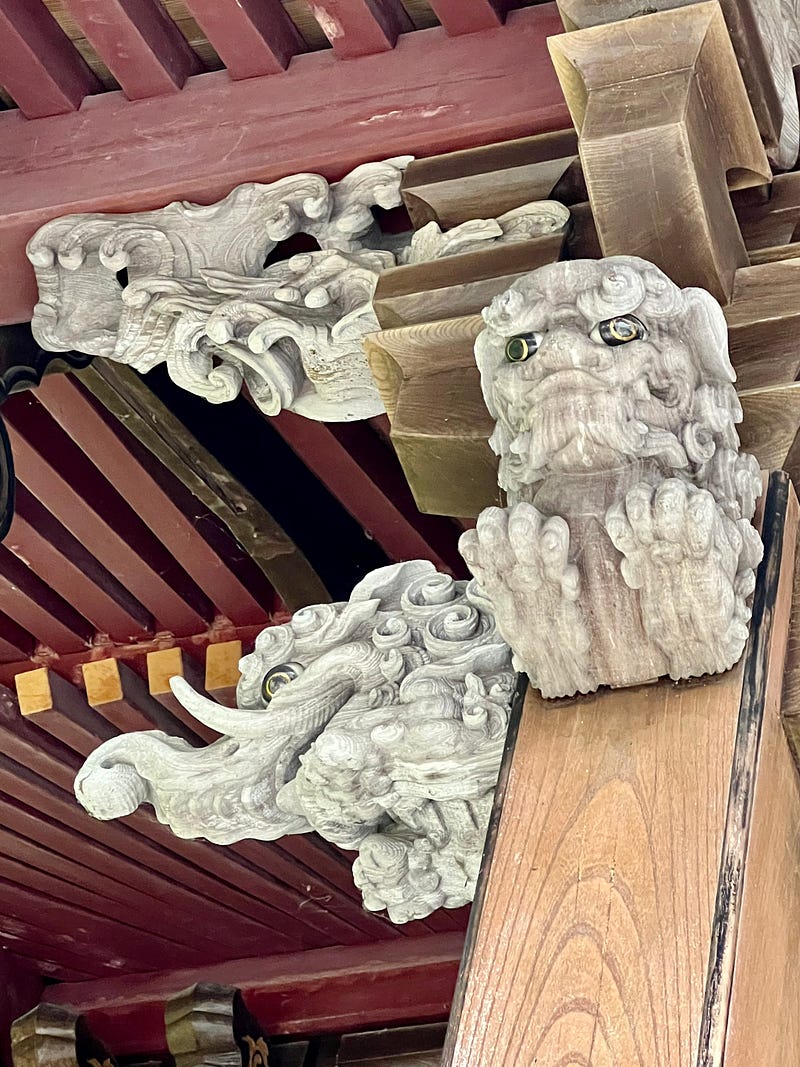
Baku and shishi carvings under the eaves at a temple.
Baku and shishi lion. Zenpoji Temple, Yamagata. (©Diane Tincher)

These curious creatures find their origin in ancient China, where it was believed that using a blanket or pillow made from the hide of a baku kept one safe from illness and misfortune.

Like many Chinese stories and traditions, the baku eventually reached Japan, where its powers transformed. In Japan, these magical creatures came to be known as devourers of nightmares. 
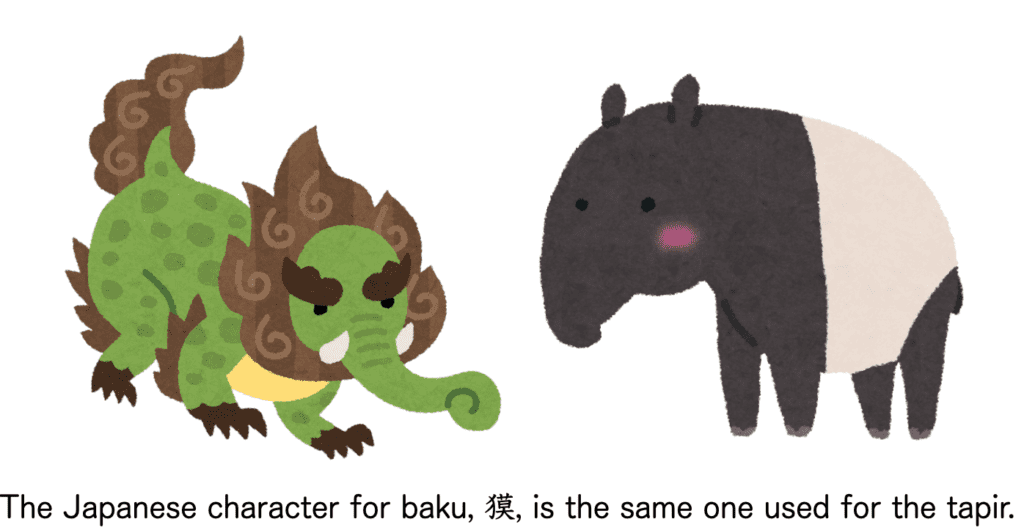
Baku illustration alongside a drawing of a tapir. Both use the same kanji character for their names in Japanese.
(Illustrations courtesy of irasuto.)

During the Muromachi period (1337-1573), people began sleeping with a picture of baku or its name written on paper placed under their pillows. So powerful is the baku that just its image or its name was enough to keep evil dreams at bay.

On New Year’s, to ensure a happy first dream, some people used to sleep with an image of the fantastical Treasure Ship that carries the Seven Lucky Gods, which was often pictured with the image of a baku on its sail. That way, they could get both good fortune and good dreams.

Stone carving of a ship upon waves, with broad sail and 7 happy passengers.
Treasure Ship with 7 Lucky Gods. Juban Inari Shrine, Tokyo. No baku on that sail. The character reads “treasure.” (©Diane Tincher)

As the years passed, pillows began being made in the shape of a baku and sold as a talisman to protect against nightmares. Even mighty warlords like Toyotomi Hideyoshi used one.
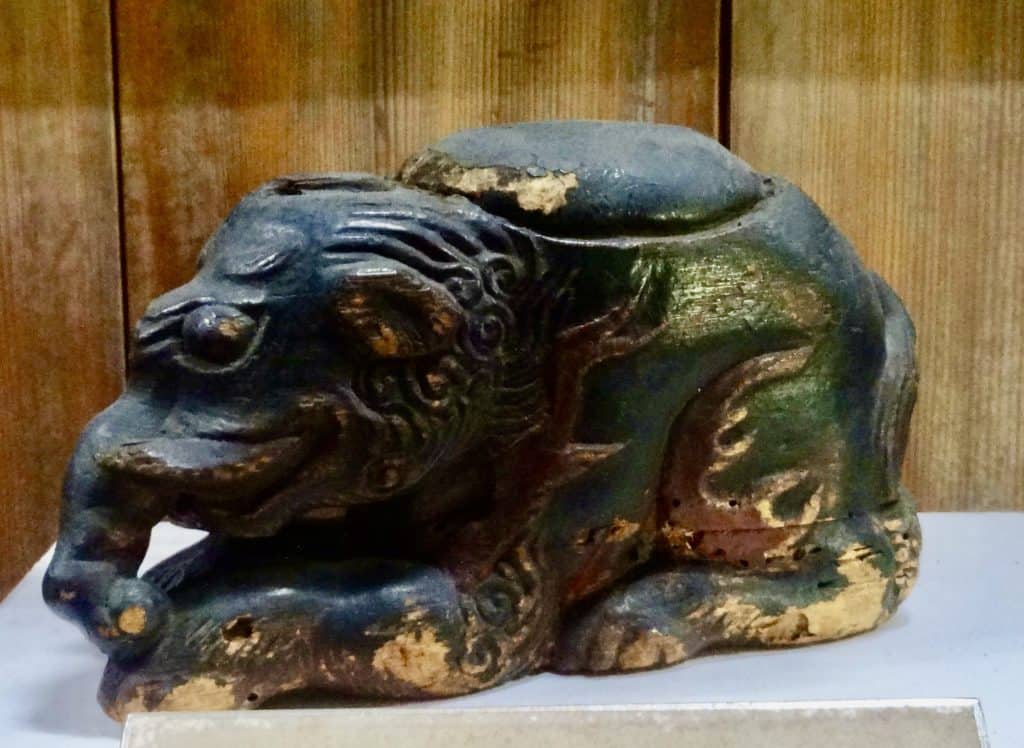
Dark wooden baku-shaped pillow.
Baku pillow used by the mighty warlord Toyotomi Hideyoshi, 16th century. (Creative Commons)

Without such a pillow, if a person wakes up from a nightmare and says, “I give this dream to Baku,” they will never experience that same dream again.

In some areas of Japan, children were taught to repeat, “Baku, eat my nightmare,” three times when they were awakened in the night by terrors.

Baku netsuke

Since Japanese kimonos have no pockets, people during the Edo era (1603–1867) started hanging small boxes, called inro, from their obi sashes. These were held in place by beautiful and intricate fob-like items called netsuke. Inro boxes could hold coins, personal seals, and other small necessities.
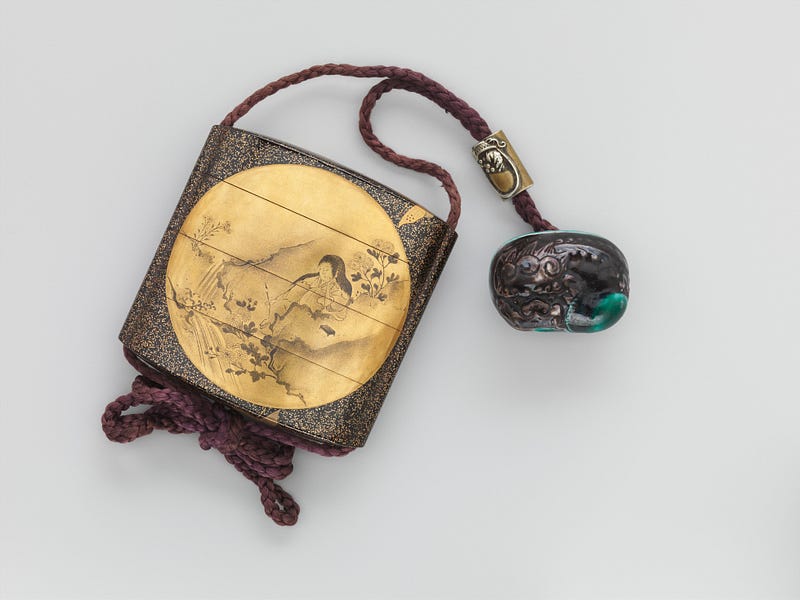
Small laquered box attached to a braided rope and netsuke fob.
Inro box and shishi lion netsuke for attaching to a kimono’s belt in lieu of pockets. (Courtesy of the MET. Creative Commons.)

Although netsuke started out as mere utilitarian items, they developed into works of breathtaking craftsmanship.
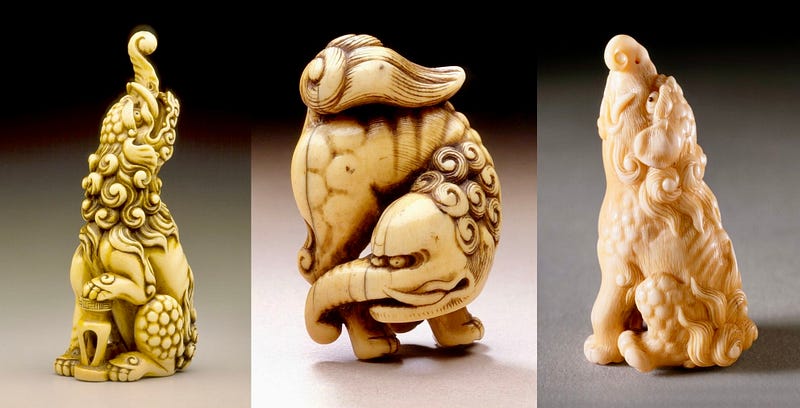
Small ivory carvings of baku in 3 different poses.
Beautiful ivory netsuke of baku from the Raymond and Frances Bushell Collection at the Los Angeles County Museum of Art. (Public domain)

Some netsuke were of baku, like those pictured above. Perhaps they were worn for protection or perhaps just for the sheer fun of wearing such fabulous creations.

Baku today

Shrine with thick thatched roof, intricate carvings over the lintel, and baku carvings protruding from each side.
Baku on either side of the entrance way to the shrine where I stayed when I visited Mount Haguro, Yamagata. (©Diane Tincher)

Baku can be found all over Japan. Next time you visit a shrine or temple, look up and see if you might find one ready to devour your nightmares and protect you from harm. They come in many shapes and sizes, and they are always delightful.

Shine buildings, one with white baku carvings beneath the eaves.
Baku at Kagoshima Shrine, Kirishima. (©Diane Tincher)

If you have questions about Japan or suggestions for articles, please add them in the comments. For more photos and information on Japan, follow me on instagram at: https://www.instagram.com/more_than_tokyo/

baku chimera Japan Japanese culture nightmares Shinto
Share
Write Comment
Leave a Reply Cancel reply

Your email address will not be published. Required fields are marked *

This site uses Akismet to reduce spam. Learn how your comment data is processed.

Previous Post

Lake Towada — Hidden Treasure of Unrivaled Beauty

Next Post

Oirase Gorge — Wonderland of Waterfalls and Otherworldly Beauty

If you enjoy my work and would like to help me continue creating, consider supporting me.

Thank you!
PayPal - The safer, easier way to pay online!
Newsletter

Subscribe

Enter your email for notifications of our latest posts

Tags
architecture Buddhism Christianity Edo Era elderly festivals folklore Food Ghosts gratitude Haunting Hiking history holidays honesty Japan Japanese Japanese cuisine Japanese culture Japanese Customs Japanese Food Japanese History Japanese Language Japanese words that English needs Japan Tips Japan travel Japan Travel Tips Jizō Kagoshima Kōyō Living in Japan longevity Manners Nature New Year Ninja Samurai Shinto shogun Shrine Tips Trade Travel volcano Washoku
Featured Posts
History Religion

The Shimabara Rebellion—The Last Stand of Japan’s Christians

July 8, 2026
History

The Okamoto Daihachi Affair—The Scandal That Turned the Tide Against Christianity in Japan

July 6, 2026
History

The 47 Ronin—Disgrace, Revenge, and Death

June 23, 2026
Destinations Folklore Ghosts

Omatsu Daigongen—The Amazing Cat Temple of Shikoku

June 1, 2026
History

Oura Kei—Unstoppable Pioneering Tea Merchant

January 19, 2026
Most Popular

Shinto — The Peaceful Spiritual Heart of Japan

Shinto gate Lake Biwa

Komorebi—A Beautiful Japanese Word that English Needs

Nakasendo Way

Dondoyaki—Burning New Year’s Decorations to Send off the God of the New Year

Dondoyaki fire

The Jizo Statues of Nashi-no-Ki—1,000s of Unique Offerings of Thanks

Jizo statues at Nashi no Jizo, Sado.

Sugawara no Michizane —Japan’s Three Most Infamous Vengeful Ghosts, part 3

Sugawara Michizane
You might also like
Nakasendo Way
Nature Language

Komorebi—A Beautiful Japanese Word that English Needs

1 Min read
November 11, 2021
temple pagoda
Culture Living in Japan

Death in Japan

8 Mins read
March 22, 2022
Japanese traditional play
Language Culture History Living in Japan

Why is Learning Japanese So Hard?

6 Mins read
January 29, 2022
Exploring the wonders of rural Japan
Exploring the Wonders of Rural Japan
  • Home
  • About
  • Recommended Books
  • Interview
  • Privacy Policy
Exploring the Wonders of Rural Japan
  • Home
  • About
  • Discover
    • History
    • Culture
    • Nature
    • Food
    • Living in Japan
    • Destinations
    • Language
    • Tips
  • Interview
  • Recommended Books
We use cookies on our website to give you the most relevant experience by remembering your preferences and repeat visits. By clicking “Accept”, you consent to the use of ALL the cookies.
Do not sell my personal information.
Cookie SettingsAccept
Manage consent

Privacy Overview

This website uses cookies to improve your experience while you navigate through the website. Out of these, the cookies that are categorized as necessary are stored on your browser as they are essential for the working of basic functionalities of the website. We also use third-party cookies that help us analyze and understand how you use this website. These cookies will be stored in your browser only with your consent. You also have the option to opt-out of these cookies. But opting out of some of these cookies may affect your browsing experience.
Necessary
Always Enabled
Necessary cookies are absolutely essential for the website to function properly. These cookies ensure basic functionalities and security features of the website, anonymously.
CookieDurationDescription
cookielawinfo-checkbox-analytics11 monthsThis cookie is set by GDPR Cookie Consent plugin. The cookie is used to store the user consent for the cookies in the category "Analytics".
cookielawinfo-checkbox-functional11 monthsThe cookie is set by GDPR cookie consent to record the user consent for the cookies in the category "Functional".
cookielawinfo-checkbox-necessary11 monthsThis cookie is set by GDPR Cookie Consent plugin. The cookies is used to store the user consent for the cookies in the category "Necessary".
cookielawinfo-checkbox-others11 monthsThis cookie is set by GDPR Cookie Consent plugin. The cookie is used to store the user consent for the cookies in the category "Other.
cookielawinfo-checkbox-performance11 monthsThis cookie is set by GDPR Cookie Consent plugin. The cookie is used to store the user consent for the cookies in the category "Performance".
viewed_cookie_policy11 monthsThe cookie is set by the GDPR Cookie Consent plugin and is used to store whether or not user has consented to the use of cookies. It does not store any personal data.
Functional
Functional cookies help to perform certain functionalities like sharing the content of the website on social media platforms, collect feedbacks, and other third-party features.
Performance
Performance cookies are used to understand and analyze the key performance indexes of the website which helps in delivering a better user experience for the visitors.
Analytics
Analytical cookies are used to understand how visitors interact with the website. These cookies help provide information on metrics the number of visitors, bounce rate, traffic source, etc.
Advertisement
Advertisement cookies are used to provide visitors with relevant ads and marketing campaigns. These cookies track visitors across websites and collect information to provide customized ads.
Others
Other uncategorized cookies are those that are being analyzed and have not been classified into a category as yet.
SAVE & ACCEPT