

The unique gojū samurai school system produced the foremost leaders of the Meiji Restoration
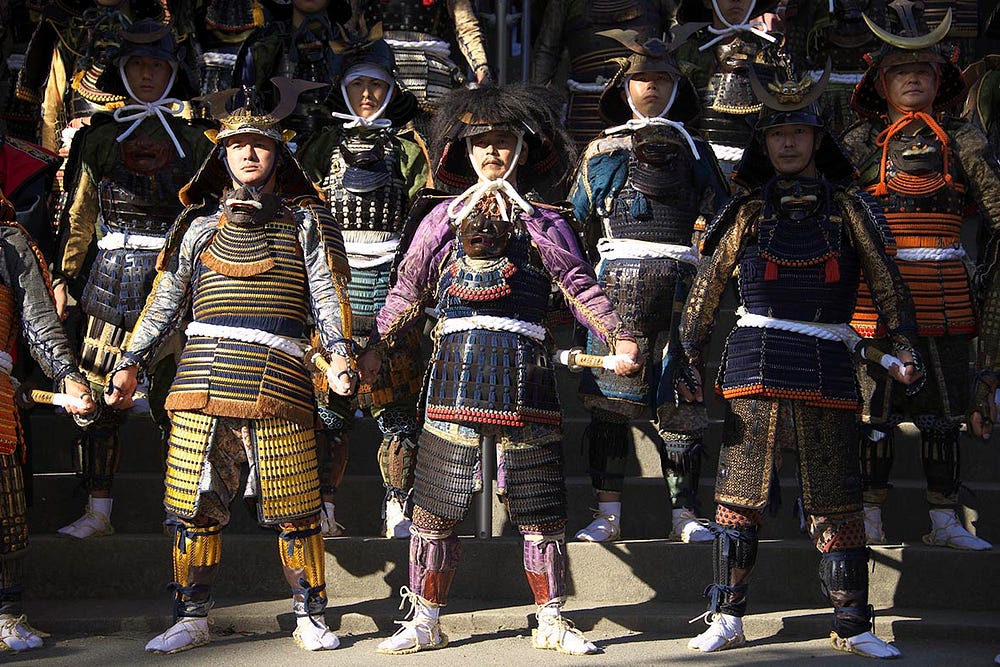
The Need for Samurai Schools
The Warring States Period had wearied the nation with continuous battles and power struggles for nigh on 100 years, when in the mid-16th century, one mighty and powerful warlord prevailed. Oda Nobunaga, the formidable lord of Owari Province (western Aichi Prefecture), had determined to unite the country by force. He was well on his way to achieving this goal when he was betrayed by one of his generals, surrounded, and driven to commit seppuku, the samurai’s ritual suicide.
Another of Nobunaga’s generals, Toyotomi Hideyoshi, led his troops to hunt down and avenge Nobunaga’s betrayer. That accomplished, and having won the support of Nobunaga’s army, Hideyoshi continued the work of unification.
Meanwhile, on the southern island of Kyushu, the Shimadzu clan of Satsuma had nearly conquered the entire island. Hideyoshi was called on to intervene. His armies overcame the Shimadzu forces, surrounded their castle in Satsuma (Kagoshima Prefecture), and forced a surrender.
Hideyoshi next set his sights on conquering the Chinese Ming Dynasty. To do this, he would first need to subjugate Korea.
Samurai from around the country were marshaled to join him. Among those were 10,000 samurai from the powerful southern Kyushu domain of Satsuma.
And this is where the story of the famous gojū samurai schools of Satsuma begins.
With so many samurai from Satsuma fighting with Hideyoshi in Korea, their young sons were running riot at home. To corral these rowdy youths, neighborhood schools were established.
Boys were assigned to these local schools where they were taught to be honest, to guard their tongues and use no strong language, and to be brave and chivalrous.
Development of Gojū Schools
One hundred fifty years after their inception, in the mid-18th century, the Satsuma samurai educational system became more structured, with each town (in what is now Kagoshima City) divided into districts, called gojū. Each gojū had its own school for training the sons of samurai. Basic academic education was added to the curriculum.
In time, the schools themselves came to be called gojū, 郷中.
Each gojū operated independently with its own leadership and code of conduct. Although a strong basic education was integral, gojū teaching placed an overarching emphasis on honor, honesty, and courage. Discipline and group solidarity were stressed in order for the students to function as a strongly united military unit in time of war. Fierce loyalty was encouraged.
Boys were not allowed to speak to boys in other schools, nor were they allowed any contact with women outside of their families. This prohibition against speaking with girls is in line with an ancient practice described in the old proverb, “From age 7, boys and girls should not share the same seat.” 男女七歳にして席を同じうせず.
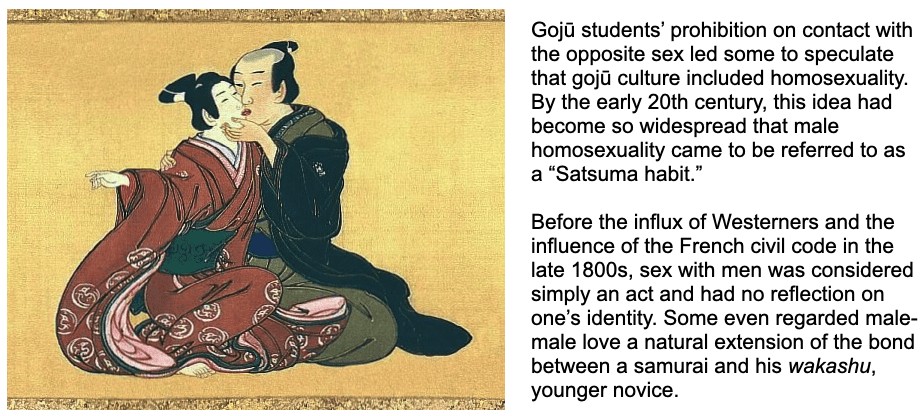
Gojū students were to uphold the honor of the samurai. Below are a few of the many principles of upright behavior they memorized.
- Never succumb to defeat.
- Never pick on someone weaker.
- Never touch a woman, nor even speak of doing so.
- Do not desire riches. Greed is despicable.
- Never lie.
Upon a boy’s 7th birthday, he would be given a wakizashi short sword and then be presented to the gojū leader.
Gojū Organization
Gojū students were divided by age:
- ko-chigo, 小稚児, ages 7–10
- ose-chigo, 長稚児, ages 11–15
- nise, 二才, ages 15–25
- osenshi, 長老, ages 24-25, nise who served as counselors
An important feature of the gojū system was that the older boys were responsible for teaching the younger. Knowing that they would later be called upon to teach meant that the younger boys diligently applied themselves to their studies. The repetition of teaching also further drilled the lessons into the boys, resulting in a solid education.

A Day in the Life of a Samurai Son
At 6:00 AM, the ko-chigo and ose-chigo boys — collectively called chigo — would hasten to their gojū for lessons, usually excerpts from the Confucian classics which they memorized. After these morning lessons taught by one of the nise, or older boys, the chigo went home for breakfast, private study, and chores.
By 8:00 AM, they were back at the gojū for exercise led by the oldest chigo. This could be anything from horse driving, practicing with wooden swords, to sumo wrestling. After two hours of strenuous activity, the lads were probably more than ready to sit down for more study and drilling by the senior chigo.
The chigo would break for lunch, then be back at school at 2:00 PM for more study. While the younger ko-chigo went home to eat, the older ose-chigo attended lectures.
Aside from Confucian classics, the boys next important text was called the Iroha Uta, which was written in the 1500s by Shimadzu Tadayoshi, the Satsuma domain leader. It is composed of 47 moral teachings written in poetic form.
Another book, the Rekidai Uta, recounted the Shimadzu house lineage, starting with Shimadzu Tadahisa, named the first lord of Satsuma in 1185 by the powerful Minamoto no Yoritomo — the very first Japanese shogun.
Both of these books of teachings had the effect of creating reverence for and loyalty to the Shimadzu clan as independent from the Tokugawa shogun in far away Edo (Tokyo).
At 4:00 PM, except on days of extreme weather when the boys would play card games to review the names and exploits of famous warriors, all chigo gathered for martial arts training led by the nise. The boys learned real combat techniques, practicing with their wooden swords.

The boys studied the renowned Jigen school of swordsmanship, unique to Satsuma, that emphasized all-out aggression and striking a single deadly blow. They practiced by hitting a vertical pole from left and right with their wooden rods. They stuck so fiercely that the central portion of the post became thinner.
The Jigen motto was, ichigeki-hissatsu, 一撃必殺, “One strike — one kill.”
A second swordsmanship school started by a Jigen disciple, the Yakumaru school, was also taught in the gojū. The Yakumaru school took aggression a step further by instilling in its students’ minds an awareness of their attackers’ willingness to die. The students of this school practiced by hitting horizontally hung sticks while wildly shrieking a “monkey cry.” This animalistic cry was nothing like the kiai shouts of other martial arts schools.
The Yakumaru school produced some of the most terrifying assassins of the final years of the Tokugawa shogunate in the mid-1800s, as well as the famed statesmen Saigo Takamori and Okubo Toshimichi.
At 6:00 PM, the exhausted chigo went home, and once there, they were forbidden to step outdoors again until 6:00 AM the next morning. The ose-chigo continued their studies at the gujō until 7:00 PM. They then observed the nise’s meeting until 8:00 PM, when they were dismissed to go home.
Ose-chigo Rite of Passage
When a chigo was old enough to become an ose-chigo, at around age 10, he was made to endure various creative and traumatic rites of passage.
One such rite called for the chigo to be ambushed as he entered the school. At the leader’s orders, all the students would pile on top of him, crushing the lad to the ground, virtually suffocating him.
For another, the chigo was locked inside a trunk that was then rolled and banged around the schoolyard.
Nise Rite of Passage
When a boy was around 14, he was ready to enter the adult world. At this time, he would have a coming of age ceremony, an audience with the daimyo (lord of the province) where he would receive his first internship assignment, and then he would be promoted to nise.
At the coming of age ceremony, a boy would receive adult clothing, choose a new name, and shave the front of his head. The hair on the back of his head would be grown long and worn in a topknot, a style originally intended for the better fitting of helmets.
His shaved head marked his adulthood and showed that he could now initiate sexual activity, be it with a wife, a concubine, a prostitute, or a young boy.
Nise Education
Aside from teaching the chigo at the gojū, nise studied at the domain academy in the morning and went to internships in the afternoon. In the evenings, they grilled each other with thought experiments, badgering the questioned until the correct answer was given.
Perhaps a thought experiment like the following would be put before the student:
You have searched the country far and wide for your father’s murderer. At last you find him on the open sea. But your boat is sinking, and your father’s murderer is your only hope of rescue. What should you do?
The “correct” samurai answer is to accept the murder’s help, cordially thank him, then kill him to avenge your father’s death.
Nise education included further study of the Confucian classics, which had served as the basis of education for civilized men in east Asia for centuries. The books were written in pithy and ancient Chinese. As chigo, the boys had memorized portions of these texts. Now as nise, they were learning the meanings from their teachers’ explanations and commentaries. Again loyalty, honor, and courage were the emphasis.
As part of their martial arts training, once a year the nise would gather at the domain execution grounds. They would wait for the executioner to sever the head of a condemned man.
The moment the executioner’s sword was thrust downwards, the boys rushed forward and piled on top of the executed man. The first to bite off an ear or finger from the corpse won the honor of being the first to practice his swordsmanship on the cadaver.
In stark contrast to the brutality of that event, the Satsuma samurai had a gentler side. The boys wrote poetry, learned to write calligraphy, and even learned to play the biwa, or Japanese lute. In the rest of the country, the biwa was considered a feminine instrument, associated with geisha, and traveling minstrels. In Satsuma, the biwa was considered manly.
The author Tachibana Nankei wrote in the late 18th century that the samurai of Satsuma,
…hike up their trouser skirts, adjust their long swords, and night after night, stroll and play the biwa. Their playing is correct and their singing is refined. It is utterly unlike the biwa of other regions.
Conclusion

The gojū educational system produced samurai who were a curious mix of East Asian philosopher and poet, fearless warrior, and fiercely loyal vassal willing to give his life for his emperor — but not necessarily for the shogun in far away Edo.
The independence and the Confucian philosophy of the Satsuma samurai schools produced powerful men of integrity who played vital roles in the Meiji Restoration of 1867, when the Tokugawa Shogunate was overthrown and power was returned to the emperor.
Sources:
https://www.e-aidem.com/ch/jimocoro/entry/galaxy29, The Last Samurai: The Life and Battles of Saigo Takamori, Mark Rivera, The Origins and Role of Same-Sex Relations in Human Societies, James Neill, 城南コベッツ, Satsuma’s Unique Gojū Educational System (Japanese)
If you have questions about Japan or suggestions for articles, please add them in the comments. For more photos and information on Japan, follow me on instagram at: https://www.instagram.com/more_than_tokyo/


